
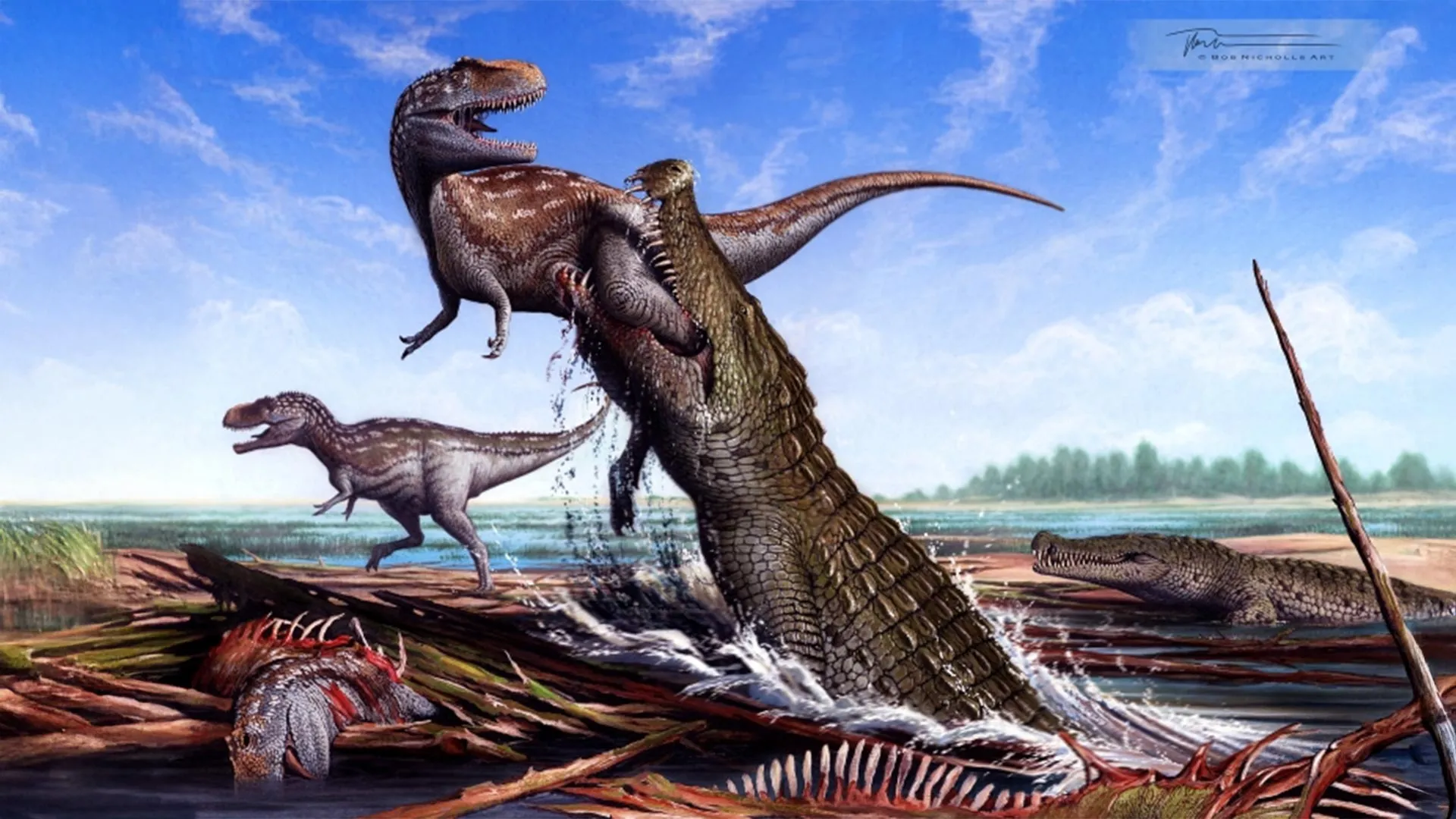
A 31-foot predator that once terrorized dinosaurs across the eastern United States has been reconstructed in scientifically accurate, life-size form for the first time. That's right, the Cretaceous's own school bus with teeth is back, and it's still bigger than your commute.
Dr. David Schwimmer, a Columbus State University geology professor and the planet's foremost authority on the giant North American crocodilian genus Deinosuchus, poured decades of research into creating the first scholarly accurate mounted skeleton replica of Deinosuchus schwimmeri. Often billed as a "dinosaur-killer," this enormous reptile was basically the apex predator of its neighborhood, and it didn't need a reality show to prove it.
Deinosuchus schwimmeri stalked the eastern United States between 83 million and 76 million years ago. It looked like an enormous alligator but belonged to an ancient lineage of crocodilians - the same group that now includes crocodiles, alligators, caimans, and gharials. At up to 31 feet (9.45 meters), roughly the length of a school bus, its sheer size and powerful jaws made it capable of attacking dinosaurs and other large animals that dared approach the water. Because nothing says "stay out of my swamp" like a 31-foot reptile.
The new prototype was commissioned by the Tellus Science Museum in Cartersville, Georgia, where it was recently installed. The project took two years of consultation between Schwimmer and Triebold Paleontology Inc., the folks who make fossil skeleton models for museums, universities, and attractions worldwide. Because apparently, you can't just wing it when reconstructing a 31-foot terror croc - who knew?
"Each year, we have thousands of students visit us from across Georgia and neighboring states," said Hannah Eisla, the museum's director of education, in a statement that probably made every kid in the state simultaneously excited and terrified. "Many of these students come on school field trips specifically to learn more about the region they call home and how it has changed over time. The addition of Deinosuchus schwimmeri allows us to provide a more detailed picture of this area's ecosystem in the Cretaceous Period." Because nothing says "home sweet home" like a giant reptile that munched on dinosaurs.
The Cretaceous Period was the final major chapter of the dinosaur age, when North America's landscape, coastline, and wildlife looked dramatically different. "Tellus is currently the only museum to have a cast of Deinosuchus schwimmeri, so this is an experience our visitors can't get anywhere else," added Rebecca Melsheimer, the museum's curatorial coordinator. "The scale of the dinosaurs and other creatures that lived during [the Late Cretaceous epoch] is hard to capture in words or pictures. We can tell you that Deinosuchus is 30 feet long, but seeing it is far more impactful." Yes, because hearing about a school-bus-sized crocodile is one thing; standing next to its skeleton is another, possibly pants-wetting, thing.
Paleontologists formally identified the "terror croc" as a distinct species in 2020 and named it Deinosuchus schwimmeri in Schwimmer's honor. The recognition followed years of fossil analysis, scientific publications, conference presentations, and his influential 2002 book about the giant crocodilian. In their study, published by the Journal of Vertebrate Paleontology in July 2020, the researchers said the name recognized "his tireless work on the Late Cretaceous paleontology of the Southeast and Eastern Seaboard, USA." So basically, Schwimmer is the guy who made the terror croc famous, and now it's named after him. Talk about a legacy.
Schwimmer has spent more than four decades searching for, excavating, and studying fossils belonging to Deinosuchus schwimmeri, with some field expeditions in Alabama, Georgia, and Texas funded by National Geographic grants. The specimens he recovered are now permanently preserved in major repository museums, including the Smithsonian Institution in Washington, D.C., the American Museum of Natural History in New York, and the Tellus Science Museum. Because even prehistoric monsters need a good home.
Constructing an accurate, full-scale replica involves far more than enlarging a drawing or arranging generic bones into a dramatic pose. Scientists must compare known fossils, determine how individual bones connected, and reconstruct missing portions using evidence from related animals. For this project, the Triebold Paleontology team produced high-resolution 3D scans of fossil records, which helped them rearticulate the skeleton and detailed dermal armor - the hard, bony plates embedded in the skin, often called osteoderms, that form the armored surface along the back. So it's not just a giant skeleton; it's a giant armored skeleton, because nature loves overkill.
Schwimmer said the completed mount does more than give museum visitors a sense of the animal's intimidating size. By presenting the skeleton as a connected structure, it can also help paleontologists examine its anatomy and better understand how the predator lived. "These replicas are more than just creating a 'scare factor,'" Schwimmer explained. "Understanding dinosaurs' predatory habits helps us decode some of nature's greatest survival strategies. By studying these ancient apex predators, we are essentially looking back in time to see exactly how life adapted and dominated a changing world." Also, they're just really cool to look at.
Schwimmer's interest in Deinosuchus began during his childhood in New York City, where he grew up only 10 blocks from the American Museum of Natural History. A frightening skull display there first captured his imagination, and he discovered his first Deinosuchus fossil remains in 1979 - a year after joining Columbus State (then Columbus College). Since then, much of his research has centered on reconstructing the animal's biology, behavior, and prehistoric environment. His work has made him a leading expert on the Late Cretaceous epoch (100.5 million to 66 million years ago) in the southeastern United States, and his research in the 1980s produced evidence of several important paleontological firsts in Georgia, including the state's first known flying reptiles (pterodactyls), dinosaurs, and Deinosuchus. Pterodactyls, by the way, were pterosaurs, not dinosaurs, but let's not split hairs - they were still pretty cool.
Schwimmer, who once worked as a science writer for pioneering ocean explorer Jacques-Yves Cousteau, summarized the first 20 years of his discoveries in his 2002 book, "King of the Crocodylians: The Paleobiology of Deinosuchus." The book became an Amazon top seller in its category for several weeks and was chosen as a book of the month by science-focused reading groups, including one organized by the Discovery Educator Network. Because who doesn't want to read about a giant crocodile that ate dinosaurs? Schwimmer is now updating the book, which helped shape scientific understanding of Deinosuchus and other Mesozoic animals found in Georgia, and built his international reputation as a paleontology scholar. His expertise has been sought by institutions including Atlanta's Fernbank Museum of Natural History, the University of Texas' Vertebrate Paleontology Laboratory, and the Tellus Museum.
In 2010, two Deinosuchus-related fossil studies brought Schwimmer international attention. One examined bite marks preserved on dinosaur bones, offering physical evidence of interactions between the giant crocodilian and dinosaurs. The other investigated fossilized dung, known scientifically as coprolites, which can preserve clues about an ancient animal's diet, digestive system, and environment. That research was conducted by Samantha (Harrell) Stanford, a 2010 undergraduate environmental science and geology major supervised by Schwimmer. The studies were presented in the special symposium volume of the New Mexico Museum of Natural History and Science Bulletin, an internationally recognized publication, and at the March 2010 Geological Society of America Northeastern-Southeastern Annual Meeting. Harrell was credited with contributing to both projects. And yes, we're talking about fossilized poop - science is glamorous.
Schwimmer said paleontology and other natural, Earth and space sciences can give students at regional universities opportunities to conduct meaningful "backyard research." Important fossil sites do not always require travel to distant deserts or remote continents; sometimes, major discoveries are waiting close to campus. He also noted that smaller institutions can provide students with direct access to faculty mentors and hands-on field research. "[Harrell] came out in the field and collected fossils with me. At most universities, undergraduates rarely collaborate on or publish peer-reviewed research. Institutions of our size provide undergraduate students like Samantha with greater one-on-one access to faculty mentors and field-based research opportunities like this that, while local, are still quite impactful on the field," Schwimmer said. So if you're an undergrad looking to publish peer-reviewed research, maybe skip the big names and head to a smaller school where you can get your hands dirty - literally.
Several known Deinosuchus sites lie within 40 miles of Columbus, providing Schwimmer and generations of student researchers with a rich source of discoveries. Their proximity also makes the Tellus Science Museum an especially fitting home for one of the first Deinosuchus fossil replicas, allowing visitors to see an animal that once dominated the same broader region millions of years before modern Georgia existed. "Bones and fossils tell us only part of the story," Schwimmer concluded. "Fully assembled, life-size replicas become a blueprint for better understanding the dynamic animals that creatures like Deinosuchus really were." And also a great photo op.
So, if you're in Georgia, swing by the Tellus Science Museum to see the only cast of Deinosuchus schwimmeri in existence. It's a school-bus-sized reminder that the Cretaceous was a wild time, and that nature has a flair for the dramatic. Just be glad it's not alive today - unless you're a dinosaur, in which case, you're already extinct, so no worries.