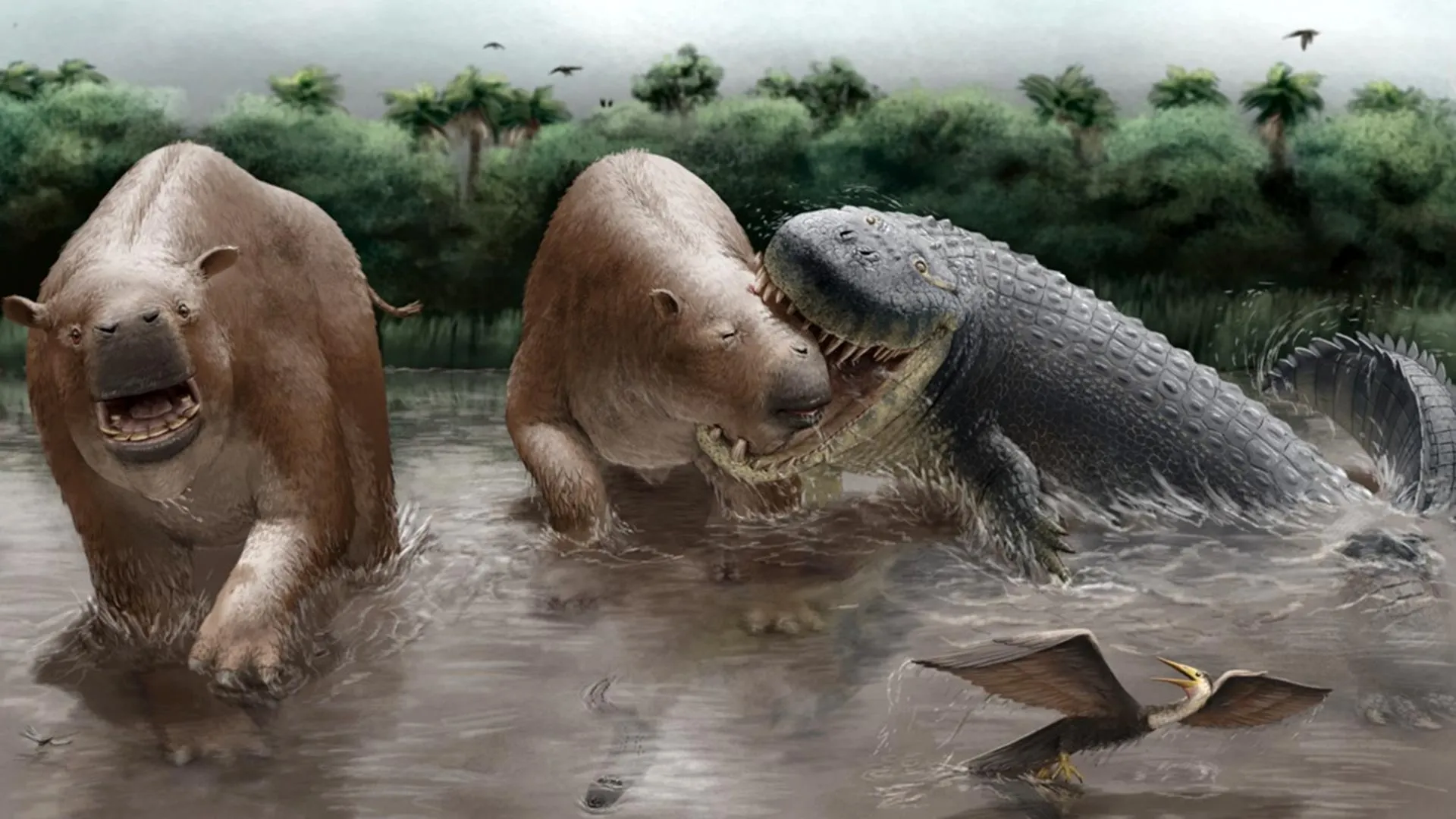
Back in the Miocene - a time when South America was basically the set of a monster movie - a vast lake hosted giant turtles, towering herbivores, and a who's who of terrifying predators. Anacondas, saber-toothed mammals, flightless terror birds, and land-dwelling croc relatives called sebecids all prowled the scene. But a new study from the University of Helsinki says the real top dogs (or top crocs, rather) were the crocodylians, because nothing says 'apex predator' like a reptile that's been perfecting its ambush game for 200 million years.
Oscar Wilson, a postdoctoral researcher at the University of Helsinki and lead author, explained the obvious-with-science: "There was so much prey available that mammalian predators couldn't have eaten it all." Indeed, the lake shores were a buffet of giant ground sloths, glyptodonts (armadillos' heavily armored cousins), and assorted ungulates - some of which, like the astrapotheres ('lightning beasts,' naturally) and toxodontids, could tip the scales at over a metric ton. That's a lot of herbivore, and someone had to keep the population in check.
Enter Purussaurus neivensis, a crocodylian related to modern caimans that stretched about seven meters (23 feet) and weighed roughly 1,800 kilograms. That's the size of a small car, only with more teeth and less concern for your feelings. The study, published in the Journal of Vertebrate Paleontology, suggests Purussaurus wasn't just a big predator - it may have been so influential that it shaped the entire herbivore population, a sort of prehistoric ecosystem manager with a taste for megafauna.
The evidence? Bite marks. Researchers examined fossils from museum collections, ranging from 10.5 to 16 million years old, and found marks likely made by Purussaurus on herbivore bones. "The frequency of marks likely made by Purussaurus suggests that it was an important predator in these tropical ecosystems," Wilson noted. Because when you're trying to figure out who ate whom 10 million years ago, you look for the dental records.
So while the terror birds and saber-toothed mammals got the flashy roles, the crocodylians were the ones actually running the food chain. It's a reminder that in the ancient world, as today, the quiet(ish) reptiles often had the last bite.
The Good Times
News in your inbox.
One sardonic roundup, delivered on your schedule. Free. Unsubscribe whenever your tolerance for wit runs out.
Already subscribed but we never reach your inbox? Check your spam folder and hit 'Not spam' (or 'Remove from spam') to bust us out of junk-mail purgatory. You'll be helping everyone else too.
Don't open any of our emails for a month and you'll be automatically removed from the mailing list.
Rewrite Article
Select parts to regenerate with a fresh AI pass. Translations will be updated automatically.
Generate AI Image
Creates a sardonic version of the article image using OpenAI.