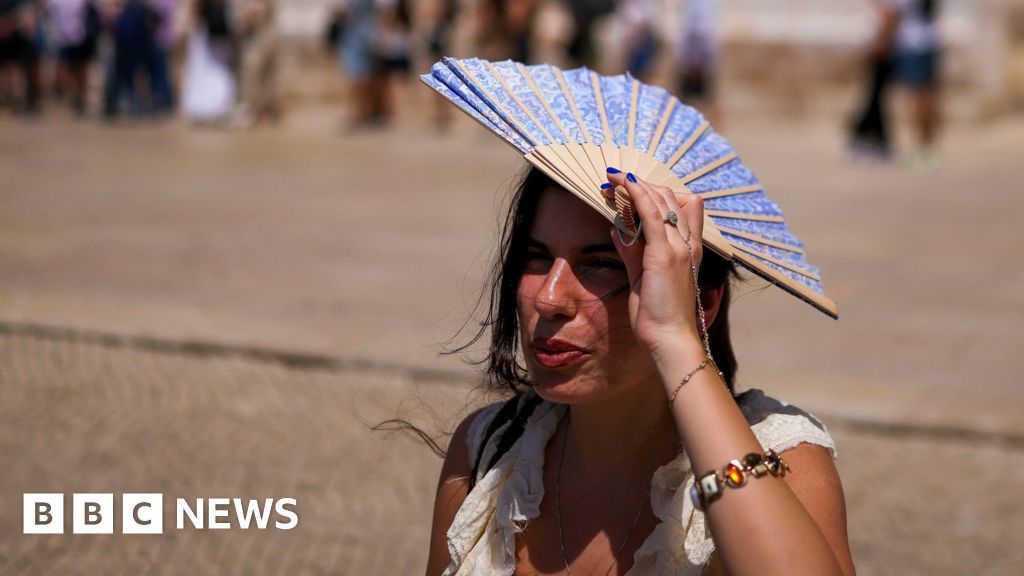
Portugal Breaks May Record While Europe Collectively Remembers Summer Exists
Portugal breaks May heat record, Europe sweats through heat dome, French exams continue because schedule, and scientists confirm summer is getting worse.
Portugal has set a new May temperature record, hitting 40.3°C in the central town of Mora on Wednesday, just barely beating the previous record of 40°C set all the way back in May 2001. The heatwave has western Europe in its sweaty grip, with countries scrambling to cope.
French ministers convened on Thursday to assess the nation's heatwave readiness, presumably asking themselves whether they were prepared for the season that happens every year. Prime Minister Sébastien Lecornu chaired a meeting to develop a plan for extreme heat, including combatting forest fires and ensuring adequate water supplies over the summer. Meanwhile, the French Open lost tennis number one Jannik Sinner to heat-related dizziness and lethargy, though he insisted it was "just me today" and not the 33°C Parisian weather that has been making everyone else miserable too.
Italian authorities issued a red heatwave alert for Rome, Florence, Bologna, Brescia, and Turin - the first such alert of the year - warning of "possible negative effects on the health of healthy, active people," which is a polite way of saying everyone should stay inside with a fan. Rome topped out at 32°C on Thursday.
The heat is forecast to continue into the weekend, with Germany, Spain, and Switzerland also facing unusually hot conditions. Parts of Portugal will peak above 35°C on Friday before the heat begins to recede, according to the nation's meteorological office, which is probably as relieved as everyone else.
France has kept its baccalaureate exams going despite the heat, because nothing says academic rigor like sweating through a test. A primary school in Souston, in the Landes region, will remain shut on Friday after reaching 53°C inside earlier in the week - a temperature at which one could theoretically bake cookies on a desk. Education Minister Édouard Geffray said exam centres could choose rooms with "the most shade" and that exams would go ahead "simply because the students are prepared and... there is also a schedule according to which they expect their results." This decision attracted criticism from education unions, with one teacher telling French radio about colleagues being "forced to bring in their own fans." A survey by France's secondary school union found nearly 78% had recorded temperatures above 30°C this week, and received reports of teachers bringing in screwdrivers to prise windows open - because apparently ventilation wasn't part of the school design.
Seventeen departments, including Paris, are under an orange alert indicating people should be "very vigilant" about the weather. Police announced measures to ease traffic in the capital until Saturday, allowing only lower-emission cars on roads and lowering speed limits, while offering a single fare for the entire public transport network. Because nothing says heatwave preparedness like making people walk to a train station.
The immediate cause is a "heat dome" - an area of high pressure that becomes stuck, trapping warm air underneath like a lid on a pot of simmering misery. While it's difficult to link individual extreme weather events to climate change, scientists say climate change makes heatwaves more frequent and intense. Over the last 30 years, Europe has been warming by 0.56°C per decade, according to the Copernicus climate service - enough to make heat extremes significantly more severe. The UN warned on Thursday that global average temperatures are likely to continue at or near record levels this year and for the next four years. The 11 hottest years ever recorded all happened from 2015 onwards, and the UN's weather and climate agency predicted a new hottest-ever year is "likely" before 2031. So, buckle up - the future is hot, and not in a fun way.
The Good Times
News in your inbox.
One sardonic roundup, delivered on your schedule. Free. Unsubscribe whenever your tolerance for wit runs out.
Already subscribed but we never reach your inbox? Check your spam folder and hit 'Not spam' (or 'Remove from spam') to bust us out of junk-mail purgatory. You'll be helping everyone else too.
Don't open any of our emails for a month and you'll be automatically removed from the mailing list.
Rewrite Article
Select parts to regenerate with a fresh AI pass. Translations will be updated automatically.
Generate AI Image
Creates a sardonic version of the article image using OpenAI.