
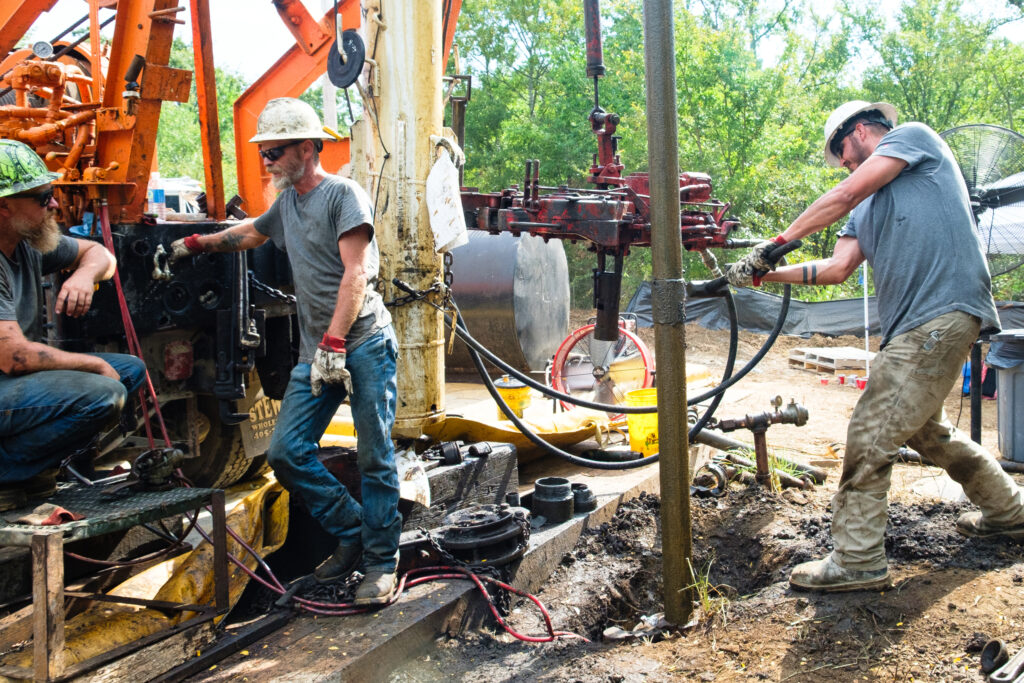
OKMULGEE, Okla. - There are a few truisms in the oil and gas industry: It is crowded with prodigious egos, there is always a boom around the corner and some industry operators aren’t above walking away from their mess at played-out well sites.
Abandoning wells is a deliberate technique to pad marginal oil and gas operators’ profits by dodging cleanup costs. In December, for instance, the New Mexico attorney general sued three Texas oilmen, accusing them of selling more than 500 unproductive wells to shell companies created for the purpose of declaring bankruptcy to avoid remediation costs.
Many of the millions of wells left derelict throughout oil-producing states are abandoned, often unplugged and polluting, some with owners of record and others, orphans with no known owner responsible for cleaning them up. In 2023 the Environmental Protection Agency estimated that there are around 3.7 million abandoned and orphaned oil and gas wells - AOOG for short - in the U.S., out of about 4 to 5 million that have been drilled since 1859. The EPA says 58 percent of abandoned wells it has logged are not plugged. A significant number of the rest were sealed so poorly, or so long ago, that their plugs are failing today.
The federal Orphaned Wells Program, using data compiled by the Interstate Oil and Gas Compact Commission, has documented 141,000 orphaned wells nationally and estimates there are an additional 250,000 to 740,000 out there, somewhere.
To make a tiny dent in the nation’s number of derelict orphans, a modest organization is plugging wells and remediating well sites. Because, as Curtis Shuck, the Well Done Foundation’s chairman, declares to anyone who will listen, “Doing the right thing is still the right thing to do.” WDF raises money and awareness to deal with the problem, and the staff of its subsidiary, Well Done, applies for grants, works on site and hires subcontractors to plug, cap and remediate wells. The effort pushes back against what Shuck’s safety supervisor and heavy equipment operator, Dominic Morgan, calls the industry’s “set it and forget it” attitude.
Shuck is, essentially, the P.T. Barnum of AOOG wells - an avowed showman operating a complicated circus. He says he walks “a very fine line between industry and environmental communism,” working side-by-side with state employees and contractors from the oil and gas industry, sometimes smoothly, sometimes not.
Plugging wells is just “putting cement in a hole,” Shuck said. But the reality on the ground is more complicated. Sealing wells is loud, foul-smelling, dirty and dangerous - not very different from drilling them except for the lack of an economic incentive to do the work. In August, heat indexes regularly exceeded 110 degrees Fahrenheit and scant breeze penetrated the dense tangle of trees surrounding the Doneghy #2 well in the Deep Fork National Wildlife Reserve near Okmulgee, Oklahoma. The muggy air was heavy with diesel and gasoline exhaust from constantly running trucks and generators mixed with the smell of crude and gases escaping the well head.
In a 2023 peer-reviewed study, researchers led by McGill University civil engineer Mary Kang estimated that 13 percent of Americans - about 4.6 million people - live within about a half-mile of an AOOG well. “These wells have the potential to contaminate water supplies, degrade ecosystems, and emit methane and other air pollutants … present[ing] risks to climate stability and to environmental and human health,” the study stated.
State oil and gas regulators’ documentation of old wells is so poor that paper trails offer little likelihood of determining if a well was adequately plugged, so Shuck presumes that AOOG wells weren’t appropriately sealed, if they were remediated at all. In the eight states Well Done has worked, its crews have pulled everything from rocks and debris to a cannonball from haphazardly plugged wells.
Each abandoned or orphaned well is a mystery that unravels as it’s plugged. Some are relatively inert on their own, but other unplugged wells might vent hydrocarbons like methane, volatile organic compounds like the carcinogen benzene or deadly gases like hydrogen sulfide. Some leak oil, or a brine called “produced water” contaminated with heavy metals, chemicals or radioactivity. Some pollute underground aquifers or nearby surface waters. Others create their own noxious lakes. Changing subterranean conditions can make previously stable AOOG wells vent or leak.
In addition to fouling nearby waterways, groundwater, air and ecosystems, AOOG wells contribute to the greenhouse gas pollution that drives global warming. According to the EPA’s 2024 assessment of greenhouse gas emissions, AOOG wells spewed 303 kilotons of methane, ranking fifth among the nine methane emitters in the U.S. energy sector.
Historically lax oil and gas industry regulation, including the ongoing failure to require producers to pay surety bonds that reflect the true costs of plugging wells, has led to a proliferation of AOOG wells, most of them unplugged. Some don’t have a responsible party after their operators declared bankruptcy, while others date back to between the 1800s and 1950s, when the hazards of unplugged wells weren’t recognized. Often, state and federal politicians sympathetic to the oil and gas industry have prevented or blunted statutory changes to well-bonding obligations, allowing marginal operators to keep walking away from spent wells.
Federal well-bonding regulations hadn’t changed in almost 40 years when the Bureau of Land Management finalized an update to onshore oil and gas leasing to bring public lands bonding requirements in line with contemporary well remediation costs in 2024. The new bonding rules were due to go into effect this June, but in December, the agency extended the deadline for compliance while the DOI proposed the rule’s recission.
“The Department of the Interior is actively evaluating the Bureau of Land Management’s bonding rule under Executive Order 14154,” a department spokesperson told ICN. “It would be premature to interpret a proposed rescission and extensions as a determination that the current bond levels constitute a burden.”
Kathleen Sgamma, the former president of the Western Energy Alliance and now a land-use consultant, called the BLM regulatory revisions “a rule in search of a problem.” At the time of the regulatory update’s proposal, she said, “the BLM was reporting 37 orphan wells on BLM lands.” The 2024 Biden administration rule change, however, affects not only lands managed by the BLM, but all federal lands. The 2023 Orphaned Wells Program (OWP) report cites 599 federal orphans in its database.
And orphans are not just a federal problem. Karr Ingham, president of the Texas Alliance of Energy Producers, acknowledged to Houston Public Media last year that some troublesome Texas AOOG wells have created “lakes of dirty water.” “Inactive wells are virtually never an environmental problem on their own,” Ingham added, “because they remained under the control and ownership, responsible ownership, of a current operator licensed to do business in the oil and gas industry in Texas.” But more than 8,000 wells have been inactive for more than a year under delinquent ownership in the state. Between 2021 and 2024, the Texas Railroad Commission, the state’s oil and gas regulator, added 2,139 wells to its roster of abandoned and orphaned wells.
Ingham sees the scrutiny that the Orphaned Wells Program brought to Texas’ AOOG wells, and the public’s rising awareness of the wells and produced water, as helping move the Texas legislature to act. It did so last year, setting a 15-year limit on operator’s idle wells. Texas Governor Greg Abbot also signed other legislation in June 2025 that set aside $100 million to plug orphaned wells, acknowledging the state’s burden.
Given the millions of AOOG wells in the U.S., no one outfit will substantially reduce the problem, and Shuck concedes that the Well Done Foundation is in the “inspiration and hope” business. “Oftentimes climate change is so overwhelming people feel that nothing they do, or can do, will matter,” he said. “If I can do this as an individual, having impact, a career, that provides something that’s bigger than just myself, then I hope that instills some hope with folks that, ‘OK, maybe I can do something.’”
On Dec. 20, 2024, the U.S. Fish and Wildlife Service (USFWS) awarded Shuck’s Well Done plugging venture a $19.3 million grant under its National Wildlife Refuge System Enhancements program. The grant was funded by President Joe Biden’s Infrastructure Investment and Jobs Act (IIJA) “to restore and conserve habitat by plugging … and reclaiming 111 orphaned well sites on at least 5 national wildlife refuges.” But a month later, the OWP’s $4.7 billion IIJA-financed plugging effort encountered resistance - on the day he was inaugurated for his second term, President Donald Trump signed his “Unleashing American Energy” executive order. That directed “the removal of impediments imposed on the development and use of our Nation’s abundant energy.” By April, the U.S. Department of the Interior paused dispersal of plugging and capping funds to oil-producing states that clearly wanted the money - 26 of 32 of them had applied for the funding, including the five states that produce the majority of all U.S. crude: Texas, Alaska, New Mexico, North Dakota and Colorado.