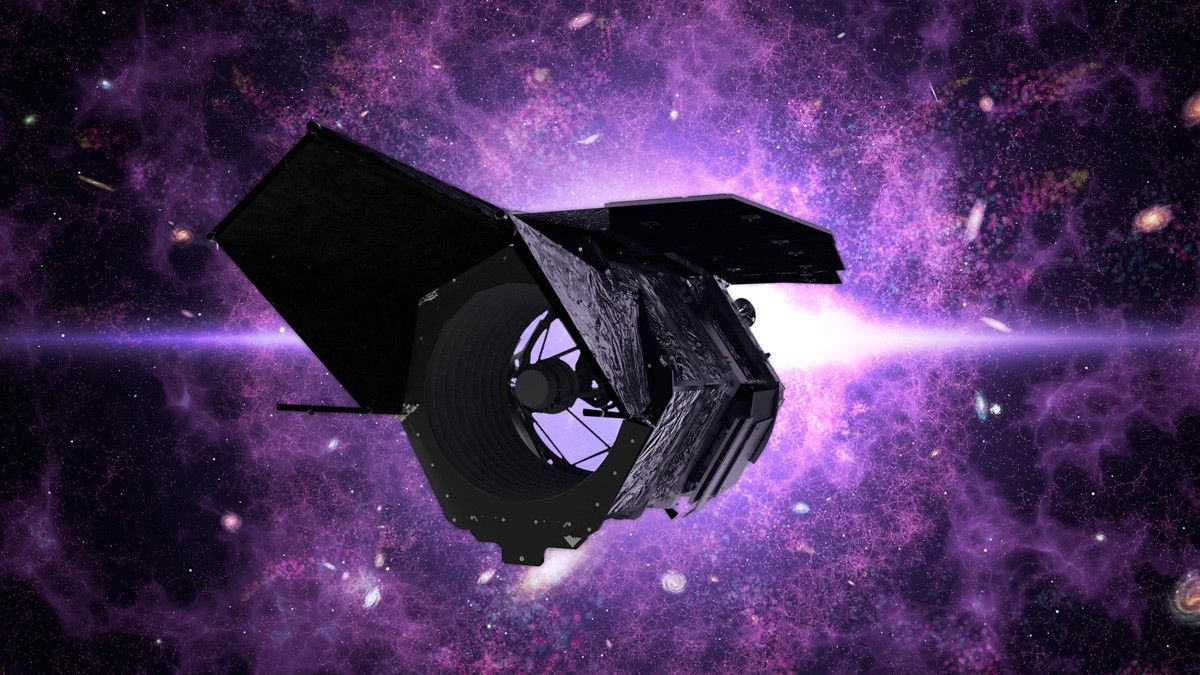
NASA's New Space Telescope Is Named After a Woman Who Basically Built Hubble
NASA's Roman Space Telescope will launch in 2026 to study dark energy, dark matter, and exoplanets - because the universe still has plenty of secrets to keep us up at night.
NASA's newest astrophysics observatory, the Nancy Grace Roman Space Telescope, is set to launch on Aug. 30, 2026, aboard a SpaceX Falcon Heavy rocket from Launch Complex 39A at Kennedy Space Center in Florida. Because nothing says 'cutting-edge science' like a rocket named after a truck.
The telescope will park itself at the second Sun-Earth Lagrange point (L2), a gravitational sweet spot about 930,000 miles (1.5 million kilometers) from Earth where it can enjoy an unobstructed view of the cosmos without burning much fuel. It's basically the RV parking spot of space.
Roman will use infrared light to peer through dust and across vast distances. Its primary mirror, 7.9 feet (2.4 meters) across, gathers lots of light - because more light equals finer details, a concept that also applies to reading glasses.
The mirror feeds two science instruments: the Wide Field Instrument, a 300-megapixel infrared camera that can look billions of years back in time, and the Coronagraph Instrument, which blocks starlight to reveal planets nearly a billion times fainter than their host star. That's like spotting a firefly next to a searchlight, but with better optics.
Scientists will focus on three cosmic mysteries: dark energy, dark matter, and exoplanets. Dark energy - the mysterious force causing the universe to expand faster - accounts for about 68% of the universe's contents, and recent observations suggest its pressure is shifting over time. Because if there's one thing the universe needs, it's more unpredictable behavior.
Exoplanets: we've found over 6,000, but billions likely exist. Roman is expected to uncover more oddballs and find planets in habitable zones, which could be key to spotting Earth-like worlds. Finally, a chance to find a planet that's not a gas giant or a scorching rock.
Dark matter, the invisible glue holding galaxies together, remains a puzzle. Roman will trace galaxy formation over cosmic history. If dark matter particles are heavy and sluggish, galaxies should form early; if light and fast, later. Either way, we're one step closer to finally catching these elusive particles in the act.
The telescope is named after Nancy Grace Roman, NASA's first chief astronomer and first female executive. She championed the Hubble Space Telescope and was involved in every major decision, earning the title 'mother of the Hubble.' She was born May 16, 1925, in Nashville, Tennessee, and died Dec. 25, 2018. Clearly, she deserved a telescope named after her more than most.
Building Roman required over a thousand technicians and engineers, including instrument technicians, mechanical engineers, and astrophysicists - plus people in photography, management, social media, and videography. Because even a space telescope needs a good Instagram account.
The Good Times
News in your inbox.
One sardonic roundup, delivered on your schedule. Free. Unsubscribe whenever your tolerance for wit runs out.
Already subscribed but we never reach your inbox? Check your spam folder and hit 'Not spam' (or 'Remove from spam') to bust us out of junk-mail purgatory. You'll be helping everyone else too.
Don't open any of our emails for a month and you'll be automatically removed from the mailing list.
Rewrite Article
Select parts to regenerate with a fresh AI pass. Translations will be updated automatically.
Generate AI Image
Creates a sardonic version of the article image using OpenAI.