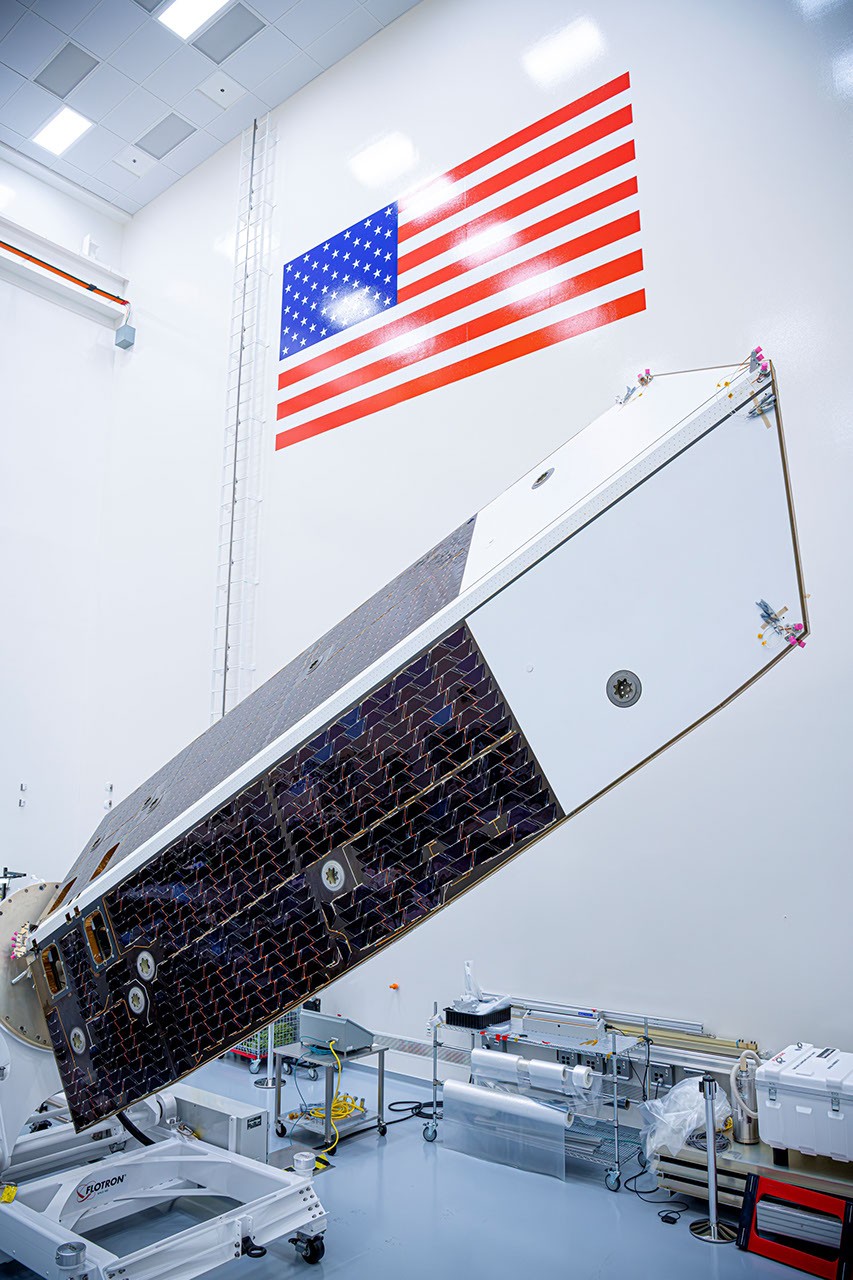
NASA has taken another step toward launching a spacecraft whose entire job is to look at the part of the sky where the Sun is - something your parents presumably told you not to do - and it starts with a very large, very solar-powered sunshade. The Near-Earth Object (NEO) Surveyor's sunshade was mounted on an assembly ring for inspections in a clean room at BAE Systems Space & Mission Systems in Boulder, Colorado, in July 2026, because even hardware destined for the void deserves a spotless room.
The structure stands 20 feet (6 meters) tall and measures 8 feet (2.4 meters) wide at its base. Its two flat panels, joined at a 23.5-degree angle - an angle that is, coincidentally, the exact tilt of Earth's axis, though here it's just a good way to catch sunlight - were covered with 864 interconnected solar cells and tested before making the trip to Colorado. This specialized solar array can produce up to 2 kilowatts of power, enough to charge the onboard batteries that keep the spacecraft's systems running. That's roughly the output of a decent space heater, but unlike a space heater, this one is designed to operate in actual space.
The sunshade structure was built by Applied Aerospace in Stockton, California, and outfitted with its solar cells by SolAero Technologies in Albuquerque, New Mexico, in January. Environmental testing of the sunshade and solar array wrapped up at a commercial thermal vacuum testing facility in El Segundo, California, in March - because if you're going to send something to space, you should first subject it to space-like conditions in a facility with a reassuringly bureaucratic name. It was delivered to BAE Systems Space & Mission Systems ahead of schedule in May, a sentence rarely written about aerospace projects without a hint of disbelief.
Once in space, NEO Surveyor will seek out some of the hardest-to-find asteroids and comets, including those lurking in the direction of the Sun - a region of sky where ground-based optical telescopes have a harder time searching, on account of the Sun being very bright and telescopes being very sensitive. The mission's sunshade, therefore, is not just a power source but a shield, allowing the spacecraft to do the one thing your optometrist warned you about: stare sunward and find the rocks hiding there.
More information about NEO Surveyor is available at https://science.nasa.gov/mission/neo-surveyor/.
The Good Times
News in your inbox.
One sardonic roundup, delivered on your schedule. Free. Unsubscribe whenever your tolerance for wit runs out.
Already subscribed but we never reach your inbox? Check your spam folder and hit 'Not spam' (or 'Remove from spam') to bust us out of junk-mail purgatory. You'll be helping everyone else too.
Don't open any of our emails for a month and you'll be automatically removed from the mailing list.
Rewrite Article
Select parts to regenerate with a fresh AI pass. Translations will be updated automatically.
Generate AI Image
Creates a sardonic version of the article image using OpenAI.