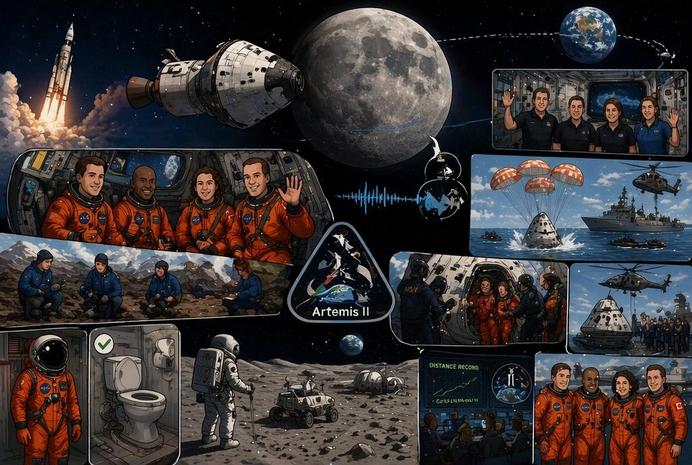
On April 1, 2026 - no, this is not a joke - Artemis II launched on a nearly 10-day voyage around the Moon, marking the first crewed flight of NASA’s Orion spacecraft. Astronauts Reid Wiseman, Victor Glover, Christina Koch, and Canadian Space Agency’s Jeremy Hansen splashed down on April 10 in the Pacific Ocean off San Diego, having traveled 252,756 miles from Earth at their farthest point. That’s a new record for greatest distance humans have traveled in space, beating Apollo 13’s 1970 mark. Take that, 1970.
To prepare for this lunar joyride, the crew trained in Iceland’s volcanic terrain, practicing navigation and field geology while collecting rock samples with hammers, scoops, and chisels. They also got cozy in NASA’s Orion Crew Survival System - the bright orange spacesuit worn during launch and re-entry. Each suit is custom-fitted with air, water, food, and waste management systems, and can sustain life for up to six days in emergencies. Because nothing says “deep space” like a six-day supply of your own waste.
The mission included a historic first: a direct call between the Artemis II crew and astronauts aboard the International Space Station - Expedition 74’s Chris Williams, Jack Hathaway, Jessica Meir, and ESA’s Sophie Adenot. That’s right, the first ship-to-ship communication from deep space. No more passing notes in class.
After splashdown, NASA and U.S. Navy teams recovered the capsule, opened the hatch, and helped the astronauts out. The crew was flown by helicopter to the Navy recovery ship, while Orion was brought aboard for transport back to shore. Then they returned to Ellington Airport in Houston, probably to a hero’s welcome and some well-deserved sleep.
The mission covered 694,481 miles total, and the crew observed the Moon from closer range than any humans before them during a crewed mission. One unexpected outcome: “Moon joy.” Because when you’ve trained for years and thousands of experts are behind you, seeing the Moon up close is apparently an emotional experience. Who knew?
NASA is now preparing for future missions to the Moon’s South Pole, with work on next-generation spacesuits, lunar tools, and rovers at Johnson Space Center. Future Artemis missions will face harsh lighting, lunar dust, and extreme temperatures - but hey, at least they’ve got the space toilet working. The Universal Waste Management System, or space toilet, had some operational issues in microgravity, but the crew managed to maintain performance. Because even in deep space, plumbing problems are universal.
The Good Times
News in your inbox.
One sardonic roundup, delivered on your schedule. Free. Unsubscribe whenever your tolerance for wit runs out.
Already subscribed but we never reach your inbox? Check your spam folder and hit 'Not spam' (or 'Remove from spam') to bust us out of junk-mail purgatory. You'll be helping everyone else too.
Don't open any of our emails for a month and you'll be automatically removed from the mailing list.
Rewrite Article
Select parts to regenerate with a fresh AI pass. Translations will be updated automatically.
Generate AI Image
Creates a sardonic version of the article image using OpenAI.