Meteorite Through New Jersey Roof Turns Out to Be a Salty, Life-Friendly Space Rock
A meteorite that crashed through a New Jersey roof turns out to be a rare, pristine sample of asteroid brine chemistry, offering clues to life's origins - and giving the homeowner a story that will last forever.
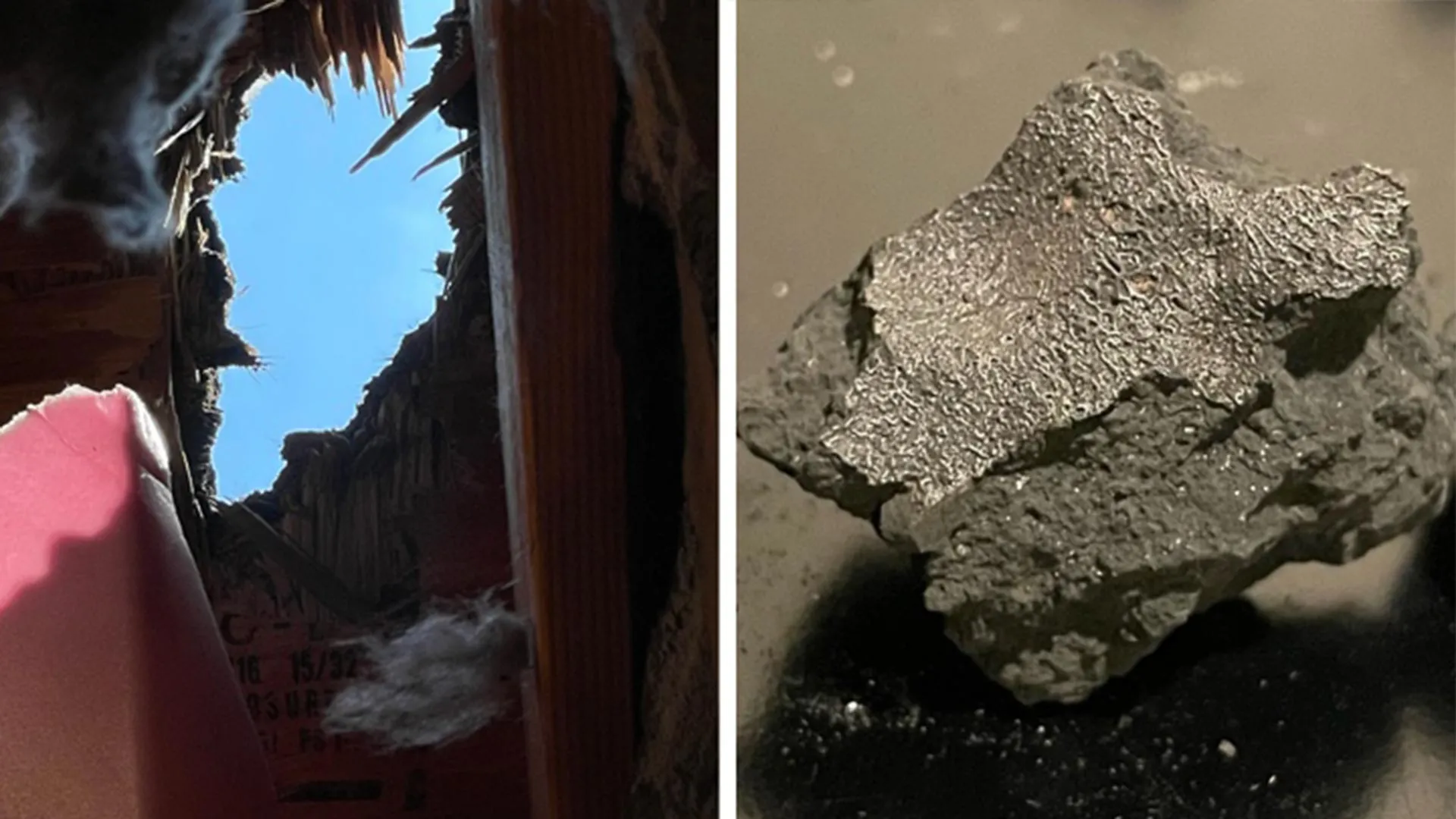
A meteor that lit up the skies over New York City on July 16, 2024, with a sonic boom that rattled the Statue of Liberty's neighborhood, ended its journey by punching a hole through a roof in Hillsborough, New Jersey. The two-pound rock that followed has since revealed something rather juicy: it contains preserved bits from the surface of a primitive asteroid where concentrated salty fluids once flowed - a process never before seen in this type of proto-planet world, according to a study published in Science Advances.
Lead author Peter Jenniskens, a meteor astronomer at the SETI Institute and NASA's Ames Research Center, described the forensic analysis as uncovering evidence of 'concentrated salty fluids' near the surface of the asteroid - which, in space-rock terms, is like finding a hidden ocean under a desert.
The meteor was about the size of a heavy airline bag, traveling at a blistering 32,000 miles per hour (14.4 kilometers per second). Sixty people across five states reported seeing the fireball, and sixteen in New York and New Jersey felt the shockwave. The American Meteor Society's cameras - in Northford, Connecticut; Douglassville, Pennsylvania; and a doorbell camera in Wayne, New Jersey - caught the show, allowing the team to trace its trajectory back to the low asteroid belt.
The fragile rock broke apart at an altitude of 22 miles (35 kilometers), and Doppler weather radar at Newark Airport briefly spotted an elongated cloud of falling pebbles stretching from Staten Island into New Jersey. Hillsborough sat at the far end of that debris field, where the biggest pieces were expected to land. Only one meteorite was recovered, mostly because it made itself impossible to miss by crashing through a ceiling.
The homeowner, who clearly has a future in forensic science, heard a loud crash, found a hole in the master bedroom ceiling, smelled a strong sulfur-like odor, and saw black fragments and dust covering his bed, carpet, and surroundings. He donned disposable gloves, used aluminum foil to collect the pieces, and sealed them in glass jars - preserving what would become the most pristine CM1/2 meteorites known to science.
Lab analysis revealed the rock is a CM-type carbonaceous chondrite, specifically a CM1/2 - a rare breed. It's only the 22nd observed fall of a CM-type meteorite, and just the second witnessed fall of a CM1/2, after the Kolang meteorite in Indonesia in 2020. No CM1 fall has ever been seen. 'Thanks to the homeowner's quick reaction, these are the most pristine CM1/2 meteorites we know of,' said Jenniskens.
Scientists are particularly excited about the salty fluids. These brines could have kept phosphate dissolved and promoted chemical reactions involving organic compounds - key ingredients for life. Isotope studies suggest that primitive carbonaceous chondrites delivered organic matter to the early Earth, and the Hillsborough meteorite contains 1.8% carbon and 0.07% nitrogen by weight, with typical CM-type isotopes. Researchers found a broad range of soluble organic compounds, including amino acids, and noted that the material experienced more extensive water alteration than most CM2s.
'We do not know if these magnesium organic compounds were contributed by brine chemistry or were simply left over from earlier impact shock processes,' said Phil Schmitt-Kopplin of Technical University Munich, adding a touch of mystery to the already steamy tale. The presence of organometallic compounds - which play roles in blood and photosynthesis - and amino acids suggests that CM-type bodies could have supplied the early Earth with prebiotic material, potentially helping set the stage for life.
Some fragments of the Hillsborough meteorite will be curated by the American Museum of Natural History in New York City, much to the delight of curator Denton Ebel, who said, 'We are thrilled that nature delivered such a precious asteroid sample on our doorstep.' Given the circumstances, 'doorstep' might be a slight understatement - more like 'through the ceiling.'
The Good Times
News in your inbox.
One sardonic roundup, delivered on your schedule. Free. Unsubscribe whenever your tolerance for wit runs out.
Already subscribed but we never reach your inbox? Check your spam folder and hit 'Not spam' (or 'Remove from spam') to bust us out of junk-mail purgatory. You'll be helping everyone else too.
Don't open any of our emails for a month and you'll be automatically removed from the mailing list.
Rewrite Article
Select parts to regenerate with a fresh AI pass. Translations will be updated automatically.
Generate AI Image
Creates a sardonic version of the article image using OpenAI.