Mathematicians Discover Donut-Shaped Exception to 150-Year-Old Rule, Because Of Course They Did
Mathematicians finally found the donut-shaped counterexample they've been hunting for decades, proving you can't always judge a surface by its local curvature.
For over a century and a half, mathematicians have operated under the comforting, if slightly rigid, assumption that if you know two key things about a compact surface - its metric (how distances work on it) and its mean curvature (how it bends in space) - you can figure out its exact shape. This principle, originating with French mathematician Pierre Ossian Bonnet, has now been gently but firmly kneaded into a new form by researchers from the Technical University of Munich (TUM), the Technical University of Berlin, and North Carolina State University.
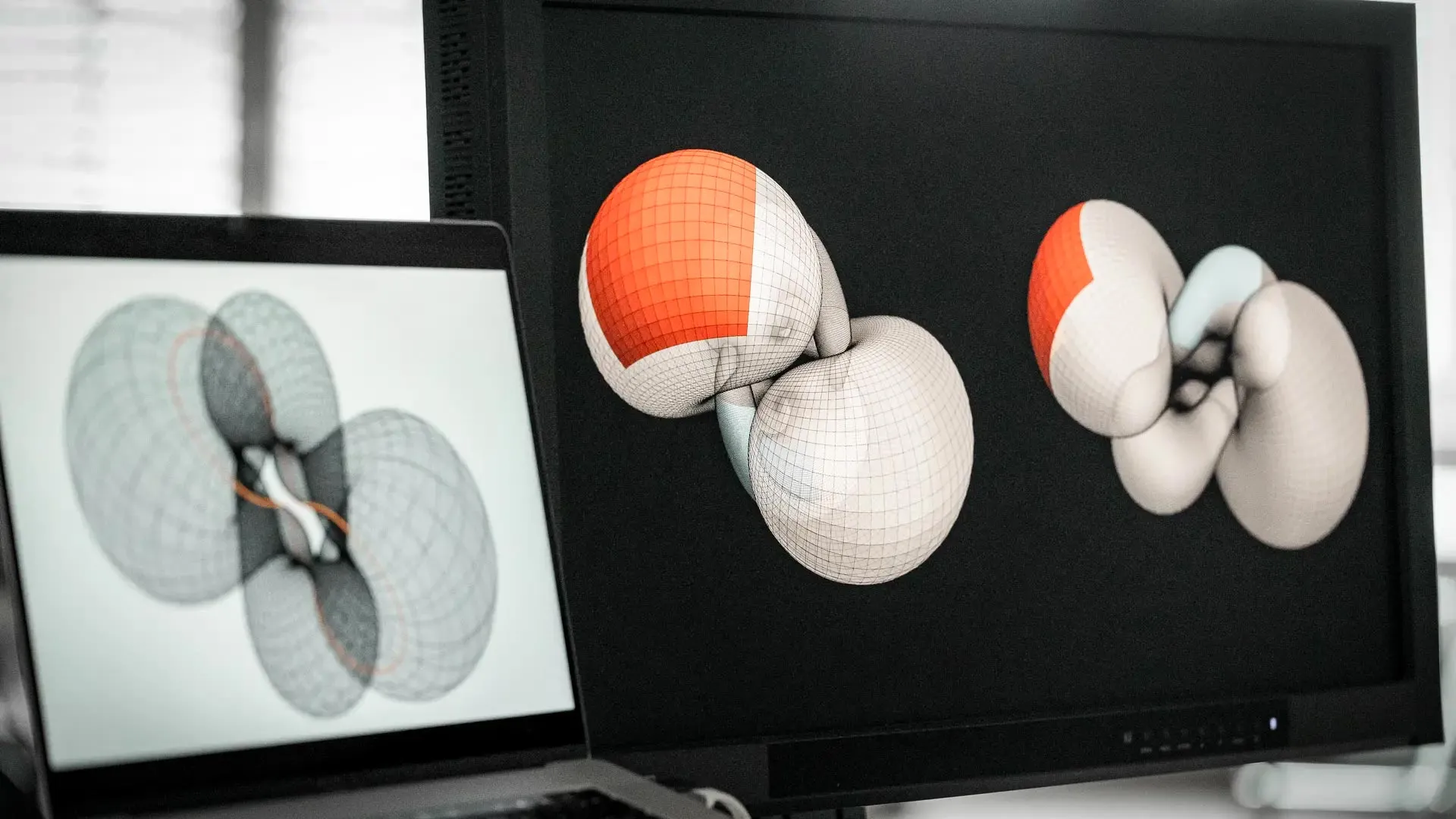
They have constructed the first explicit counterexample to this long-held rule. The team built two compact, self-contained surfaces shaped like doughnuts, known as tori. These two tori share identical values for both metric and mean curvature at every point, yet their overall structures are not the same. This type of example, a pair of surfaces that are locally identical but globally different, had been sought for decades.
Mathematicians were already aware that Bonnet's rule had its limits, with known exceptions involving non-compact surfaces that extend infinitely or have edges. Compact surfaces like spheres were thought to be safe from such ambiguity. For torus-shaped surfaces, theory had suggested a single set of metric and mean curvature values could correspond to up to two different shapes, but no one had ever baked a concrete example.
"After many years of research, we have succeeded for the first time in finding a concrete case that shows that even for closed, doughnut-like surfaces, local measurement data do not necessarily determine a single global shape," said Tim Hoffmann, Professor of Applied and Computational Topology at the TUM School of Computation, Information and Technology. The finding resolves a decades-old problem, proving that even with complete local information, a surface's full shape cannot always be uniquely pinned down.
The Good Times
News in your inbox.
One sardonic roundup, delivered on your schedule. Free. Unsubscribe whenever your tolerance for wit runs out.
Already subscribed but we never reach your inbox? Check your spam folder and hit 'Not spam' (or 'Remove from spam') to bust us out of junk-mail purgatory. You'll be helping everyone else too.
Don't open any of our emails for a month and you'll be automatically removed from the mailing list.
Rewrite Article
Select parts to regenerate with a fresh AI pass. Translations will be updated automatically.
Generate AI Image
Creates a sardonic version of the article image using OpenAI.