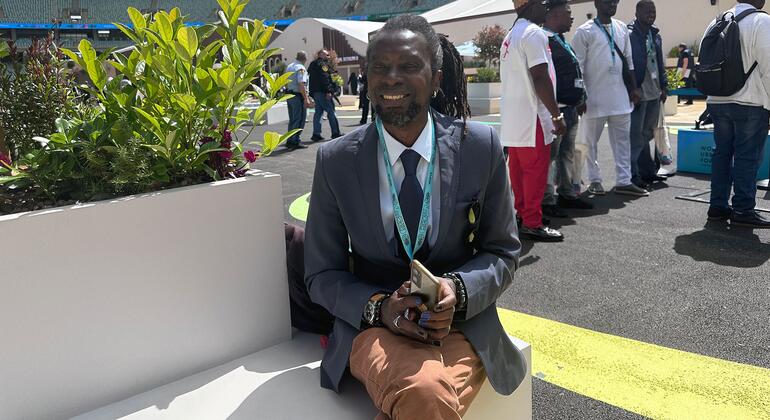
Man's Four-Year Detour into Homelessness Highlights How Fast a 'Good Life' Can Vanish
Former EU employee Latyr Thioye spent four years homeless in Spain after a forged cheque and passport confiscation - only to be cleared without explanation, now sharing his story at a UN forum.
Latyr Thioye had it all: a job at the European Commission, a middle-class life in Belgium, and a future that didn't involve sleeping in a tent under Spanish trees. Then a forged cheque, a confiscated passport, and a bureaucratic maze turned his world upside down for nearly four years - until authorities eventually shrugged and handed his belongings back with no charges.
At the World Urban Forum in Baku, Azerbaijan, Thioye is now the reluctant star of the documentary *What Nobody Wants to See*, a film that might as well be titled *How to Lose Everything in Three Easy Steps*. The forum, organized by UN-Habitat with partners like The Gere Foundation and Spanish non-profit HOGAR SÍ, is putting homelessness front and center - because apparently, it takes a global summit to remind us that people living on streets exist.
HOGAR SÍ, founded in 1998, has spent over 25 years helping more than 10,000 people across 11 regions escape homelessness. They're the ones who pulled Thioye out of a tent and into a shelter called “Espacio Salut” just in time for his lung cancer treatment. “That saved my life,” he says - though one wonders why it took a cancer diagnosis to get a bed.
Thioye's spiral began innocuously enough: after a divorce and job loss, he agreed to facilitate a bank transaction for some shady acquaintances. The cheque was forged. Spanish authorities confiscated his passport, bank cards, and documents, ordering him to stay put while they investigated. He could have fled, but he didn't - because risking a flight from justice seemed worse than risking homelessness, apparently.
For four years, he lived in a tent community, working odd jobs at street markets to buy vegetables and meat. Doctors diagnosed him with emphysema, then lung cancer, but refused chemotherapy because, as they put it, “if I give you chemotherapy while you are living in the street, you are going to die.” So much for universal healthcare.
Eventually, HOGAR SÍ placed him in a shelter where he could rest and eat properly while undergoing treatment. Now cancer-free and freelancing on his laptop for former clients in London, France, and the US, Thioye is asking governments and businesses to do something about Spain's 37,000 homeless people - a number he calls “manageable” for a country of 50 million. “If they want to stop it right now, they have the means,” he says, suggesting partnerships between non-profits and real estate companies.
But the wound remains: after years of investigation, authorities returned his passport and laptop without explanation. No charges. No apology. Just four years of his life, gone. “I had a good life,” he says, “and I lost it from one day to another.”
The Good Times
News in your inbox.
One sardonic roundup, delivered on your schedule. Free. Unsubscribe whenever your tolerance for wit runs out.
Already subscribed but we never reach your inbox? Check your spam folder and hit 'Not spam' (or 'Remove from spam') to bust us out of junk-mail purgatory. You'll be helping everyone else too.
Don't open any of our emails for a month and you'll be automatically removed from the mailing list.
Rewrite Article
Select parts to regenerate with a fresh AI pass. Translations will be updated automatically.
Generate AI Image
Creates a sardonic version of the article image using OpenAI.