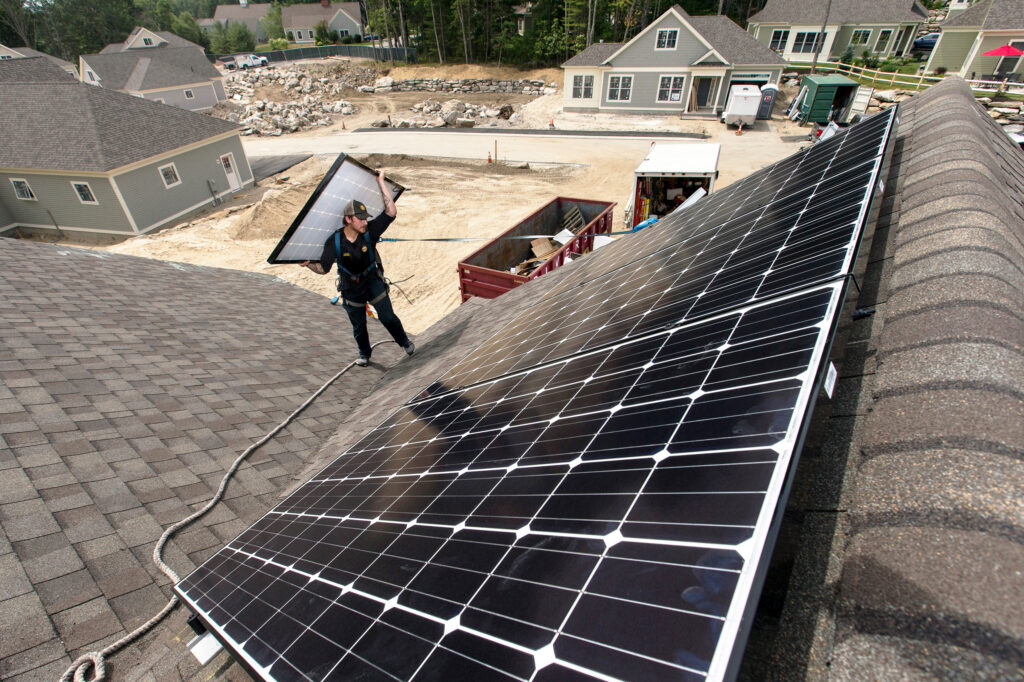
Graham Platner’s freshly released energy plan is a masterclass in trying to have it both ways: build clean energy projects and transmission lines quickly to combat climate change and lower sky-high electricity prices, but also - wait for it - pause for community input. Platner’s plan devotes only a short section to this tension, calling for permitting reform. But his record as a member of the Planning Board in Sullivan, Maine, tells a more vivid story. In 2024, Platner voted to advance a temporary ban on larger solar projects while permanent rules were being worked out. Because nothing says “buildout of renewable energy” like hitting the brakes.
Maine, being a “home-rule” state, grants towns significant control over land use, including energy developments. Platner told Inside Climate News he was responding to public concerns: “There’s been a lot of community backlash just here locally. Nobody was preparing for these large solar farms. The communities - they just kind of sprung up out of nowhere.” His goal with the moratorium was to buy time for Sullivan to “get ordinances in place and have a deeper and more nuanced conversation.” Because nothing says nuance like a moratorium.
Renewable energy advocates expressed understanding. Eliza Donoghue, executive director of the Maine Renewable Energy Association, said moratoria “can play an important role in giving towns an opportunity to take a beat.” She added that concerns arise when moratoria become “a de facto ban on solar energy generation.” There is no evidence that Sullivan’s yet-to-be-adopted moratorium or its development review ordinance would fit that description - yet.
Town manager Ray Weintraub noted that no developers have proposed larger-scale solar projects in Sullivan, though several have been built nearby, including a 100-acre array on a blueberry barrens in neighboring Hancock. “So maybe we as a town should get ahead of this,” he said. The moratorium proposal hasn’t advanced to a popular vote and likely won’t be ready for this summer’s town meeting.
Sullivan’s pause comes during a wave of at least a dozen Maine towns adopting similar measures, following rapid solar growth. Total capacity from community and utility-scale solar in Maine grew nearly 13-fold from 2020 to 2024, to 1,640 megawatts - roughly 8,000 acres of land. That’s a tiny fraction of the state’s total land, and the arrays help Maine produce more power locally without harmful emissions. But rapid growth, combined with perceptions that state solar subsidies contributed to higher electricity prices, fueled backlash.
To address concerns about solar farms on agricultural land, Maine passed a 2023 law requiring extra permits and fees for projects on especially fertile land. Last year, the state revised its net-energy billing rules to make them less generous. Despite these measures, the movement to regulate solar farms persists. The state’s Department of Energy Resources even released a handbook for towns, including a model solar development ordinance. Sullivan’s draft ordinance differs in minor but potentially impactful ways, notably a noise-decibel limit of 50-55 decibels at the property line. (Solar panels are noiseless, but tracking motors and inverters produce low-level noise.)
Platner sees local ordinances and permitting reform as compatible. “When you get more community input, you actually come up generally, I find, with better answers,” he said. “Things start getting placed in areas that aren’t going to piss everybody off, because you actually sat down and had a conversation.” Which is a nice sentiment - assuming everyone shows up to the conversation before the moratorium becomes permanent.
The Good Times
News in your inbox.
One sardonic roundup, delivered on your schedule. Free. Unsubscribe whenever your tolerance for wit runs out.
Already subscribed but we never reach your inbox? Check your spam folder and hit 'Not spam' (or 'Remove from spam') to bust us out of junk-mail purgatory. You'll be helping everyone else too.
Don't open any of our emails for a month and you'll be automatically removed from the mailing list.
Rewrite Article
Select parts to regenerate with a fresh AI pass. Translations will be updated automatically.
Generate AI Image
Creates a sardonic version of the article image using OpenAI.