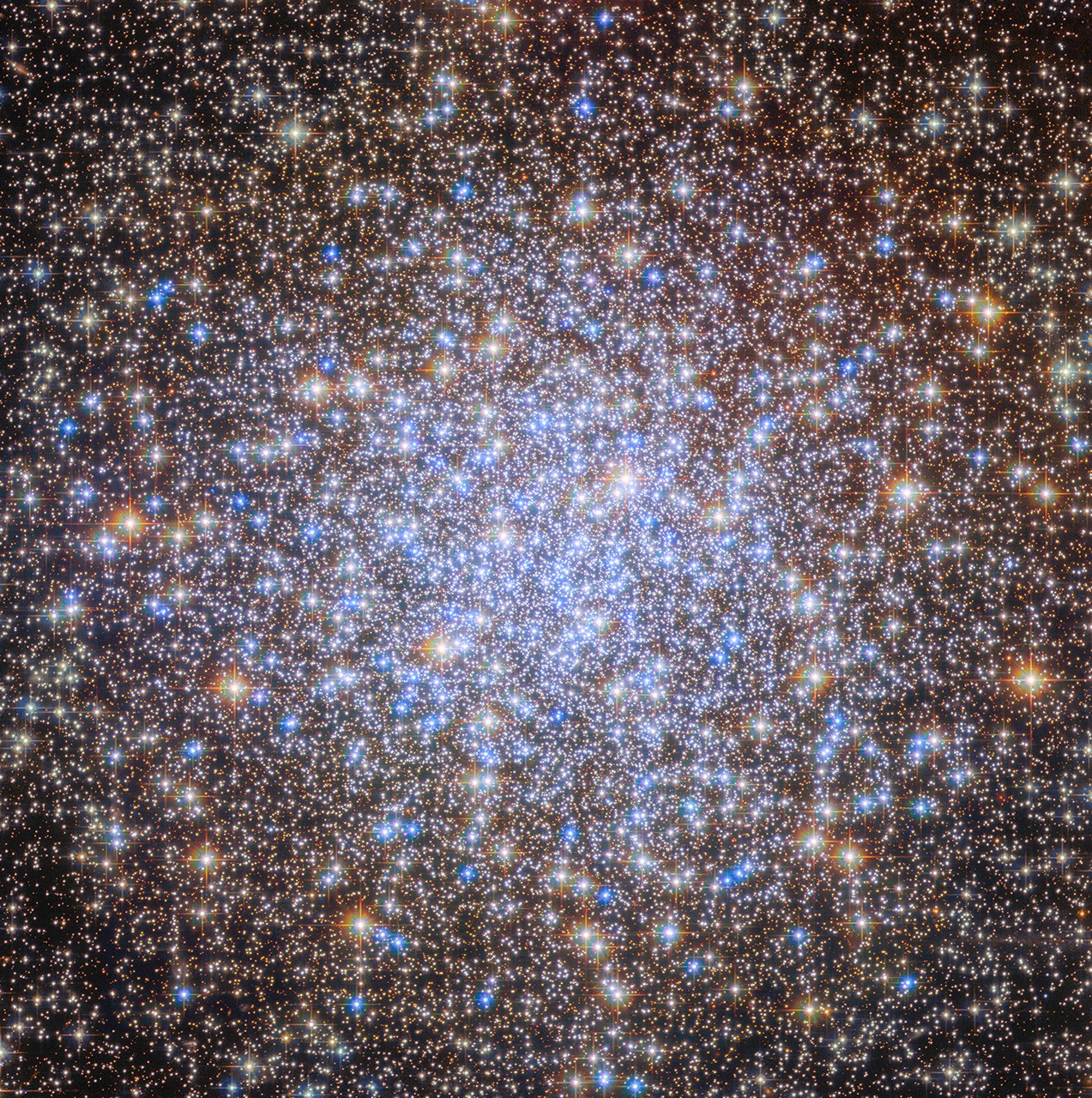
Hubble Spies Starry Chandelier, Reminds Us the Universe Is Very Old and We Are Very Small
Hubble takes a closer look at a 10-billion-year-old globular cluster, revealing it’s even more complicated than we thought - and making us feel appropriately insignificant.
The subject of today’s NASA/ESA Hubble Space Telescope image is an ancient inhabitant of our galaxy: a globular cluster called NGC 6723, also known as the Chandelier Cluster. It’s a collection of tens of thousands to millions of stars all tightly bound by gravity, like a cosmic mosh pit that’s been going on for billions of years. There are more than 150 such clusters in our galaxy, though some may still be hiding behind dust or crowded star fields - because even the universe has its messy closets.
NGC 6723 sparkles like its namesake chandelier, but each ‘lightbulb’ is an individual star 27,000 light-years away in the constellation Sagittarius. These clusters contain some of the oldest stars in the galaxy, often exceeding 10 billion years old - some nearly as old as the universe itself. Astronomers think globular clusters were among the first structures to form in our galaxy, coalescing billions of years before the thin disk of stars where our Sun hangs out. How exactly they formed remains a bit of a mystery, because the universe likes to keep us guessing.
Initially, astronomers assumed all stars in a globular cluster formed at the same time, like a batch of cosmic cookies. That would mean they’d all be the same age and chemical composition. But thanks to Hubble, we now know these stellar populations have more complex histories - because nothing in space is ever simple.
Hubble first observed NGC 6723 as part of an ambitious survey (#10775, PI: Sarajedini) studying 65 globular clusters in visible and near-infrared light. That data let researchers examine everything from cluster ages to the process where massive stars sink to the center while lighter ones drift outward - stellar social stratification, basically. The survey has inspired hundreds of research papers, proving that Hubble is still the overachiever of space telescopes.
In a follow-up program (#13297, PI: Piotto), researchers used Hubble’s ultraviolet sensitivity to detect subtle chemical variations and determine age spreads among stars. For NGC 6723, they found evidence of two closely-spaced periods of star formation, the second occurring within 634 million years of the first. That’s ‘closely-spaced’ in cosmic terms - 634 million years is a blink of an eye for a cluster over 10 billion years old. So, you know, no big deal.
Thanks to these findings, astronomers are finally getting closer to understanding how and when globular clusters formed. And Hubble’s observations of celestial chandeliers like NGC 6723 are lighting the way - because sometimes you need a very expensive telescope to appreciate the universe’s interior design.
The Good Times
News in your inbox.
One sardonic roundup, delivered on your schedule. Free. Unsubscribe whenever your tolerance for wit runs out.
Already subscribed but we never reach your inbox? Check your spam folder and hit 'Not spam' (or 'Remove from spam') to bust us out of junk-mail purgatory. You'll be helping everyone else too.
Don't open any of our emails for a month and you'll be automatically removed from the mailing list.
Rewrite Article
Select parts to regenerate with a fresh AI pass. Translations will be updated automatically.
Generate AI Image
Creates a sardonic version of the article image using OpenAI.