Europe's $2B Mercury Mission Finally Ditches Its Training Wheels, Prepares for Orbit
After eight years, a $2B spacecraft finally drops its propulsion module and gets ready to orbit Mercury - because the hardest part was getting there, not the science.
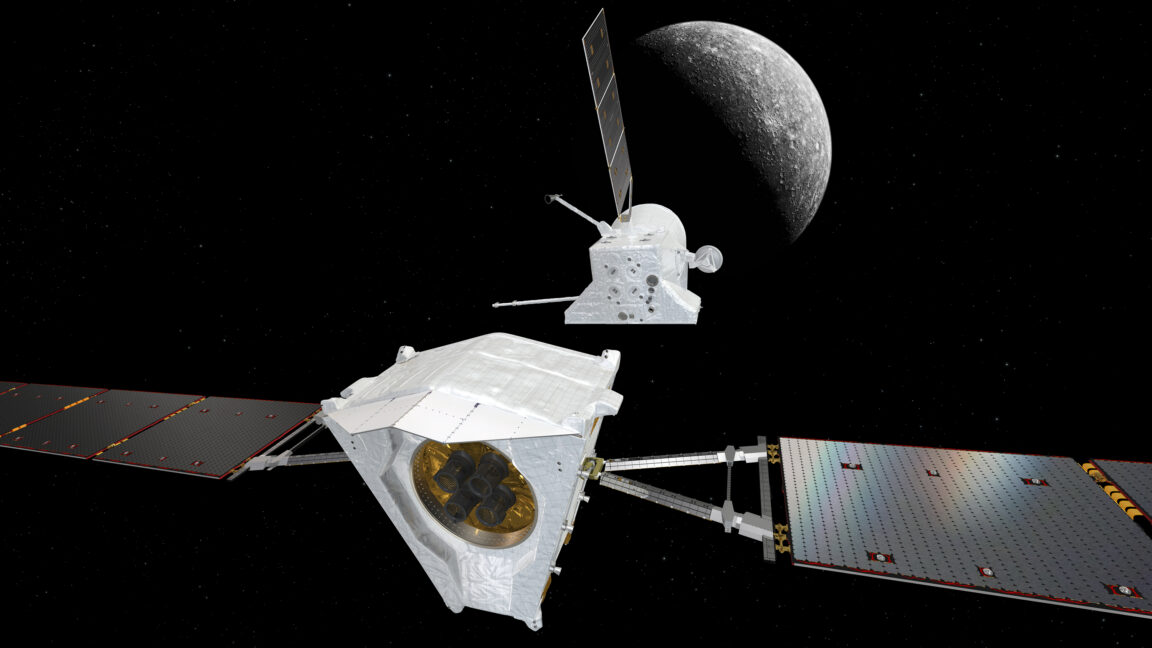
After eight years of spiraling through the Solar System like a cosmic corkscrew, Europe's BepiColombo mission is finally ready to commit to Mercury - and it marked the occasion by throwing off its propulsion module like a spaceship shedding its winter coat.
The nearly $2 billion robotic mission, led by the European Space Agency with help from Japan and the United States, has been on a slow, patient voyage since its 2018 launch. Using a combination of plasma propulsion and a record-setting nine planetary flybys (Earth, Venus, and Mercury, in case you're counting), BepiColombo has been reshaping its orbit to match the innermost planet's frantic pace. Turns out, getting into orbit around Mercury takes more energy than flying past Pluto - a fact that would have been nice to know before NASA's New Horizons made the trip in a mere 10 years.
Thursday marked a pivotal moment: BepiColombo jettisoned the Mercury Transfer Module, the part of the spacecraft that housed its ion thrusters and provided power during the long cruise. With the separation, the mission's two remaining orbiters - the European Mercury Planetary Orbiter and Japan's Mercury Magnetospheric Orbiter, nicknamed Mio - are now free to begin their scientific work. The separation happened 39 million miles (63 million kilometers) from the Sun, a region with extreme temperatures and intense solar radiation, making the maneuver a bit like performing surgery while standing in a blast furnace.
"This is something that we will only see after separation if it has worked," said Ignacio Tanco, ESA's head of inner Solar System mission operations, adding that the challenge is "equivalent to launching a new spacecraft." The transfer module had been blocking several key instruments, including the best cameras, so this is their first chance to actually look at Mercury. Early telemetry suggests everything went according to plan: the solar arrays are generating power, and the batteries are recharging. "This is all excellent news," said Elsa Montagnon, BepiColombo's spacecraft operations manager, sounding almost surprised.
The road here hasn't been smooth. BepiColombo's ion thrusters lost partial power in 2024, forcing engineers to extend the cruise by a year. But the spacecraft has now covered more than 6 billion miles (10 billion kilometers) and is on track to slip into Mercury's orbit on November 21. The two orbiters will separate from each other in December, and routine science operations are expected to begin next April.
Mercury, at first glance, looks like the Moon's boring cousin - gray, cratered, and bombarded by radiation and micrometeoroids. But scientists are hoping to find water ice in the dark floors of polar craters and to learn what the planet is actually made of. "We want to look at it in new colors beyond what we can see with our own eyes," said Geraint Jones, ESA's project scientist.
The mission is named after Giuseppe "Bepi" Colombo, the Italian mathematician who helped NASA design the flyby trajectory that allowed Mariner 10 to encounter Mercury three times in the 1970s. NASA's MESSENGER later became the first probe to orbit Mercury in 2011, but there's still plenty to learn. "Having two spacecraft there is groundbreaking," Jones said. "It makes an enormous difference in understanding the effects that the solar wind has on planets like Mercury." Because nothing says "groundbreaking" like sending two robots to a scorching hot iron world that's harder to reach than Pluto.
The Good Times
News in your inbox.
One sardonic roundup, delivered on your schedule. Free. Unsubscribe whenever your tolerance for wit runs out.
Already subscribed but we never reach your inbox? Check your spam folder and hit 'Not spam' (or 'Remove from spam') to bust us out of junk-mail purgatory. You'll be helping everyone else too.
Don't open any of our emails for a month and you'll be automatically removed from the mailing list.
Rewrite Article
Select parts to regenerate with a fresh AI pass. Translations will be updated automatically.
Generate AI Image
Creates a sardonic version of the article image using OpenAI.