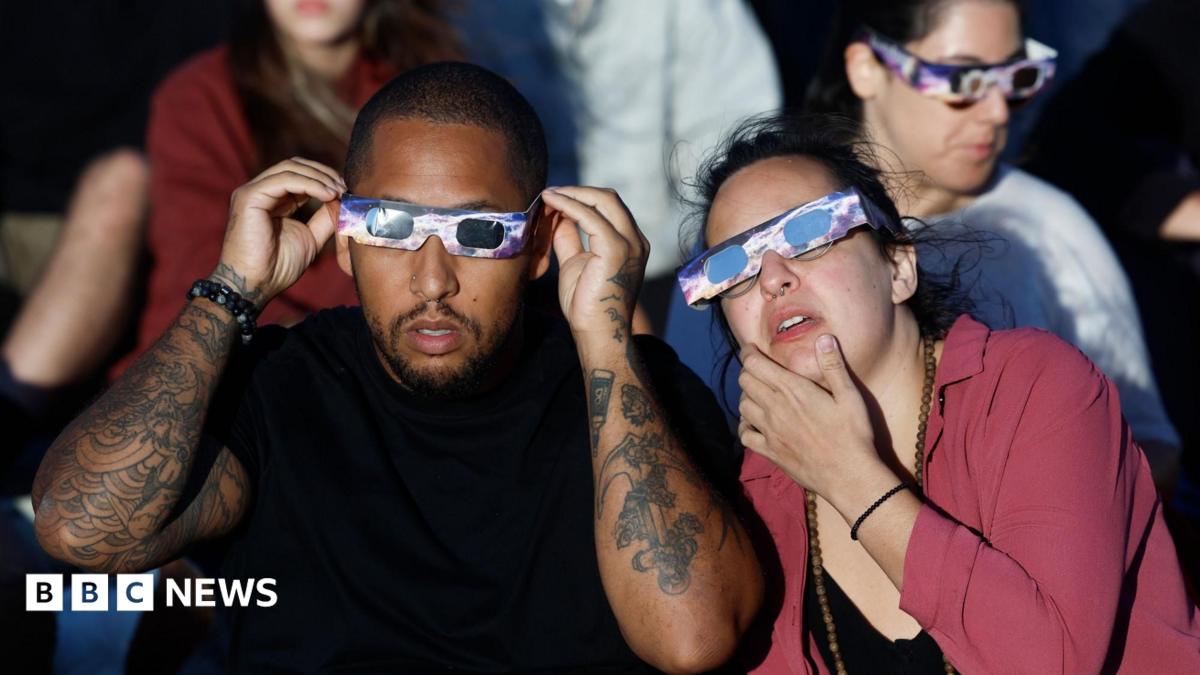
Eye experts are telling anyone who just spent Wednesday's eclipse staring directly at the sun to maybe, just maybe, get their peepers checked. Symptoms of solar self-sabotage include blurred vision, a central blind or dark spot, and an increased sensitivity to light - basically, your eyes filing a formal complaint.
History suggests this isn't a niche concern: after the UK's last total solar eclipse in 1999, around 70 people were left with damaged sight, many after less than a minute of unprotected ogling. The sun, it turns out, is incredibly bright - even when the moon is doing its best impression of a celestial bouncer. Normally, we wince and look away, but during an eclipse, that survival instinct apparently clocks out, leaving our retinas to fend for themselves.
The damage occurs when staring at the eclipse without protection harms the retina, particularly the cells responsible for sharp central vision. The sun's bright light and ultraviolet radiation can cause 'solar retinopathy,' and because the retina has no pain receptors, you won't feel a thing - until hours later, when a grey, yellow, or dark spot parks itself dead-center in your vision. Alexander Ionides, a consultant eye surgeon at Moorfields Eye Hospital in London, describes it as a distortion in whatever you're looking at, whether it's a face, a page, or the clock on the wall. It doesn't hurt, he notes, which is probably why people keep doing this.
If you suspect you've damaged your eyes, Ionides advises seeking urgent medical attention. In the UK, local opticians are well-equipped to perform retinal scans for solar retinopathy and can refer you to eye units or eye casualties. Most hospitals have an eye doctor on call, so there's really no excuse for squinting through life.
As of the morning after, it's too early to tell how many people have actually damaged their eyes, since symptoms take time to develop. But Ionides reports that far fewer people have contacted his hospital compared to 1999, when the switchboard and casualty were 'inundated.' The partial eclipse the UK experienced meant the sun was still pretty bright, so perhaps fewer people tried to stare it down. Or, as Ionides optimistically suggests, 'the message is getting out there' that looking directly at the sun is bad. Either way, if you're suddenly seeing spots, you know who to call.
The Good Times
News in your inbox.
One sardonic roundup, delivered on your schedule. Free. Unsubscribe whenever your tolerance for wit runs out.
Already subscribed but we never reach your inbox? Check your spam folder and hit 'Not spam' (or 'Remove from spam') to bust us out of junk-mail purgatory. You'll be helping everyone else too.
Don't open any of our emails for a month and you'll be automatically removed from the mailing list.
Rewrite Article
Select parts to regenerate with a fresh AI pass. Translations will be updated automatically.
Generate AI Image
Creates a sardonic version of the article image using OpenAI.