Ashoka Shivareddy comes from a family of farmers who, like many in India's drought-prone Kolar district, spent most of their money chasing water down 1,300-foot borewells. It didn't work. They gave up farming in 2005, moved to Bengaluru, opened a vegetable shop, and Shivareddy became an AI software engineer. But the farming bug, as it turns out, is harder to kill than a custard apple tree in a drought.
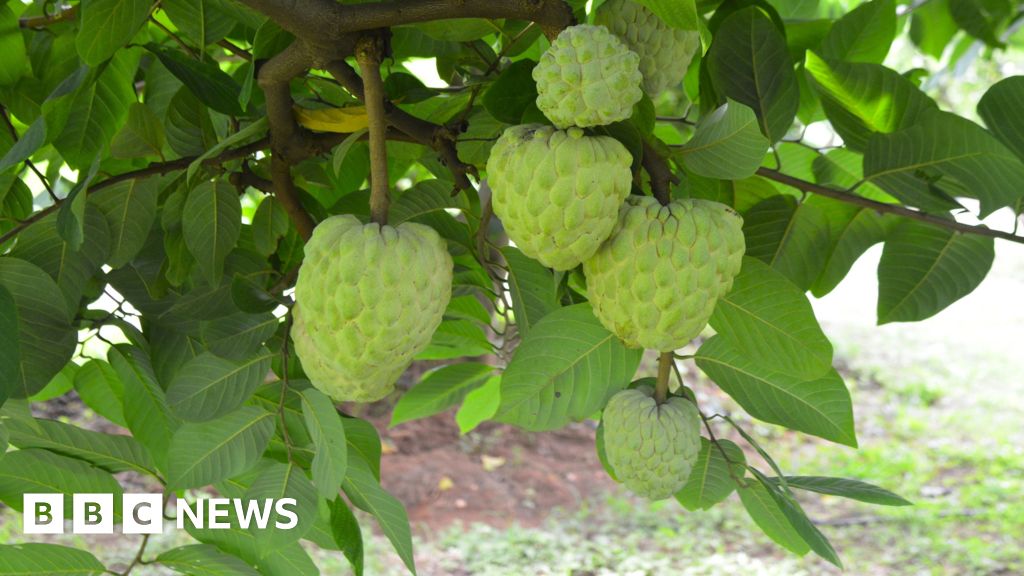
In 2018, he revived the family farm with a scientific approach, looking for a crop that could survive on rainfall alone, need little water, and laugh in the face of pesticides. Enter the custard apple: a knobbly fruit the size of a large avocado whose creamy, sweet flesh tastes vaguely like custard because nature has a sense of humor. The trees grow wild in his area, and locals already sold them at market. Shivareddy just planted them closer together and chose three varieties with different superpowers. Last year, he produced 20 tonnes; this year, 25. Demand, he says, is "huge" both in India and abroad.
But custard apples have issues. The traditional Balangar variety has a shelf life of three to four days - roughly the lifespan of a mayfly with a cold - and more seeds than a pomegranate's angry cousin. "Traditional varieties have excellent flavour, but they suffer from low pulp content, high seed count, and a very poor shelf life," says Dr Sakthivel T, principal scientist at the Indian Institute of Horticulture Research (IIHR) in Bangalore. His team developed a hybrid called Arka Sahan, which lasts a week at room temperature and has fewer seeds and more pulp. Over 20 years, it has spread across southern India. "The shift from 30% pulp recovery in wild varieties to 70% recovery in hybrids like Arka Sahan has effectively doubled the usable harvest for farmers without needing more land," Sakthivel says. His team is now working on keeping the pulp from turning brown faster than a banana in a sauna, experimenting with equipment to maintain its milky colour longer.
Maharashtra leads India in custard apple production, accounting for nearly a third of national output. There, Navnath Malhari Kaspate has been farming the fruit for decades, traveling across India to collect seeds and cross-pollinating them on his farm. "No one had really paid attention to custard apple or done research, so I decided to keep working on it. It takes 12 to 15 years to develop a new variety. This is not quick work - it's decades of experimentation," he says. His NMK-01 variety, named after his initials, went on sale in 2014 and is known for high yields: about 10 tonnes per acre on 50 acres. "This improved variety which does not get spoiled has created opportunity for exports. We started exporting to Gulf countries, and even sent it to Europe, something that hadn't been done before at this scale," he says. He's now working on a variety with better looks and disease resistance.
Exporting custard apples requires military precision. Manoj Kumar Barai, who exports the NMK-01 variety to the US, UAE, Saudi Arabia, and Europe, says: "We have to plan everything precisely - harvesting time, transport to pack houses, airport transfer, flights, customs clearance - every hour matters." The fruit is sensitive to heat, so road journeys happen at night. In Maharashtra, where temperatures hit 40°C, even transit can reach 30 - 35°C, which is not ideal. The fruit is pre-cooled for five hours, packed in special corrugated boxes, transported in refrigerated vans, stored in cold rooms, then air-freighted. Increasingly, it's exported as pulp or powder - a "revolution" for the industry, says Barai. Pulp goes to ice cream makers, bakeries, and "pulp-shot" cafes, though it must be stored at -18°C. Still, that's cheaper than air freight and allows large volumes to travel for weeks without waste.
Back in Kolar, Shivareddy wants to expand by selling pulp alongside whole fruit, setting up a processing unit for his unsold crop. But chilling pulp to -20°C requires equipment investment that demands a mindset shift. "Custard apple sits in a strange gap. Demand is rising, but the farming hasn't gone high-tech as the crop is naturally hardy. It grows in poor soil, needs very little water, and survives on rainfall. Farmers don't need expensive irrigation, sensors, or controlled environments so tech adoption stays low," he says. In other words, the fruit is so low-maintenance it's accidentally holding back agricultural innovation.
The Good Times
News in your inbox.
One sardonic roundup, delivered on your schedule. Free. Unsubscribe whenever your tolerance for wit runs out.
Already subscribed but we never reach your inbox? Check your spam folder and hit 'Not spam' (or 'Remove from spam') to bust us out of junk-mail purgatory. You'll be helping everyone else too.
Don't open any of our emails for a month and you'll be automatically removed from the mailing list.
Rewrite Article
Select parts to regenerate with a fresh AI pass. Translations will be updated automatically.
Generate AI Image
Creates a sardonic version of the article image using OpenAI.