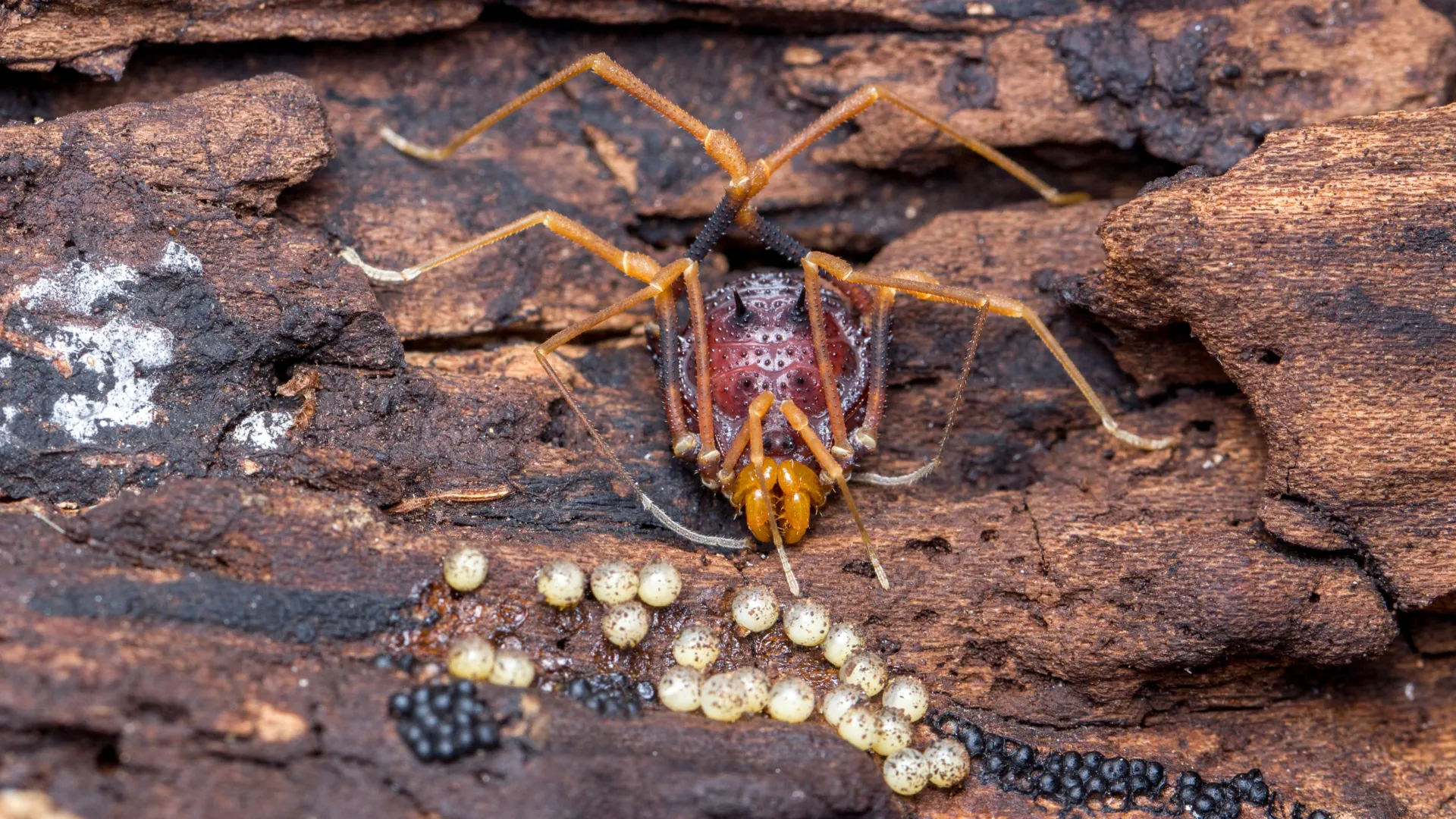
Citizen Scientists Help Reveal That Harvestmen Are Surprisingly Complicated Dads
Citizen scientists on iNaturalist helped researchers discover that harvestmen have evolved paternal care multiple times, making them the arachnid world's most interesting dads.
In news that will surprise exactly no one who has spent time on iNaturalist, citizen scientists have once again proven useful - this time by helping researchers figure out how parental care evolved in harvestmen, those spindly arachnids that look like spiders but aren't. The findings, published in the Zoological Journal of the Linnean Society, show that parental guarding behavior in these creatures has appeared, disappeared, and reappeared multiple times over their evolutionary history, like a bad sitcom plotline.
By combining nearly 30 years of field research with observations from iNaturalist, an international team led by a University of São Paulo scientist more than doubled the known examples of parental care in harvestmen. The expanded dataset allowed researchers to reconstruct, for the first time, how both maternal and paternal care evolved within the superfamily Gonyleptoidea. Because when you're studying daddy longlegs, you might as well aim high.
The analysis revealed that maternal care evolved only from species that showed no parental care, which matches patterns seen in insects. Paternal care, however, took two different evolutionary routes: it arose either directly from species with no parental care, or from species where females already guarded the eggs. The researchers suggest that when paternal care evolved from maternal care, it likely reflects a form of sexual selection called 'enhanced fecundity' - basically, females dig guys who are already doing the childcare.
Harvestmen are ideal for studying fatherhood because, although they make up only about 0.6% of all arthropod diversity, they account for more than half of the independently evolved examples of paternal care known among arthropods. That's right: these leggy weirdos are the deadbeat dads of the arachnid world, except when they're not.
From 1936 through 2025, published studies documented parental guarding in only 80 harvestman species. Using iNaturalist, the researchers more than doubled that total, including 62 new records contributed through the platform alone. The iNaturalist search itself took only two days. Compare that to the decades of museum visits and fieldwork it would have required otherwise, and you start to understand why scientists are so keen on crowdsourcing.
According to lead researcher Machado, iNaturalist's greatest strength is not just the number of observations but their accessibility. "I would never be able to do this by visiting museums around the world. It would be very expensive, very time consuming, but here we conducted the search in only one week." By cutting costs, citizen science platforms are making large-scale biological research more accessible, especially for scientists in the Global South.
Despite the enthusiasm, the researchers caution that expert taxonomists are still essential. Identifying species correctly, determining the sex of caregiving individuals, and distinguishing true parental care from mate guarding all require specialized expertise. As Machado put it, "We cannot preserve a species that doesn't have a name. And names are provided by taxonomists. So, it's very important." In other words: don't quit your day job, bug namers.
The study has limitations, including sampling bias - animals actively guarding eggs are much easier to spot than those that don't. But the authors argue that studies like this help close major gaps in understanding which species exhibit parental care. Because more than half of the records analyzed were newly documented, Machado believes citizen science will continue to play a big role in studies of parental behavior across many animal groups. So next time you snap a photo of a harvestman standing over its eggs, remember: you're not just procrastinating - you're doing science.
The Good Times
News in your inbox.
One sardonic roundup, delivered on your schedule. Free. Unsubscribe whenever your tolerance for wit runs out.
Already subscribed but we never reach your inbox? Check your spam folder and hit 'Not spam' (or 'Remove from spam') to bust us out of junk-mail purgatory. You'll be helping everyone else too.
Don't open any of our emails for a month and you'll be automatically removed from the mailing list.
Rewrite Article
Select parts to regenerate with a fresh AI pass. Translations will be updated automatically.
Generate AI Image
Creates a sardonic version of the article image using OpenAI.