China Catches Its First Reusable Rocket, Because Apparently Catching Falling Things Is a National Sport Now
China catches its first reusable rocket in a net over the sea, because apparently landing on legs is so last decade - and also because they want to catch up to SpaceX before the space race gets any more awkward.
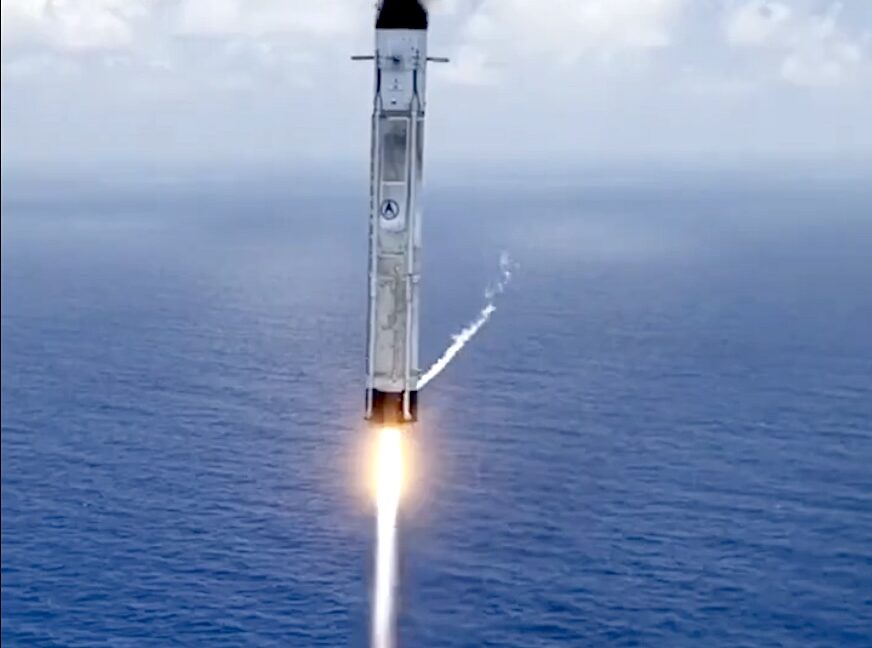
China's state-owned rocket developer, the China Aerospace Science and Technology Corporation (CASC), announced it successfully recovered a reusable orbital-class booster for the first time on Friday, snagging it in a net over the South China Sea. The Long March 10B rocket lifted off from the Wenchang Commercial Space Launch Site on Hainan Island at 12:15 am EDT (04:15 UTC), powered by seven kerosene-fueled engines. About 10 minutes later, the booster descended from space and guided itself into a four-legged frame with tensioned cables on an offshore vessel, leaving it hanging in midair like a very expensive piñata. The upper stage continued into orbit and deployed a payload known only as CX-26 - because what's a space mission without a little mystery? Chinese officials hailed the flight as a "complete success."
This makes CASC and its subsidiary, the China Academy of Launch Vehicle Technology (CALT), the third enterprise to pull off a controlled rocket recovery, following SpaceX's Falcon 9 in 2015 and Starship/Super Heavy in 2024, and Blue Origin's New Glenn last November. But China had to do it differently, because apparently copying homework is frowned upon even in rocketry. Instead of propulsive landings on legs, the Long March 10B uses a net-catching system on a downrange ship, somewhat like SpaceX's Starship catch but with more fishing vibes. This approach reduces the effect of reuse on payload capacity - no heavy landing legs needed, and less fuel wasted on descent.
Friday's launch was the first flight of the Long March 10B, a medium-lift rocket with a payload capacity of about 16 metric tons to low-Earth orbit, slightly less than SpaceX's Falcon 9. It has two stages: seven YF-100K engines on the booster (kerosene and liquid oxygen) and a single methane-fueled YF-219 engine on the second stage. CASC said the test flight "validated key core technologies" for reusable launch, including multiple engine restarts, high-precision navigation, and the first net-based capture on a sea platform. They plan to complete the first stage reuse flight test by the end of this year.
The Long March 10B is similar to the Long March 10A, which is waiting for its first full-scale test flight and is designed for crew launches to China's Tiangong space station using the new Mengzhou spaceship. A heavier configuration, the Long March 10, will combine three reusable first-stage boosters to send astronauts to the Moon by 2030. Friday's launch was a small step toward that goal - because you have to crawl before you can moonwalk.
China is the world's second-largest spacefaring nation, but US companies, led by SpaceX, launch about twice as often. US military officials have noted China's reusable rocket advancements as key to potentially threatening US assets in space. "I'm concerned about when the Chinese figure out how to do reusable lift that allows them to put more capability on orbit at a quicker cadence," said Maj. Gen. Brian Sidari. SpaceX's rapid launch cadence has deployed over 12,000 Starlink satellites and spawned military spinoffs like Starshield and spy satellite constellations. China is still in the early stages of its own Starlink-like projects, but mastering rocket reuse would accelerate its ability to close the gap.
"Clearly, they admire the work done by SpaceX and are trying to replicate it," said retired US Space Force Col. Charles Galbreath. "But it's the capability being launched that could have a significant impact on our competition, and if it came to it, a conflict." Multiple Chinese rocket companies are also pursuing reusability: LandSpace's Zhuque-3 crashed in December, and the Long March 12A lost control on descent. The next Zhuque-3 flight could happen soon, and other rockets like Tianlong-3, Kinetica-2, Hyperbola-3, and Pallas-1 are in the pipeline. China also plans a Starship-scale Long March 9.
Meanwhile, US companies like SpaceX, Blue Origin, Rocket Lab, Relativity Space, Firefly Aerospace, and Stoke Space are developing reusable rockets, as are European, Indian, Japanese, and Russian firms - with varying degrees of realism. With four land-based spaceports and multiple ocean platforms, China is poised to ramp up launch cadence. "It probably won't be but a few years before they achieve a much higher launch cadence," Galbreath said. "There's nothing wrong with competition as long as it's peaceful. But we have to look at everything they do carefully."
The Good Times
News in your inbox.
One sardonic roundup, delivered on your schedule. Free. Unsubscribe whenever your tolerance for wit runs out.
Already subscribed but we never reach your inbox? Check your spam folder and hit 'Not spam' (or 'Remove from spam') to bust us out of junk-mail purgatory. You'll be helping everyone else too.
Don't open any of our emails for a month and you'll be automatically removed from the mailing list.
Rewrite Article
Select parts to regenerate with a fresh AI pass. Translations will be updated automatically.
Generate AI Image
Creates a sardonic version of the article image using OpenAI.