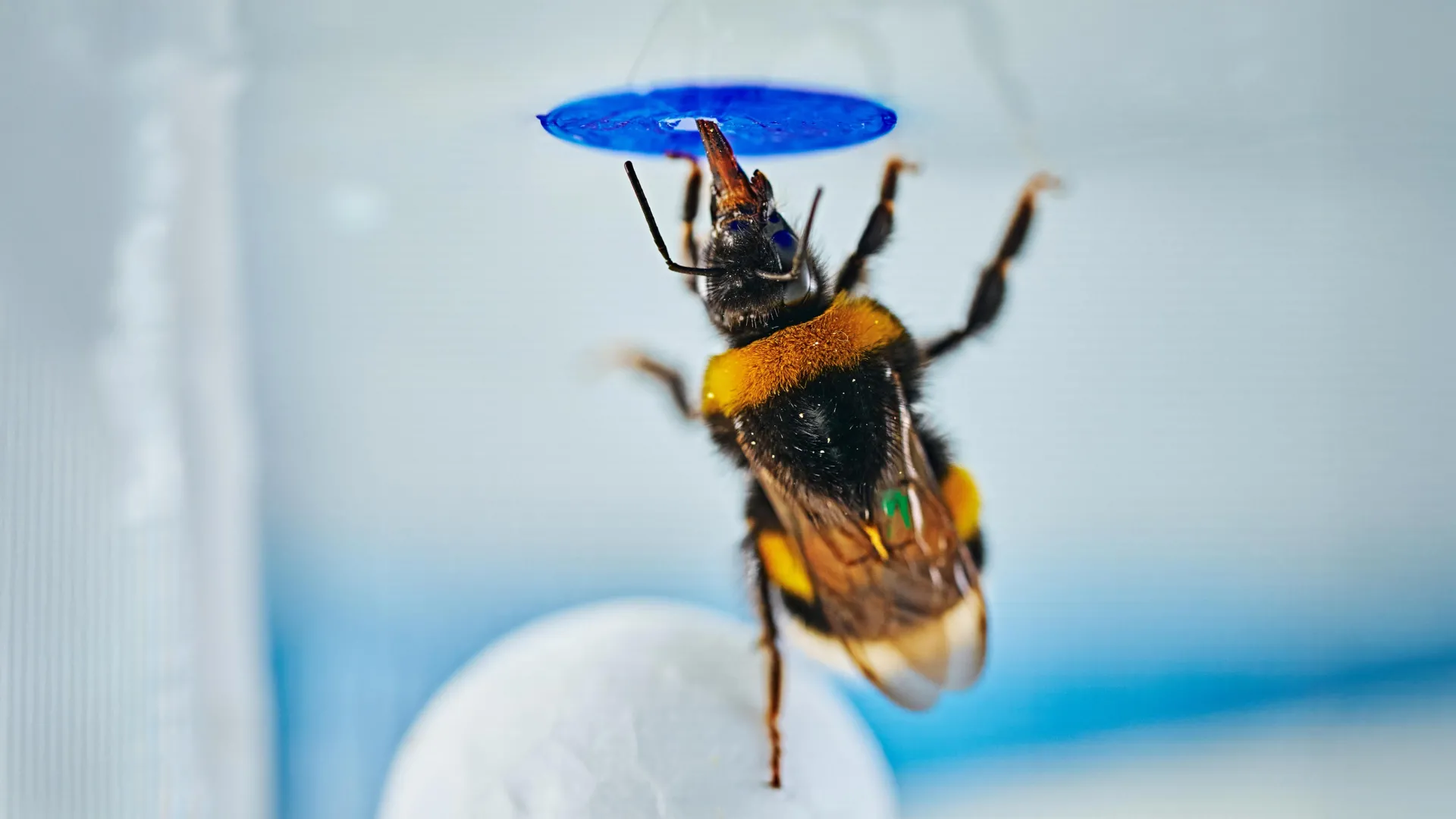
Bumble bees spontaneously roll balls to reach rewards, proving that small brains can solve big problems - and that scientists may need to update their VIP list.
Bumble bees have pulled off a trick that scientists thought required a brain the size of a chimp's - or at least a brain larger than a poppy seed. In a new study, the insects solved an unfamiliar object manipulation task without any training, challenging the long-held belief that spontaneous problem-solving is a VIP club reserved for humans and other large-brained vertebrates.
More than a century ago, psychologist Wolfgang Köhler showed that chimpanzees could suddenly solve problems by combining objects in new ways, like stacking boxes to reach a banana. Now, researchers from the University of Oulu, the University of Helsinki, and the University of Turku have found that bumble bees (Bombus terrestris) can do the insect equivalent: rolling a small ball beneath a blue artificial flower to reach a reward. The study, published in Science, tested bees with a problem they'd never encountered - a blue flower moved to the ceiling of a transparent arena, beyond their reach. Successful bees rolled a ball beneath the flower and climbed onto it, a sequence they'd never been trained to perform.
"This is essentially an insect version of the classic 'box-and-banana' problem," says senior author Olli Loukola, Docent at the University of Oulu. "What stands out is that this kind of spontaneous problem-solving is now demonstrated in an insect." The bees had learned only two separate things beforehand: that the blue flower provided a reward and that the ball was a movable, harmless object. When faced with the challenge, many combined those experiences in a way that went beyond anything they had learned. Control experiments ruled out simpler explanations like accidental success, play behavior, trial-and-error learning, or direct visual guidance. In some tests, the flower was hidden from view while bees moved the ball, yet many still rolled it to the correct location.
"One moment the animal is exploring seemingly without direction, and the next it performs a highly efficient sequence of actions leading directly to the solution," says co-author Ece Nur Akmeşe from the University of Helsinki. The findings add to evidence that bees possess sophisticated cognitive abilities despite tiny brains. However, the researchers stress this doesn't mean bees think like humans. "Our findings show that miniature brains can generate flexible solutions to novel problems in ways we are only beginning to understand," says Loukola. For over a century, spontaneous object-based problem-solving has been studied mostly in vertebrates; this study suggests insects may belong in that conversation too.
The Good Times
News in your inbox.
One sardonic roundup, delivered on your schedule. Free. Unsubscribe whenever your tolerance for wit runs out.
Already subscribed but we never reach your inbox? Check your spam folder and hit 'Not spam' (or 'Remove from spam') to bust us out of junk-mail purgatory. You'll be helping everyone else too.
Don't open any of our emails for a month and you'll be automatically removed from the mailing list.
Rewrite Article
Select parts to regenerate with a fresh AI pass. Translations will be updated automatically.
Generate AI Image
Creates a sardonic version of the article image using OpenAI.