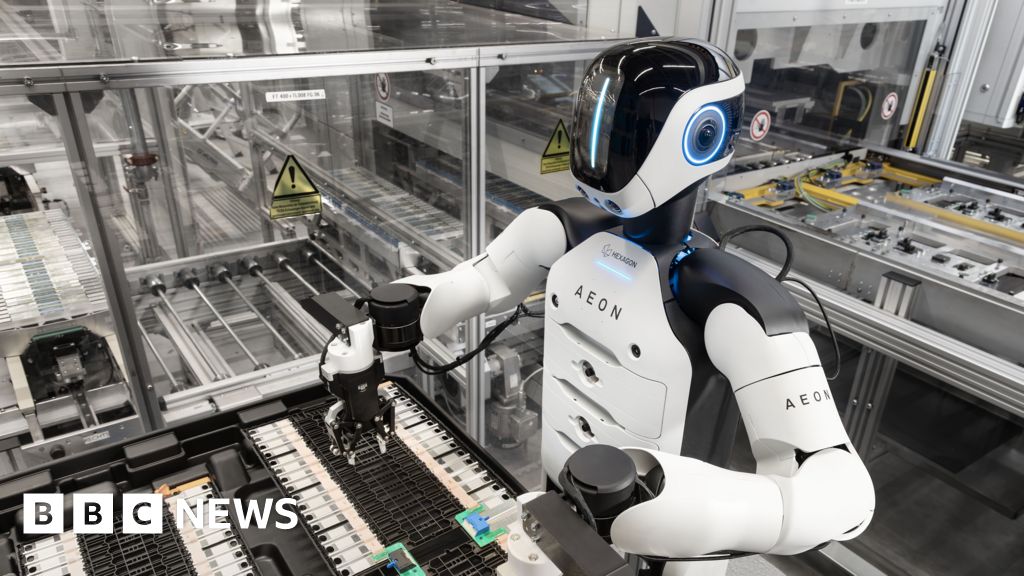
BMW has announced it will deploy humanoid robots in its European car manufacturing plants for the first time, apparently having run out of things that regular robots couldn't do with slightly less existential dread. Two robots from Hexagon Robotics, named Aeon, are scheduled to begin work at the Leipzig factory this summer, currently undergoing a test deployment that probably involves a lot of standing around looking vaguely human.
"This will be the future of automotive production," declared Michael Nikolaides, BMW's head of process management and digitalisation, with the kind of confidence usually reserved for people who haven't yet seen the robots try to assemble a cupholder. While carmakers have used robot arms and automation for decades, the new humanoid form factor allows them to fit into existing human workspaces without the expense of redesigning the entire assembly line. As Bill Ray, distinguished VP analyst at Gartner, put it: "When a robot costs 17 million, you'd re-organise your factory around the robot, but it doesn't anymore. So now you want to fit it into your existing way of working."
The Aeon robot stands 1.65m tall, weighs 60kg, and moves at a top speed of 2.4m/second - roughly the pace of a very determined toddler. It can carry 15kg for short periods or 8kg continuously, and is equipped with 21 sensors including cameras, radar, a microphone, and force and torque sensors for manipulation. The robots were trained using a combination of teleoperation (humans wearing sensors) and simulation in a digital twin of the factory running Nvidia software, using reinforcement learning to repeatedly simulate tasks. Arnaud Robert, president of robotics at Hexagon, highlighted imitation learning as a breakthrough: "The best translation [from the human to the robot] is when the teacher and the student have the same form factor." He estimates that within a year or two, robots could simply watch someone packing boxes and join in. Gartner's Ray predicts that within three to five years, a robot will be able to follow simple voice instructions.
Aeon has a battery life of just three hours - less than a single eight-hour shift - but it has been designed to swap its own battery in about three minutes, including travel time. At BMW, the robots will feed parts to manufacturing tools and perform pick-and-place tasks for battery assembly. Nikolaides says they will help with repetitive or physically challenging work and address labour shortages: "We know that staff will be short in a matter of years, and humanised robots help." He dismissed fears of job losses, noting that automation in the '70s actually created new jobs. Other carmakers are also exploring humanoid robotics: Toyota plans to use Digit robots from Agility Robotics, Xiaomi has tested its own humanoids in EV production, and Hyundai is deploying Spot and Atlas robots from Boston Dynamics.
BMW has already tested the Figure O2 robot in Spartanburg, US, where it helped build 30,000 X3 cars at human pace. One key observation: AI-based robots handle variance better than traditional machinery. "If you changed the position of the sheet metal a little bit or you shift it, or you tilt it, with a standardised industry robot, you would have a failure," said Nikolaides. "These humanoid robots can analyse that and they will just keep on working." Unlike Figure, which walks, Aeon uses wheels - which Nikolaides says makes more sense on a shop floor. BMW has also used a Boston Dynamics Spot robot (shaped like a dog) for maintenance, including navigating stairs.
The robots have been welcomed by staff, who are expected to give them names - a psychological trick, according to Gartner's Ray: "If it doesn't have a name, it's a machine. If it gets it wrong, it's broken. If it has a name, then people expect it to make mistakes. People forgive it." Aeon lacks a human face but has a display area showing symbols - a line when working, a circle when listening. "We feel very strongly that Aeon needs to be signalling in a way that's natural to humans," said Robert.
Despite the enthusiasm, Ray warns of overhyping: "The primary use case for a humanoid robot today is to walk on stage and artificially inflate your share price. Robots dancing or whatever: That's not that difficult to do." He adds that seeing a robot walk leads people to assume it can run, climb, and jump - which it cannot. "We're having unrealistic expectations when people deploy these robots." So, yes, the future of car manufacturing is here. It just needs a battery swap every three hours and a good name.
The Good Times
News in your inbox.
One sardonic roundup, delivered on your schedule. Free. Unsubscribe whenever your tolerance for wit runs out.
Already subscribed but we never reach your inbox? Check your spam folder and hit 'Not spam' (or 'Remove from spam') to bust us out of junk-mail purgatory. You'll be helping everyone else too.
Don't open any of our emails for a month and you'll be automatically removed from the mailing list.
Rewrite Article
Select parts to regenerate with a fresh AI pass. Translations will be updated automatically.
Generate AI Image
Creates a sardonic version of the article image using OpenAI.