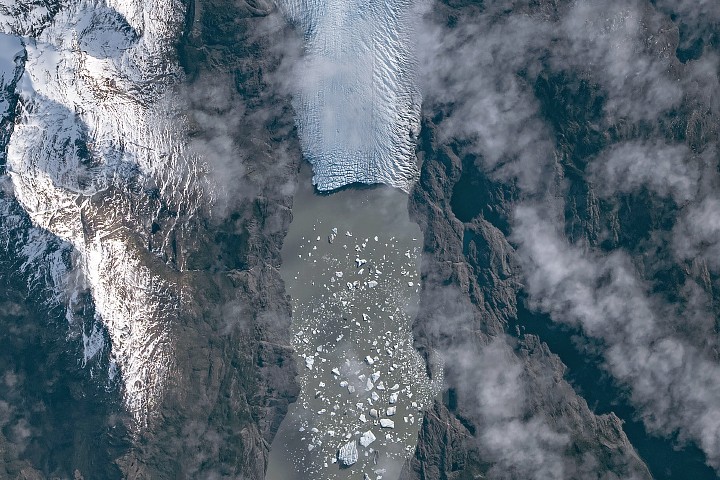
Astronaut Snaps Pic of Chilean Glacier That's Been Having a Rough 150 Years
NASA astronaut photographs Tyndall Glacier in Chile shedding icebergs like bad habits, revealing 150 years of retreat and a lake that didn't exist until 1940.
An astronaut aboard the International Space Station looked down on May 10, 2026, and saw something that wasn't there when their grandparents were kids: a bunch of icebergs floating in Lago Geikie, courtesy of the Tyndall Glacier in southern Chile. The Southern Patagonian Icefield, the largest ice sheet outside Antarctica, feeds dozens of glaciers that grind down the Andes, and Tyndall is one of the ones that's been losing its cool.
Lago Geikie itself didn't even exist until about 1940, when the glacier's retreat created it, according to glaciologist Mauri Pelto of Nichols College. Since then, Tyndall has been shrinking like a wool sweater in a hot dryer - especially since the end of the Little Ice Age 150 years ago. Part of the glacier used to flow into Lago Tyndall to the east, but by 2010, thinning ice had cut off that outlet, exposing bedrock that happens to be packed with ichthyosaur fossils. (Because nothing says 'climate change' like a dead sea monster's bones.)
Since November 2022, Tyndall has lost 2.2 kilometers (1.4 miles) in length, following a decade of modest retreat but considerable thinning. A big calving event in March and April 2023 kicked off the recent acceleration, and satellites watched several large icebergs break away. By austral autumn 2026, calving was still active but more incremental, Pelto said. "The substantial crevasses crisscrossing the glacier near the calving front lead to many smaller icebergs," he noted, while larger tabular bergs prefer thinner ice with fewer deep cracks.
The ice cliff at the terminus casts a handy shadow, letting Pelto estimate its height using the Sun's position in the photo: 30 - 40 meters (100 - 130 feet) above the lake surface. Observations from orbit help scientists monitor remote glaciers where ground-based data is scarce. As for the future, Pelto predicts more small icebergs will keep popping off, given the heavily crevassed front. "Look for a burst of iceberg production next fall," he said.
The photo, ISS074-E-582898, was taken by an Expedition 74 crew member with a Nikon Z9 at 560mm, then cropped and enhanced by NASA's Earth Science and Remote Sensing Unit. Because if a glacier has to go, at least we get a nice picture of it.
The Good Times
News in your inbox.
One sardonic roundup, delivered on your schedule. Free. Unsubscribe whenever your tolerance for wit runs out.
Already subscribed but we never reach your inbox? Check your spam folder and hit 'Not spam' (or 'Remove from spam') to bust us out of junk-mail purgatory. You'll be helping everyone else too.
Don't open any of our emails for a month and you'll be automatically removed from the mailing list.
Rewrite Article
Select parts to regenerate with a fresh AI pass. Translations will be updated automatically.
Generate AI Image
Creates a sardonic version of the article image using OpenAI.