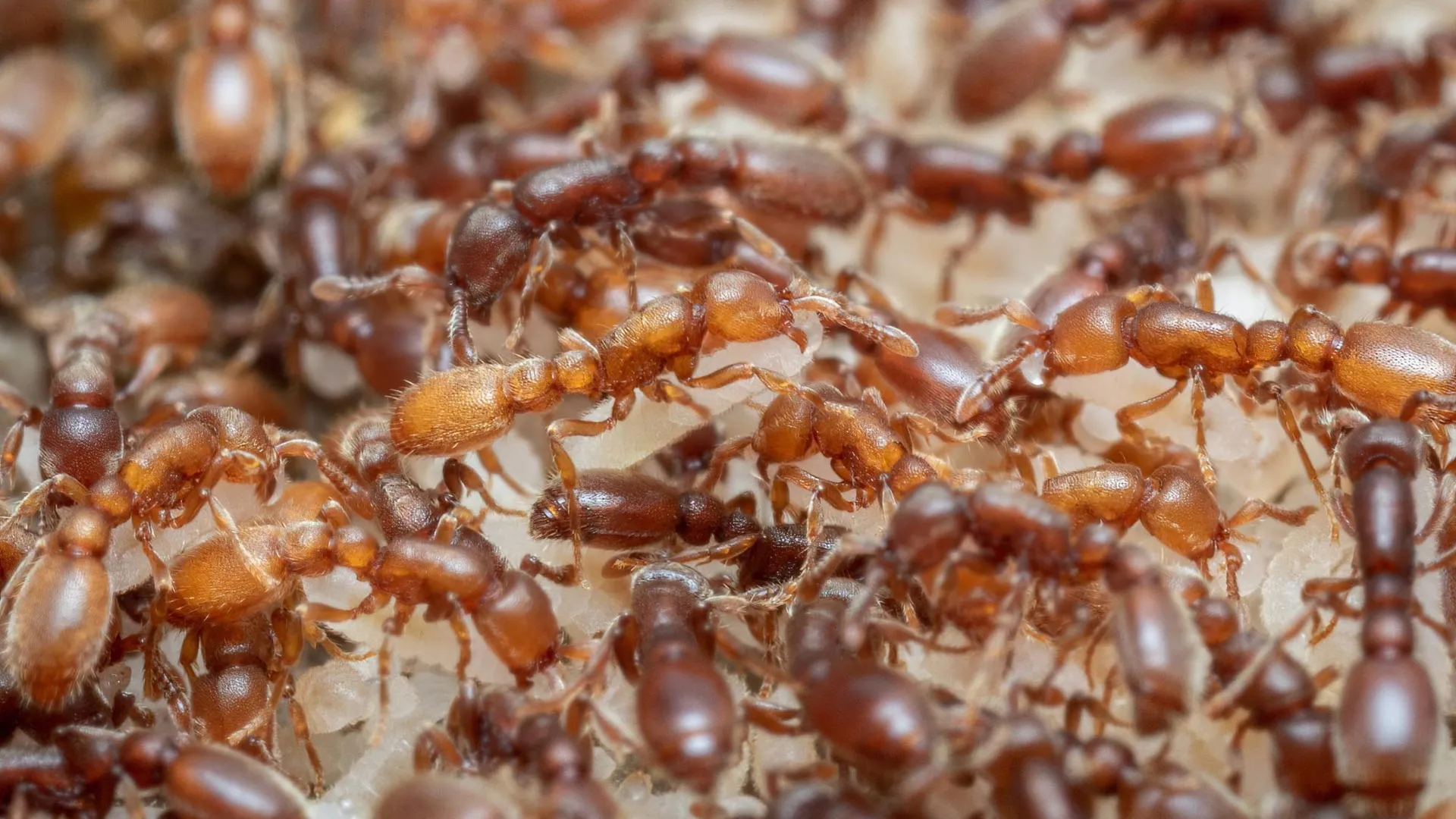
For most of evolutionary history, animals procreated and then promptly ghosted their offspring, leaving them to fend for themselves. But a new study in Nature offers a tantalizing explanation for how some creatures evolved into attentive caregivers: evolution didn't invent new brain systems for parenting - it just repurposed the old hunger circuits. Because nothing says 'I love you' like 'I'm hungry and you look edible.'
Researchers at Rockefeller University, led by Daniel Kronauer, studied clonal raider ants and found that caregiving behaviors are built on ancient neural pathways originally designed for feeding. 'Evolution takes what it has and works with that, sometimes in very surprising ways,' Kronauer said, which is basically the biological equivalent of duct-taping a spoon to a fork and calling it a spork.
The team identified a complete set of 70 neuropeptides in the ant brain, then tested each one's effect on caregiving. Two molecules stood out: Neuropeptide F (NPF) encouraged ants to tend larvae, while Allatostatin A (AstA) made them ditch the nursery for the great outdoors. Young ants had high NPF and low AstA, but as they aged, the balance flipped - explaining why old ants are like, 'I've raised enough larvae, time to go get some snacks.'
Hunger also influenced these signals. Starved ants showed higher NPF and lower AstA, making them behave like dedicated caregivers. Once fed, they lost interest in larvae and focused on foraging. As Kronauer noted, 'Parental behavior is a lot about feeding - not just yourself, but your offspring.' So next time you feed your kid, remember you're just following a deeply ancient neural urge.
This research isn't just about ants. Mammals use similar neuropeptides for caregiving, and since ant brains have only about 60,000 cells (versus 100 million in mice), they're a handy model for studying neural circuits. The team now plans to map the exact circuits affected by NPF and AstA, hoping to uncover a shared biological blueprint for parenting across species.
And there's a bonus: these ants could help us understand healthy brain aging. Because ant behavior changes predictably with age, they offer a natural system to study how neuromodulators influence social roles over time. 'We actually know very little about how the brain changes throughout the normal healthspan of an individual,' Kronauer said. So while we're busy funding research on Alzheimer's, these ants are reminding us that aging is also about some pretty nifty chemical shifts - like deciding you're too old for this larva-tending nonsense.
The Good Times
News in your inbox.
One sardonic roundup, delivered on your schedule. Free. Unsubscribe whenever your tolerance for wit runs out.
Already subscribed but we never reach your inbox? Check your spam folder and hit 'Not spam' (or 'Remove from spam') to bust us out of junk-mail purgatory. You'll be helping everyone else too.
Don't open any of our emails for a month and you'll be automatically removed from the mailing list.
Rewrite Article
Select parts to regenerate with a fresh AI pass. Translations will be updated automatically.
Generate AI Image
Creates a sardonic version of the article image using OpenAI.