Amazon's Satellite Fleet Collecting Dust in Florida While Europe's Rocket Actually Shows Up
Amazon's satellites are ready for orbit, but only Europe's Ariane 6 is showing up - Bezos's New Glenn blew up, and Vulcan is stuck with the same engine.
Amazon has hundreds of flight-ready satellites sitting idle in a Florida payload processing facility, waiting for rides to orbit, an Amazon official said Tuesday. Steve Metayer, vice president of Amazon Leo Production Operations, told reporters that the satellites are built and ready, and the company is currently manufacturing several a day.
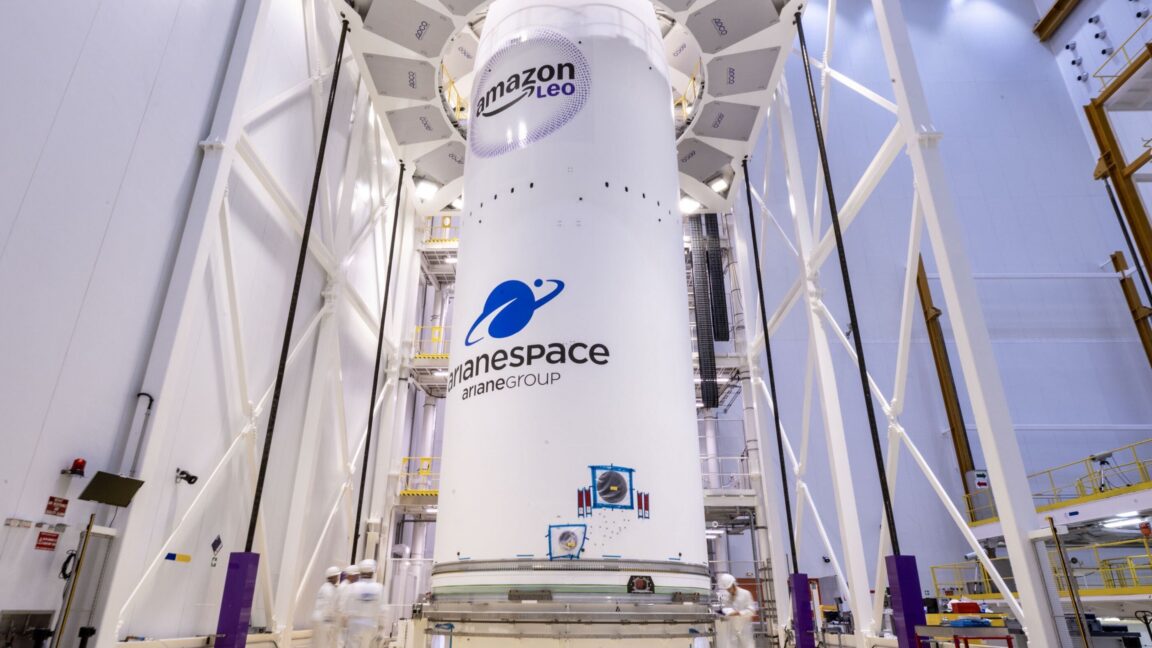
On Wednesday, an Ariane 64 rocket will launch three dozen Amazon Leo satellites from French Guiana at 7:53 am ET (11:53 UTC). France-based Arianespace has emerged as a critical partner for Amazon, which has launched the majority of its 331 satellites on Atlas V rockets - but that rocket is being retired, and Amazon has just one more mission booked on it.
Four years ago, Amazon booked rides on three large, new rockets: 18 launches on the Ariane 6, 12 launches on Blue Origin's New Glenn (with options for 15 more), and 38 launches on ULA's Vulcan. So far, only Arianespace has delivered, with two launches this year, another Wednesday, and more to come. Neither New Glenn (owned by Amazon founder Jeff Bezos) nor Vulcan have launched Amazon satellites yet.
“As for Arianespace, they have definitely stepped up,” Metayer said. “They’re very reliable on their manifest dates, and they’re very reliable and safe on their insertions into orbit. So we definitely would continue to look forward to the next 16 launches with them on our existing contract, and we see them being a player long-term beyond that.”
Amazon originally planned high flight cadence by mid-2020s, but only about 10 percent of its planned 3,236 satellite constellation has been deployed. The company recently suffered another setback when the New Glenn rocket exploded during a test firing at its Florida launch pad in late May, destroying the rocket and severely damaging the only launch pad for New Glenn. Bezos says New Glenn will return to flight this year, but independent observers expect 12 to 18 months to restore Launch Complex 36A.
Multiple sources say the BE-4 rocket engine that powers both New Glenn and Vulcan's first stage may be the culprit behind the explosion, complicating both rockets' return to flight. Metayer said the first Vulcan launch carrying Amazon Leo satellites could still occur in the “late” third quarter of this year.
Asked about the New Glenn accident's impact, Metayer noted that rocket accounts for less than one quarter of all launches Amazon has booked. (True, but New Glenn is expected to carry at least 50 satellites per flight, versus Ariane's 36.) “We have quite a few other launches we’ve secured across all the multiple vehicles,” Metayer said. “We definitely want to see New Glenn come to service, but they’re not the only provider. We have a very diversified launch portfolio, intentionally.”
Metayer said Amazon remains “on track” to begin commercial service with the Amazon Leo constellation later this year.
The Good Times
News in your inbox.
One sardonic roundup, delivered on your schedule. Free. Unsubscribe whenever your tolerance for wit runs out.
Already subscribed but we never reach your inbox? Check your spam folder and hit 'Not spam' (or 'Remove from spam') to bust us out of junk-mail purgatory. You'll be helping everyone else too.
Don't open any of our emails for a month and you'll be automatically removed from the mailing list.
Rewrite Article
Select parts to regenerate with a fresh AI pass. Translations will be updated automatically.
Generate AI Image
Creates a sardonic version of the article image using OpenAI.