Afghan Fathers Forced to Sell Children to Survive, Because Apparently That's a Choice Anyone Should Have to Make
Afghan fathers sell their children to survive as aid cuts, drought, and Taliban policies push millions to the brink of famine - because apparently, choosing which child starves is a normal Tuesday.
In a dusty square in Chaghcharan, capital of Afghanistan's Ghor province, hundreds of men gather at dawn each day, hoping someone will offer them work. The odds are not in their favor. Juma Khan, 45, has found just three days of work in the past six weeks, earning between 150 and 200 Afghanis ($2.35-$3.13; £1.76-£2.34) per day. "My children went to bed hungry three nights in a row. My wife was crying, so were my children. So I begged a neighbor for some money to buy flour," he says. "I live in fear that my children will die of hunger."
According to the United Nations, three in four people in Afghanistan cannot meet their basic needs. The country faces record hunger, with 4.7 million people - more than a tenth of the population - estimated to be one step away from famine. Ghor is one of the worst-affected provinces. At a local bakery, stale bread is distributed to the crowd; within seconds, the loaves are torn apart by desperate men. In two hours, only three of the hundreds gathered got hired.
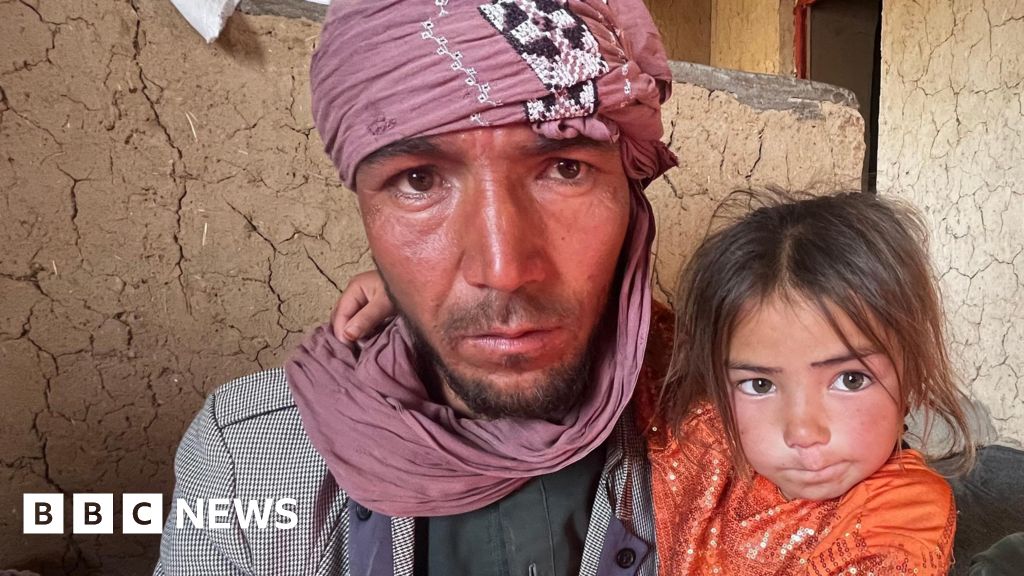
Abdul Rashid Azimi holds his seven-year-old twin daughters, Roqia and Rohila, and explains his unbearable choice: "I'm willing to sell my daughters. I'm poor, in debt and helpless." He says selling one daughter for marriage or domestic work could feed the rest of his children for at least four years. "It breaks my heart, but it's the only way." Saeed Ahmad has already sold his five-year-old daughter, Shaiqa, to a relative for 200,000 Afghanis ($3,200; £2,400) to pay for her appendicitis and liver cyst surgery. She will become the relative's daughter-in-law in five years. "If I had money, I would never have taken this decision," he says. "But then I thought, what if she dies without the surgery?"
Massive cuts in aid have exacerbated the crisis. The US, once the top donor, cut nearly all aid last year; the UK and other donors have also significantly reduced contributions. Current UN figures show aid received so far this year is 70% lower than in 2025. Severe drought has affected more than half of Afghanistan's provinces. The Taliban government blames the previous administration's "artificial economy" created by US dollars during the 20-year invasion, but its own policies - particularly restrictions on women - are a key reason donors have turned away. The Taliban rejects responsibility, saying "humanitarian assistance should not be politicized."
At the main provincial hospital in Chaghcharan, the neonatal unit is the busiest, with every bed full, some with two babies. Most are underweight and struggling to breathe. Nurse Fatima Husseini says days when three babies die have become "almost normal." Dr. Muhammad Mosa Oldat reports a mortality rate as high as 10%. The hospital lacks medicine, and families must buy their own from outside pharmacies. One 14-month-old baby died of hunger and lack of medicine; a local elder says child mortality has "really gone up" in the last two years. In the local graveyard, small graves outnumber big ones roughly two to one - suggesting twice as many children as adults are dying.
Gulbadan's twin granddaughters were born two months premature, one weighing 2kg, the other just 1kg. The heavier baby died before she could be named. The surviving baby was taken home because the family couldn't afford to keep her in hospital. Baby Zameer, suffering from meningitis and pneumonia, was also taken home for the same reason. Their tiny bodies will now have to fight the battle to survive all on their own.
The Good Times
News in your inbox.
One sardonic roundup, delivered on your schedule. Free. Unsubscribe whenever your tolerance for wit runs out.
Already subscribed but we never reach your inbox? Check your spam folder and hit 'Not spam' (or 'Remove from spam') to bust us out of junk-mail purgatory. You'll be helping everyone else too.
Don't open any of our emails for a month and you'll be automatically removed from the mailing list.
Rewrite Article
Select parts to regenerate with a fresh AI pass. Translations will be updated automatically.
Generate AI Image
Creates a sardonic version of the article image using OpenAI.