
YUNLIN COUNTY, Taiwan - At nearly 80 years old, Diane Wilson would have preferred to stay home in her tiny Gulf Coast town in Texas. But as a retired shrimper with a high school education and a habit of not overthinking things, she instead found herself on a dock in Taiwan listening to a gray-haired oysterman named Lin Chun Lan speak in Mandarin.
Wilson and Lin, both lifelong fisherfolk, discovered they shared a reverence for the ocean and a stubborn refusal to abandon its pursuit - which is what drove them both to fight the same multi-billion-dollar company, Formosa Plastics Corp. Both persisted for decades. Both earned the ire of local power structures. “They know that no one can buy him,” a translator told Wilson. “The local politicians hate him.” “He also hates the politicians,” the translator added.
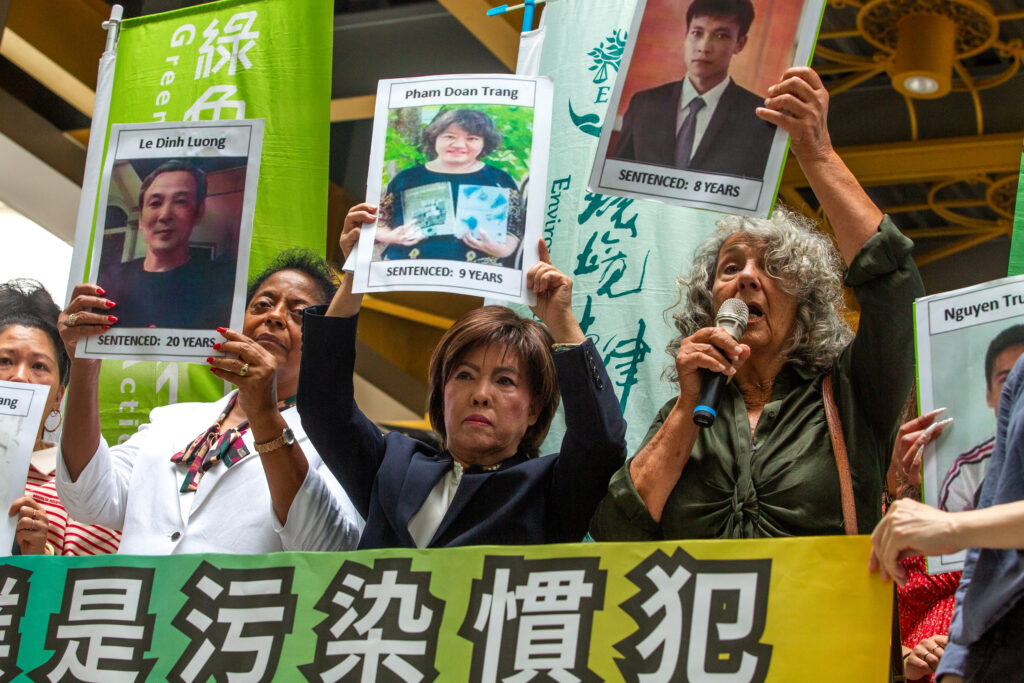
Wilson has spent nearly 40 years as a radical activist, branded an extremist in a political system devoted to economic growth. But she counts plenty of allies outside the system, especially since she won the Goldman Environmental Prize in 2023 for her landmark lawsuit and $50 million settlement agreement with Formosa on the Gulf Coast of Texas. Now she had crossed 13 time zones to confront Formosa’s leadership on its home turf, at its annual shareholder meeting in Taipei, joined by two fellow Goldman Prize winners: Sharon Lavigne, 76, a retired special education teacher from Louisiana’s St. James Parish, and Nancy Bui, 72, a former Vietnamese refugee whose organization is suing Formosa in Taiwanese court over a 2016 disaster in Vietnam.
Wilson didn’t expect to change Formosa’s board or chairman’s minds. That wasn’t the point. She traveled all this way to show Formosa that, even at 78, she isn’t going away - and with Bui and Lavigne beside her, isn’t alone. The Environmental Rights Foundation, a Taiwanese organization, brought the three women here to pressure authorities, speak before Formosa shareholders, and inspire local leaders in their own exhausting struggles against Asia’s largest petrochemical company.
Looking over the remnants of his oyster farm, Lin recounted 30 years of organizing against industrial giants, including Formosa, which once planned to fill this patch of sea with earth to build a steel mill. Very few civic leaders, academics, or environmental groups supported him. If townspeople spoke out, Formosa showered gifts on their friends and family. If that didn’t work, criminal organizations stepped in to intimidate him. “He was threatened with guns,” Lin’s translator said. “He said, ‘If you want to shoot me, just shoot.’” Lin was never shot, but later construction of industrial shipping infrastructure affected water currents, lapping mud into the clear lagoon where he used to farm. Most of the fishermen along this coastline are now gone.
Wilson could relate. Born in 1948, she watched the timeless way of life in her Texas fishing village dwindle as marine life faded and petrochemical industries moved in with higher-paying jobs. For refusing to bow to the new order, she felt shunned at home. She asked Lin if he ever gathered wild oysters from natural reefs like they did in Texas. In his grandmother’s time they did that, he said. He looked at Wilson, whose frizzy grey hair blew over her face in the wind, and asked if she remembered him. Wilson, 78, suspected she did, but her memories were jumbled. This was her fourth time in Taiwan, she told him proudly.
Her first visit was in 1992, invited by local environmental groups who read about her fight against Formosa in Texas and thought she had something to teach them. But the Taiwanese became Wilson’s teacher instead, she said. She attended a secret rally in the mountains at midnight with a local environmental organizer, recently returned from exile and surrounded by volunteer bodyguards to protect him against assassination. She heard stories about village leaders who disappeared after speaking out against Formosa and met a man who spent six years in jail for climbing a chemical plant tower in protest. “That inspired me,” Wilson told Lin. “Ten years later I did it in Texas.” (In 2003, a SWAT team on a construction crane arrested Wilson after she chained herself to the top of a tower at Dow’s Seadrift plant.)
The second time she flew to Taiwan, in 2010, she violated parole shortly after her arrest at the U.S. Capitol for pouring crude oil over herself in protest of BP’s Deepwater Horizon oil spill. In Taipei she infiltrated Formosa’s annual shareholder meeting and shouted about the company’s pollution near her hometown in Texas. Footage broadcast on Taiwanese TV showed guards dragging her out by the arms and legs. On her third visit, in 2018, she infiltrated the meeting again. That time she was allowed to speak, then politely escorted out. Lin nodded in approval as the translator related Wilson’s story. “The company became smarter,” explained the translator, Mark Hsu, deputy CEO of the Environmental Rights Foundation. “They learned if they kick us out it makes big news, so they now just let us talk and ignore us.”
And now, on her fourth visit: Over 12 hours after they arrived in late May, Wilson, Lavigne, and Bui visited poor, aging communities across more than 400 miles, exchanging familiar stories about high cancer rates, chemical pollution, and campaigns of intimidation. “I’m almost 80 years old,” Wilson panted with a grin as she paused in the shade of a mango tree. “I’m gonna get heat stroke.” “There is a solidarity, not just within this village but in many villages all around the world,” said Annie Huang, an organizer with ERF. The foundation sponsors tours like these to provide a small counterbalance, introducing locals to international allies to show they, too, are part of something very large.
Walking together, Huang listened as Wilson recounted the chemicals Formosa has put into coastal waters of Texas and the weak response from state regulators. “Pretty much me,” Wilson replied when asked who was fighting Formosa in Texas. “There’s a lot of intimidation. Formosa is very powerful in our community.” “But people know?” Huang asked, referring to the pollution. “Yeah, most people know. They choose to ignore it,” Wilson said.
The next afternoon, later reported as the hottest May day on record in Taipei, the three women marched into the Presidential Office Building for a closed-door meeting with representatives of Taiwanese lawmakers and banks. Wilson carried a red folder stuffed with papers - the latest updates in her landmark lawsuit and settlement agreement with Formosa. She had filed the suit in 2017 after collecting tons of plastic nurdles illegally discharged by Formosa. Two years later, she won a historic settlement in which Formosa committed to zero discharge of plastic into Texas coastal waters. Yet Formosa has continued to discharge plastic: Since 2020, the company reported 962 wastewater tests, all detecting plastics, incurring $41 million in penalty fees on top of the initial $50 million settlement. The company says it is working hard to reduce plastic discharge but faces technical challenges. In April, Texas regulators did not include the ban on plastics discharge in a proposed renewal of Formosa’s wastewater permits. Wilson’s organization filed official comments May 18, challenging the Texas Commission on Environmental Quality’s decision. A TCEQ spokesperson said a zero-discharge limit “is not required by applicable effluent guidelines or water quality standards.” Wilson also carried a 22-page lawsuit filed against Formosa by the state of Texas in March, alleging chronic air pollution violations with more than 372,000 pounds of unauthorized air pollutants since 2023. Wilson wasn’t sure why Republican Attorney General Ken Paxton was going after Formosa for air pollution, but she thought someone in Taiwan might care.
The other women brought their own stories. Lavigne comes from a part of Louisiana dense with petrochemical industries and toxic emissions, nicknamed Cancer Alley for high cancer rates among the predominantly Black residents. She didn’t think much about it for the first 60 years of her life, raising six kids and working in a local school. Then in 2018, Formosa announced plans to build a 14-plant megacomplex about 2 miles from her home. More than 20 industrial complexes already operated in little St. James Parish, with only 20,000 residents. State politicians gleefully said Formosa’s $9.4 billion, 2,400-acre project would be “transformational.” Lavigne founded Rise St. James to fight it, and in 2022, Formosa canceled the project after years of legal battles, citing economic reasons. But the fight continues: The company still owns the land and hasn’t ruled out building something else there.
Bui, a former Vietnamese refugee who settled in Texas, founded the nonprofit Viet Boat People to help victims of a 2016 Formosa disaster in Vietnam, when the company discharged toxic chemicals that killed massive numbers of fish along the central coast, devastating fishing communities. Her organization is suing Formosa in Taiwanese court. “I want to let the Formosa Plastics know that we are not afraid, we are not going away,” Bui said.
At the Presidential Office Building, the three women sat across from three Taiwanese legislative staffers and two bank representatives. Wilson opened her folder and held up a plastic bottle filled with murky water she said she collected from a drainage ditch on the outskirts of Formosa’s Texas complex. “This is what Formosa is discharging,” Wilson said. She then handed out photos of dead fish and plastic-laden water from Texas. The staffers nodded politely. Wilson wasn’t sure if anything would come of it. But for her, it was about being relentless.
The next day, they arrived at Formosa’s annual shareholders meeting at the Taipei Marriott Hotel. Wilson, Lavigne, and Bui were ushered into a room where about 100 shareholders sat in rows of chairs facing a stage. Wilson stood and addressed the chairman, Jason Wang. “I’m 78 years old, and I’ve been fighting Formosa for 30 years,” she said. “I’m not going away. We have a settlement agreement that says zero discharge of plastics. You are violating that. We have evidence. We want you to stop.” Wang listened, then said the company was working hard to comply. Lavigne spoke next, describing Cancer Alley and the canceled plant. “You may have left Louisiana, but we haven’t forgotten,” she said. Bui then described the 2016 disaster in Vietnam. “My people are still suffering,” she said. “We want justice.” Wang nodded and said the company would look into the issues. The three women were then politely escorted out. As they left, Wilson turned to Lavigne and Bui. “Well,” she said, “we did what we came to do.”