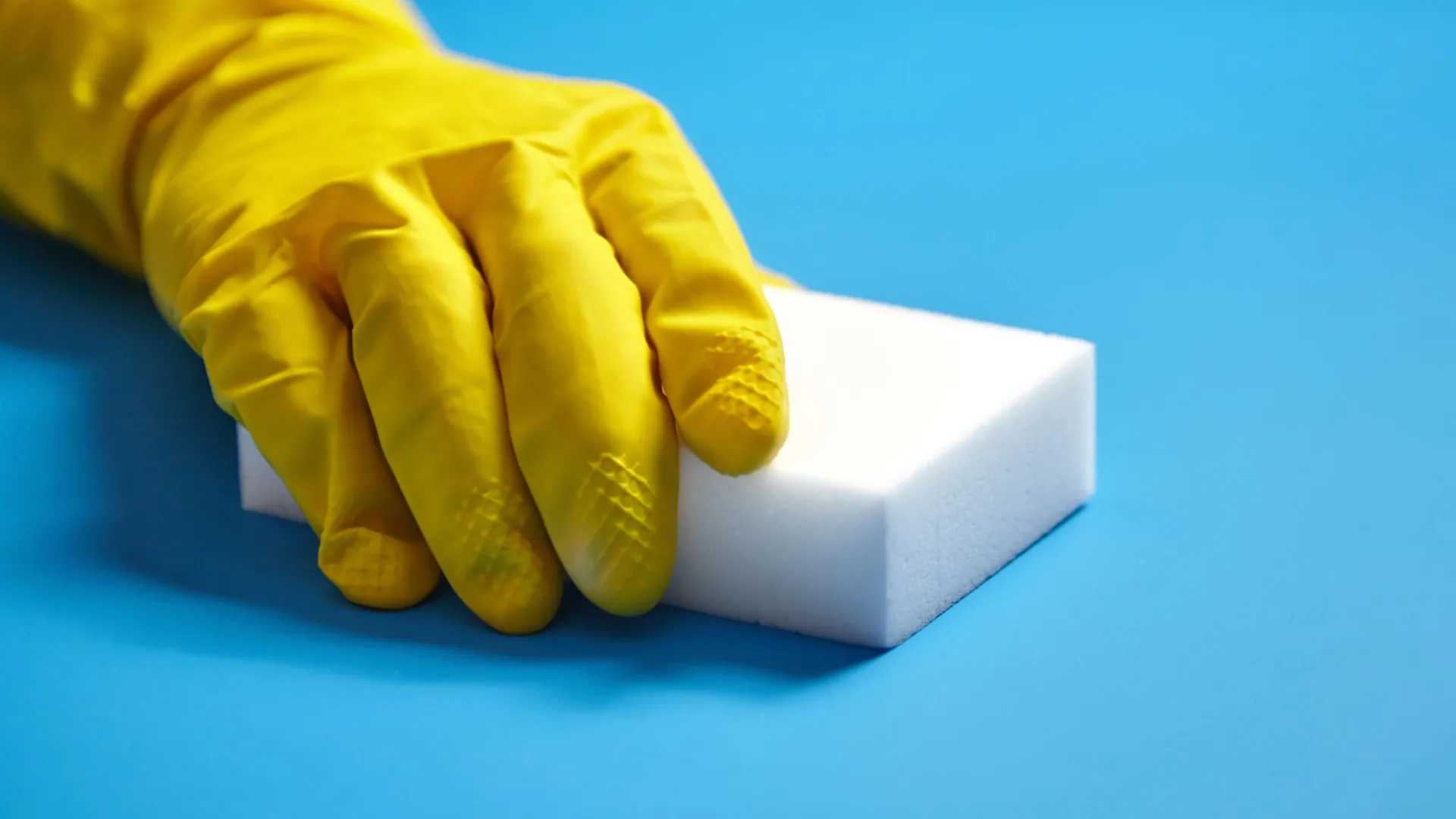
That 'magic eraser' sponge you use to scrub crayon off walls and scuffs off shoes is indeed powerful. Scientists have now confirmed its power extends to launching trillions of tiny plastic particles into the environment, because of course it does.
A study in ACS Environmental Science & Technology suggests melamine sponges are a surprisingly large source of microplastic pollution. Researchers estimate over a trillion microplastic fibers may be released worldwide every month from people using and discarding these everyday cleaners.
Melamine sponges are made from poly(melamine-formaldehyde) polymer, which forms a rigid, web-like structure of plastic strands. It feels soft but acts like extremely fine sandpaper, which is how it physically scrapes away stains without chemicals. The trade-off is that the scraping action also causes the sponge itself to break apart.
As the sponge wears, small foam fragments break down into microplastic fibers - plastic strands often too small to see, defined as particles smaller than 5 millimeters. Once rinsed down the drain, these fibers can enter wastewater systems, potentially pass through treatment plants, and end up in rivers, lakes, or oceans, where they can be ingested by wildlife and move up the food chain.
To quantify the release, researchers Yu Su, Baoshan Xing, Rong Ji, and colleagues tested products from three well-known brands. They simulated real-world use by scrubbing sponges against rough metal surfaces. Results showed denser sponges held up better and released fewer fibers, while less dense versions broke down more quickly.
The team calculated that a single sponge can release about 6.5 million fibers per gram of material lost. Assuming the average sponge wears down by about 10% during use and combining this with sales data, they estimated the global impact. Using Amazon sales from August 2023 as a reference, they calculated approximately 1.55 trillion microplastic fibers could be released each month. Since this is based on just one retailer, the true number is likely much higher.
The findings suggest a few ways to limit the impact. Manufacturers could design denser, more durable sponges to slow wear. Consumers could switch to natural, non-plastic cleaning materials or improve filtration at home or in wastewater systems to capture microplastics.
So, melamine sponges remain highly effective cleaning tools, but their widespread use comes with an environmental cost many haven't considered. What seems like a simple household product is contributing to a much larger global issue. The authors acknowledge funding from the National Natural Science Foundation of China and the Key-Area Research and Development Program of Guangdong Province.
The Good Times
News in your inbox.
One sardonic roundup, delivered on your schedule. Free. Unsubscribe whenever your tolerance for wit runs out.
Already subscribed but we never reach your inbox? Check your spam folder and hit 'Not spam' (or 'Remove from spam') to bust us out of junk-mail purgatory. You'll be helping everyone else too.
Don't open any of our emails for a month and you'll be automatically removed from the mailing list.
Rewrite Article
Select parts to regenerate with a fresh AI pass. Translations will be updated automatically.
Generate AI Image
Creates a sardonic version of the article image using OpenAI.