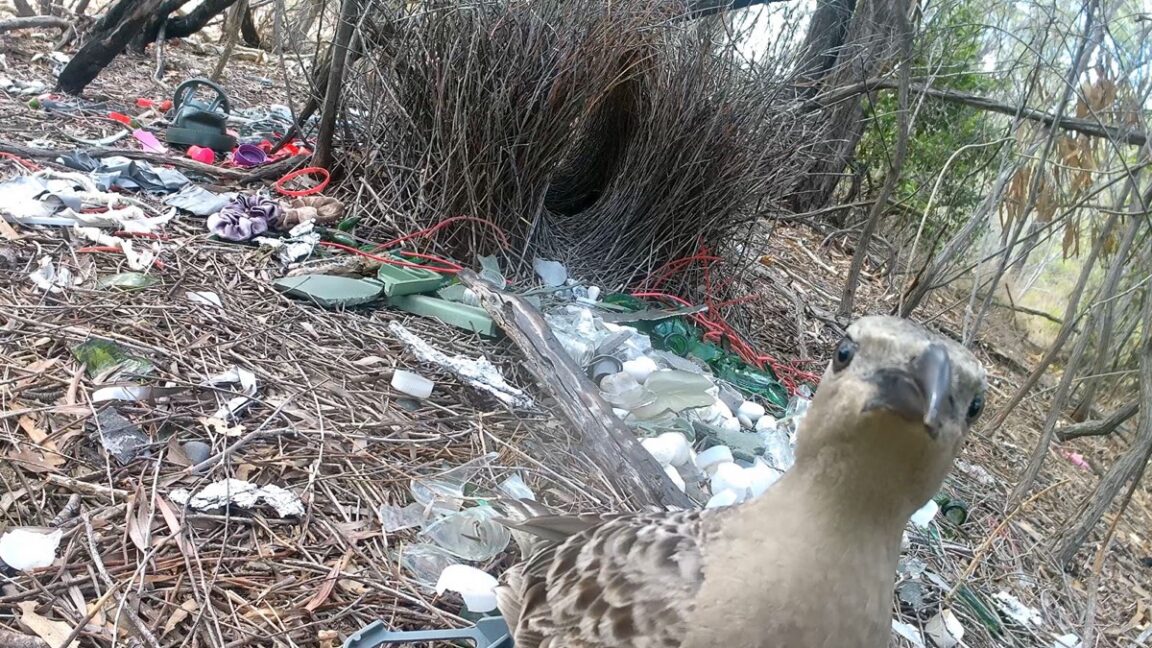
Male bowerbirds have always been the real estate agents of the avian world, building elaborate twig structures and decorating them with whatever shiny junk they can find. But according to a new paper in Royal Society Open Science, urbanization has turned these birds into full-blown interior decorators with a preference for human litter.
University of Exeter researchers monitored 61 male great bowerbirds in rural and urban sites in northern Queensland during the 2023 breeding season. They photographed the bowers in visible and UV light - because bowerbirds see in UV, showing off just how extra they are - then removed all decorations and offered the birds a slush pile of random items. After three days, they checked which decorations had been selected.
Rural bowerbirds preferred green glass and leaves or seeds. Urban birds, however, went for green glass and red wire, plus plastic items including “a pair of handcuffs, medicine jars near a hospital, and fluorescent mouth guards from a site near an Australian Rules football ground,” said co-author Caitlin Evans. Urban bowers had nearly five times as many decorations as rural ones - averaging 90 items compared to 20. One overachiever collected 300 items.
Both urban and rural males showed a strong preference for human-made items when given the choice, suggesting rural birds are just stuck with leaves because the nearest hospital isn't close enough for a handcuff heist. “Our results suggest that display produced by urban males may represent an adaptive change to a more attractive display,” the authors wrote, adding that the easy availability of human junk “may reduce energetic costs and risks associated with leaving the bower unguarded.”
The study didn't measure whether this actually helps urban males get more dates, though prior research suggests higher display and mating rates in cities. Co-author Laura Kelley noted, “We don’t yet know whether this has any negative or positive impact on them, but it’s a reminder of how human activity is changing the natural world in unanticipated ways.” In other words, birds are now accessorizing with our trash, and we're not sure if that's a good thing or just a really weird fashion trend.
The Good Times
News in your inbox.
One sardonic roundup, delivered on your schedule. Free. Unsubscribe whenever your tolerance for wit runs out.
Already subscribed but we never reach your inbox? Check your spam folder and hit 'Not spam' (or 'Remove from spam') to bust us out of junk-mail purgatory. You'll be helping everyone else too.
Don't open any of our emails for a month and you'll be automatically removed from the mailing list.
Rewrite Article
Select parts to regenerate with a fresh AI pass. Translations will be updated automatically.
Generate AI Image
Creates a sardonic version of the article image using OpenAI.