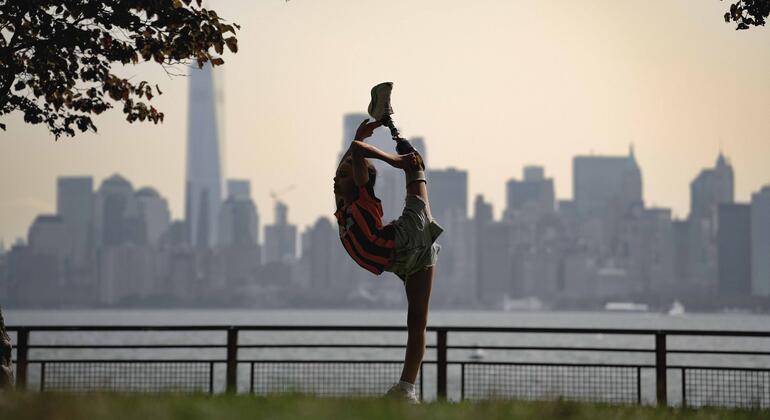
Ten-year-old Ukrainian gymnast Sasha Paskal stepped onto a stage in New York's Times Square this week, carrying a message far bigger than her choreographed routine. After surviving a Russian attack that claimed her leg, Sasha hopes her story will remind the world that Ukraine's children are still living through war.
Before her performance, Sasha and her mother, Maria, visited UN Headquarters, where they spoke about resilience, recovery, and why children need peace. Sasha had been training in rhythmic gymnastics since early childhood when her life changed dramatically in 2022. During the early months of Russia's full-scale invasion, she was seriously injured in an attack in the Odesa region. A collapsing concrete slab crushed the bones in her leg, leaving doctors with no choice but to amputate after she spent 15 days in a medically induced coma.
Following months of rehabilitation, Sasha returned to the sport she loves, performing with a modern prosthetic leg. Over the past four years, she has competed alongside children without disabilities, winning medals at several competitions, including an international tournament in Romania. For Maria, every performance is an opportunity to keep international attention focused on Ukraine's children. “The main message is that people should not forget that the war is still going on in our country,” she said. What Ukrainian children need most, she added, is peace.
Sasha's story has also inspired *The Heart Sees More Than the Eyes*, an inclusive comic book created by young people with support from UNICEF through the UPSHIFT programme. The comic follows a young gymnast who continues training after losing a leg and is used in classroom activities to encourage understanding of disability and inclusion.
Sasha's experience reflects the wider toll the war continues to take on Ukraine's children. According to UNICEF, nearly 2.6 million children - more than one-third of all children in Ukraine - remain displaced from their homes. Around 791,000 are internally displaced, while another 1.8 million live as refugees abroad. Since February 2022, more than 3,400 children have been killed or injured in attacks, although the true number is believed to be significantly higher. The war has also disrupted education, with more than 1,700 schools damaged or destroyed. One in three children are still unable to attend school in person full time, and those near the frontlines face severe psychological impacts. UNICEF and its partners continue to provide humanitarian assistance, psychosocial support, and education services.
Today, Sasha trains for three to four hours a day, five days a week. Her mother believes gymnastics has been essential to her recovery. “I think that without sport, everything would have been much worse,” Maria said. “She would have withdrawn into herself and been ashamed of her prosthetic leg. But when she competes, she isn't embarrassed. She becomes much more confident.” Looking ahead, Sasha dreams of one day representing Ukraine at the Paralympic Games if rhythmic gymnastics is included. Although she admits she still gets nervous before competitions, she has simple advice for other children facing challenges: “Don't give up and keep moving forward. And don't be afraid of anything.”
The Good Times
News in your inbox.
One sardonic roundup, delivered on your schedule. Free. Unsubscribe whenever your tolerance for wit runs out.
Already subscribed but we never reach your inbox? Check your spam folder and hit 'Not spam' (or 'Remove from spam') to bust us out of junk-mail purgatory. You'll be helping everyone else too.
Don't open any of our emails for a month and you'll be automatically removed from the mailing list.
Rewrite Article
Select parts to regenerate with a fresh AI pass. Translations will be updated automatically.
Generate AI Image
Creates a sardonic version of the article image using OpenAI.