Donald Trump has been desperate for Iran to loosen its grip on the Strait of Hormuz for months. Now he claims it's happening - a deal to reopen the waterway has been "largely negotiated," per a Truth Social post on Saturday. Nothing is finalized, details are sparse, and the White House called a draft agreement released by Iranian state media a "complete fabrication." But even if an agreement emerges, reestablishing normal ship traffic through the strait will take time, and energy markets won't be quick to respond.
Getting vessels through the strait isn't just a matter of telling captains to start their engines. Ships need to know safe routes and whether underwater mines still linger. Seafarers need assurances of safe passage before oil, fertilizer, helium, aluminum, and other commodities can reach ports and relieve global markets. Trump has falsely announced breakthroughs before: during the past three months of war, he's repeatedly claimed the conflict is effectively over and much of Iran's military capacity has been destroyed. These statements are directly contradicted by the facts - the war continues, the U.S. launched strikes as recently as Monday, and Iran has proved resilient. Last month, after Iran agreed to reopen the waterway amid a tentative cease-fire, Trump wrote that Iran had "agreed to never close the Strait of Hormuz again." Iran closed it the next day.
Officials on both sides claim they're inching closer to a deal to end the war and reopen the strait. But a deal announcement wouldn't guarantee peace. The U.S. has been escorting trapped vessels, and some crews have paid tolls for safe passage - yet this week's strikes make clear the conflict remains volatile even during a cease-fire. A deal could break down almost as quickly as it's announced. Claire O'Neill McCleskey, formerly of the Office of Foreign Assets Control, told The Atlantic that "a Truth Social post is not going to be sufficient to convince people to take the risk."
If a lasting deal does materialize, immediate dangers persist. American officials signaled last month that Iran's military may not be able to locate all the mines it has placed. Trump says the U.S. Navy cleared some, but the fear that mines remain could deter ships. Captain Tim Hawkins, a U.S. Central Command spokesperson, said Monday that renewed strikes on Iran were partly targeting boats trying to lay new mines. The International Energy Agency reported this month that getting minesweeping resources into the region could take "several weeks," and cleanup could take "a minimum of two to three months" to re-establish steady export operations.
Logistical concerns abound. Some ships operate with skeleton crews and need new workers; others need barnacles and algae cleaned off. Which lanes should ships use, and in what order? Iran has been rerouting traffic closer to its shores, creating a new strategic choke point near Larak Island. Trump insisted during a Cabinet meeting that "nobody's going to control" the strait, but Iranian officials are unlikely to give up their new power after leveraging it so successfully.
Resolving the larger problem - the most significant oil shock in history, by some estimates - could take longer. When ship traffic resumes, tankers headed for East Asia might take weeks to reach their destination. The Middle East's reduced oil production capacity is another issue. Damaged refineries need repairing (Ras Laffan, a large Qatari facility hit by drone and missile strikes, isn't expected to return to full capacity for three to five years), and closed wells need careful reopening, which could reportedly take weeks.
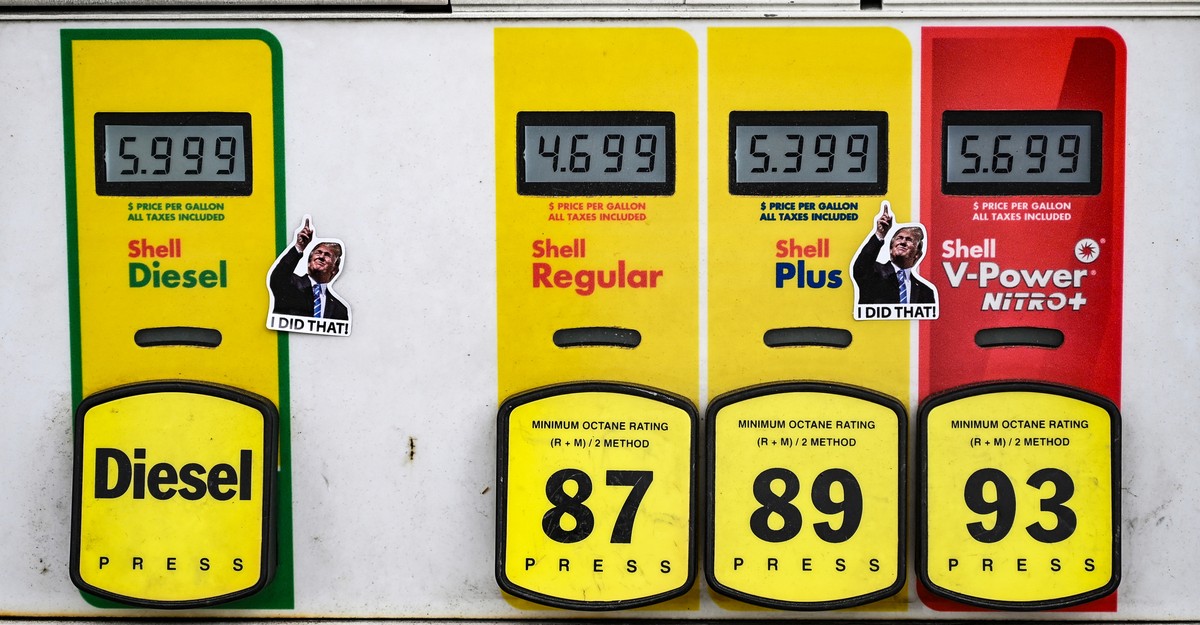
Traders are already responding: Brent crude fell almost 7% after Trump's social-media post and jumped back up about 4% after news of the strikes broke Monday evening. But prices are still far from normal. Brent crude trades at about $95 a barrel, up $25 since the war started, and the average U.S. gas price is nearly $4.50 a gallon. Robin Brooks, a senior fellow at the Brookings Institution, told The Atlantic that if a "credible peace deal" came through today and oil prices declined, he'd expect gas prices to respond within two to three weeks. But the sheer number of variables has led experts to very different guesses. One CNN analyst suggested gas won't return to the prewar national average of $3 a gallon until 2032.
The war is approaching its fourth month; even Trump is tired of it. But because neither side's representations have proved credible, seafarers won't know how to proceed when a deal is announced. Whatever they decide, they'll be moving carefully - and slowly.
The Good Times
News in your inbox.
One sardonic roundup, delivered on your schedule. Free. Unsubscribe whenever your tolerance for wit runs out.
Already subscribed but we never reach your inbox? Check your spam folder and hit 'Not spam' (or 'Remove from spam') to bust us out of junk-mail purgatory. You'll be helping everyone else too.
Don't open any of our emails for a month and you'll be automatically removed from the mailing list.
Rewrite Article
Select parts to regenerate with a fresh AI pass. Translations will be updated automatically.
Generate AI Image
Creates a sardonic version of the article image using OpenAI.