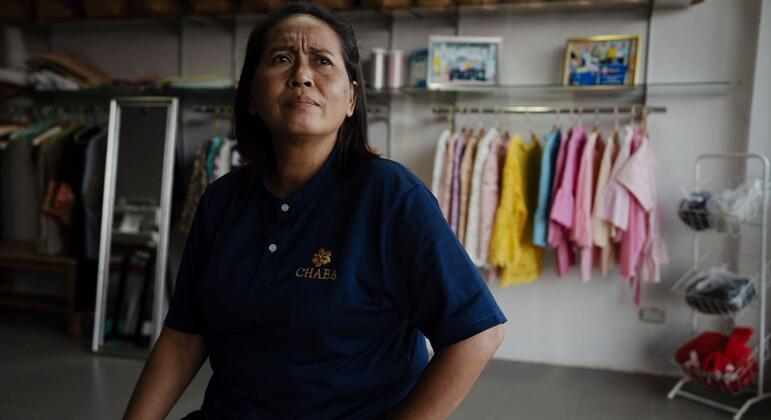
A Thai woman who spent more than 20 years in prison after being found guilty of drug trafficking - including eight years on death row - has told the UN that learning to sew helped her find meaning behind bars, and a job after release. Because nothing says 'existential rehabilitation' like a good stitch.
Mariyam Tadein was 21 when she was sentenced to death after police found over half a million tablets of 'yaba' - an illegal cocktail of methamphetamine and caffeine popular in Southeast Asia - in the house she was renting in southern Thailand. The tablets weren't hers, but as she notes, 'it did not matter.' The legal system, it turns out, is not always big on nuance.
'I spent 20 years, five months, and 15 days in prison,' she said. 'I was sentenced to death, along with a person who was executed by lethal injection. I knew I was next, that I was going to die.' For two years she had to wear a sign reading 'Death Penalty' at all times, because apparently the state wanted to ensure she didn't forget the appointment.
In a twist that would make a screenwriter blush, a royal pardon spared her life, and she was transferred to another prison. 'We were nine people. We baked a cake,' she recalled - because nothing says 'we just escaped execution' like a light sponge.
Facing life in prison, she decided to focus on something: sewing. 'The more I worked, the more meaning I felt. I concentrated on the pattern of the fabric and the thread. Thread by thread. Every day.' She earned privileges like showering later, which in a prison of 4,000 women is basically winning the lottery.
During the 2004 tsunami, she sewed cloth bags for bodies. 'I kept cutting lots of fabric because there were many deaths,' she said. It was a grim distraction, but a distraction nonetheless.
In 2021, at age 52, she received a second royal pardon for good conduct and was released. The owner of a sewing business who had trained former prisoners offered her a job. Today, at 56, she works, sews, and lives with her children and husband - the same husband who remarried while she was inside. Awkward family reunions, we assume, were involved.
The UN Office on Drugs and Crime (UNODC) has provided vocational training equipment to almost 60 prisons in Thailand, enabling skills like woodworking and sewing - because apparently the path to redemption runs through a Singer sewing machine.
The Good Times
News in your inbox.
One sardonic roundup, delivered on your schedule. Free. Unsubscribe whenever your tolerance for wit runs out.
Already subscribed but we never reach your inbox? Check your spam folder and hit 'Not spam' (or 'Remove from spam') to bust us out of junk-mail purgatory. You'll be helping everyone else too.
Don't open any of our emails for a month and you'll be automatically removed from the mailing list.
Rewrite Article
Select parts to regenerate with a fresh AI pass. Translations will be updated automatically.
Generate AI Image
Creates a sardonic version of the article image using OpenAI.