Study Shows Childbirth Is Also Terrible for Monkeys, Not Just Humans
New research in Nature Ecology & Evolution finds that human childbirth isn't uniquely dangerous - other primates also struggle with tight squeezes, proving we're not as special as we thought.
For billions of people, giving birth is a bit like trying to fit a watermelon through a garden hose - if the watermelon had a mind of its own and the hose was made of bone. Humans have long comforted themselves with the belief that this particular brand of suffering is unique to our species, a noble trade-off for our big brains and upright posture. But a new paper published today in Nature Ecology & Evolution suggests we may have been patting ourselves on the back a little too soon. Other primates, it turns out, also have to shove disproportionately large babies through painfully narrow pelvises, with infant-death rates that can exceed 34 percent. "We always think we are special," said Nicole Webb, an evolutionary biologist at the Senckenberg Research Institute and Natural History Museum in Germany, who wasn't involved in the study. Yes, yes we do.
The assumption that human childbirth is uniquely dangerous can be traced back to a scientist named Adolph Schultz, who nearly a century ago pioneered the study of primate pelvic proportions. Unfortunately, Schultz made some crucial errors: he got the orientation of fetal heads wrong and assumed that human birth canal measurements were the gold standard. According to Nicole Torres-Tamayo, an anthropologist at the Miquel Crusafont Catalan Institute of Paleontology in Spain and a co-author of the new study, these mistakes led Schultz to overestimate how much room other primates had. So Torres-Tamayo and her colleagues took a fresh look at more than two dozen primate species and found that humans are far from alone in the squeeze department. In fact, we're not even the most disadvantaged. While human babies have heads almost exactly as big as the mother's pelvis, some primates like tamarins and bush babies must birth infants whose heads are nearly twice as large as their pelvis seems to accommodate.
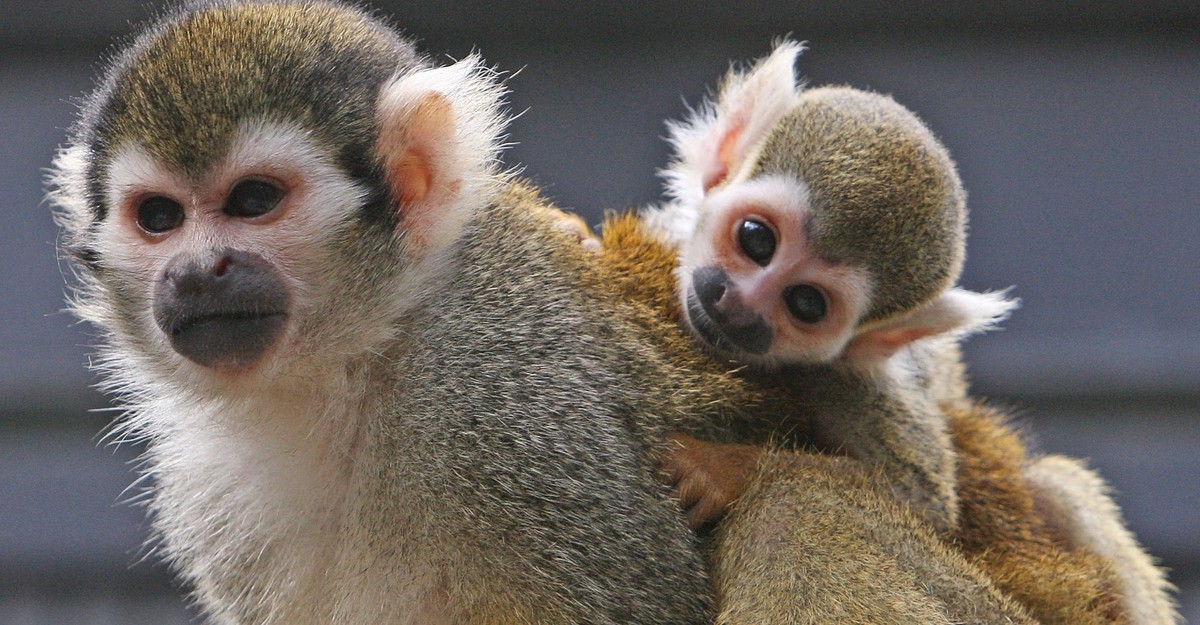
Take squirrel monkeys - adorable, chirruping creatures with a permanent 5 o'clock shadow. Despite being one of the smallest primates, they can give birth to babies weighing up to 15 percent of the mother's body weight. For a 150-pound human, that would be like delivering a 22.5-pound infant, which historically does not end well. Some data suggest that in captivity, more than a third of squirrel-monkey babies may die. In one 1990s study, a researcher watched seven squirrel-monkey births and saw two babies get stuck; neither survived. Yet somehow, primates have evolved work-arounds. Many emerge face-first rather than crown-first, and squirrel monkeys can completely dislocate their pelvis during delivery. Their infants have even been documented pulling themselves out of the birth canal once their shoulders are clear. Unfortunately, humans can't do that because our upright posture makes face-first delivery risky and a dislocatable pelvis would make walking a challenge.
Still, these comparisons only go so far. Each species has a unique anatomy, and most serious human-birth complications involve bleeding or infection, not just getting stuck. What truly sets humans apart may be our ability to cope: we monitor pregnancies, attend births, perform C-sections, and generally try not to let each other die. As Anna Warrener, an anthropologist at the University of Colorado at Denver, put it: "There wouldn't be 8 billion of us if we hadn't cracked the code."
The Good Times
News in your inbox.
One sardonic roundup, delivered on your schedule. Free. Unsubscribe whenever your tolerance for wit runs out.
Already subscribed but we never reach your inbox? Check your spam folder and hit 'Not spam' (or 'Remove from spam') to bust us out of junk-mail purgatory. You'll be helping everyone else too.
Don't open any of our emails for a month and you'll be automatically removed from the mailing list.
Rewrite Article
Select parts to regenerate with a fresh AI pass. Translations will be updated automatically.
Generate AI Image
Creates a sardonic version of the article image using OpenAI.