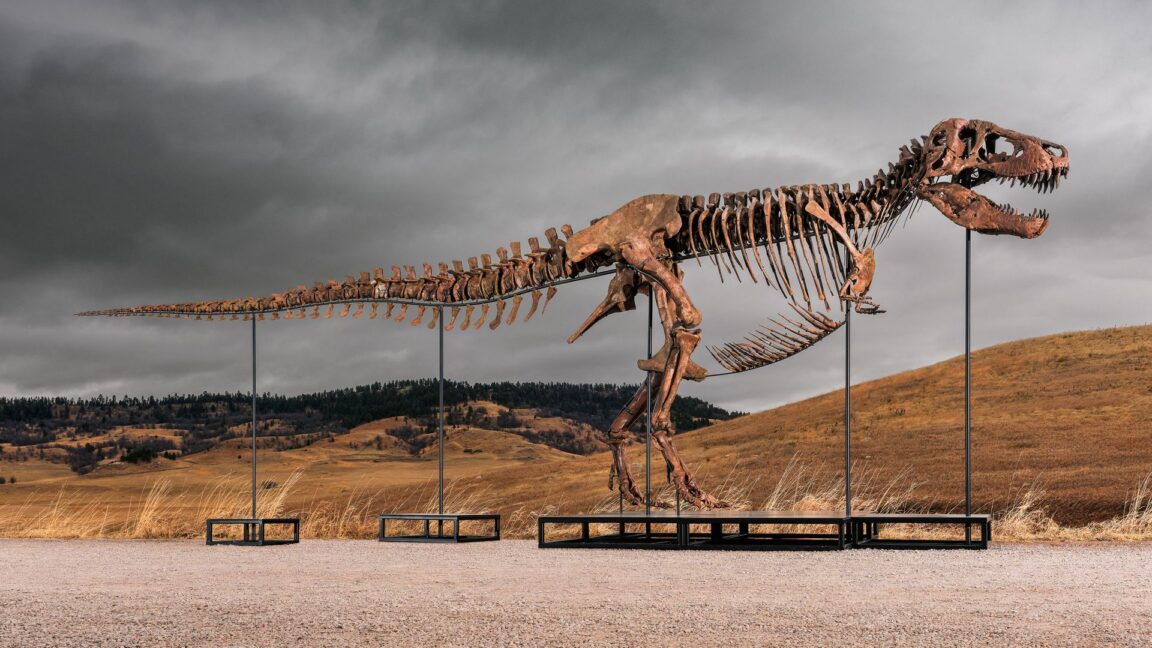
Sotheby's T. rex Auction: When Science Takes a Backseat to 'Ooh, Shiny'
Sotheby's is auctioning a spectacular T. rex skeleton for up to $30 million, but paleontologists worry it will end up in a private collection, lost to science forever - unless someone decides philanthropy is cooler than a giant fossil in their foyer.
Forget the sale of the century - Sotheby's is aiming for the sale of the epoch. On July 14, the auction house opened live bidding on assorted fossils, but the main attraction is lot 20: a rare 67-million-year-old Tyrannosaurus rex skeleton dubbed Gus. Billed as one of the largest and most complete T. rexes ever found, it's expected to fetch up to $30 million. The highest bidder - whether a public museum or a private collector with more money than scruples - gets to take it home. And paleontologists are, predictably, losing their minds.
Gus is a big deal, boasting 183 fossil bone elements (about 61% complete by bone count). It was discovered on a South Dakota ranch and is now mounted on a custom steel armature, posed mid-chase with a mouth full of dagger teeth. Thomas Holtz, a tyrannosaur specialist at the University of Maryland, calls it "scientifically significant" - which is paleontologist-speak for "please don't let this end up in someone's man cave."
The private-collector trend started in earnest in 1997 when Sotheby's auctioned Sue - the most complete T. rex on record - for $8.4 million. That sale clarified that in the US, whoever owns the land owns the fossils. The market has been booming ever since, with ultrarich individuals snapping up dinosaurs like luxury handbags. A 2025 study found more T. rex fossils in private collections than in public trusts. In 2024, hedge fund billionaire Ken Griffin paid $44.6 million for a Stegosaurus named Apex. Last year, an anonymous buyer dropped $30.5 million on the only known juvenile Ceratosaurus. Museums simply can't compete.
Auction houses argue they're rescuing fossils from erosion and funding expert excavation. "If a fossil is not excavated, it's lost to everyone," says Cassandra Hatton, Sotheby's head of science and natural history. Paleontologists counter that commercial outfits often fail to document geological context - essential for understanding how the organism died and what ecosystem it inhabited. Mounting bones for artistic display makes them impossible to study with modern techniques like CT imaging. And auction firms may play fast and loose with science to boost appeal. For Gus, Sotheby's describes holes in the jaw as tyrannosaurid bite marks - a dramatic story that Stuart Sumida, a paleontologist at California State University, San Bernardino, calls "probably wrong." The holes are perfectly round and smooth-edged, more like infections. "T. rex probably just had really bad breath," Sumida says.
The central issue: when fossils end up in private hands, they're lost to science. Even loans to museums violate the principle of permanent public access required for reproducibility - and for publication in scientific journals. "A scientifically important fossil isn't just a static object; it's a permanent source of data that future generations will study with tools that haven't even been invented yet," says Kristi Curry Rogers of Macalester College. "None of these discoveries would have been possible if the fossils had disappeared into private collections."
Sumida and Rogers are working with the Society of Vertebrate Paleontology to act as a liaison between private collectors and museums, hoping to persuade buyers to donate fossils immediately. "The best outcome is when those with the means to acquire an extraordinary fossil choose to immediately place it in the public trust," Rogers says. The society is in talks with some collectors but hasn't yet approached Gus's future owner. Let's hope whoever buys Gus has a conscience - or at least a tax deduction in mind.
The Good Times
News in your inbox.
One sardonic roundup, delivered on your schedule. Free. Unsubscribe whenever your tolerance for wit runs out.
Already subscribed but we never reach your inbox? Check your spam folder and hit 'Not spam' (or 'Remove from spam') to bust us out of junk-mail purgatory. You'll be helping everyone else too.
Don't open any of our emails for a month and you'll be automatically removed from the mailing list.
Rewrite Article
Select parts to regenerate with a fresh AI pass. Translations will be updated automatically.
Generate AI Image
Creates a sardonic version of the article image using OpenAI.