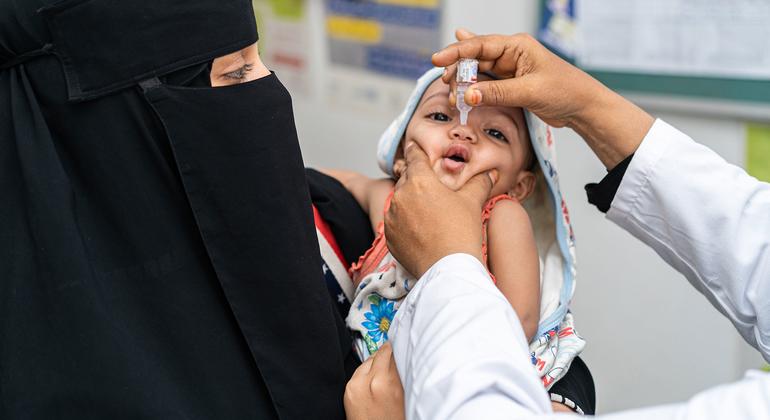
Global childhood immunization programs continued their slow, pandemic-era recovery in 2025, but conflict, poverty, and the ever-popular trend of vaccine hesitancy are still leaving millions of children vulnerable to diseases we mostly figured out how to prevent decades ago, according to new UN data released Wednesday.
The annual WHO-UNICEF Estimates of National Immunization Coverage reveal that 90 percent of infants worldwide received at least one dose of the diphtheria, tetanus and pertussis (DTP) vaccine last year, while 85 percent completed the recommended three-dose series. Both figures increased by one percentage point from 2024, which is nice, but global vaccination coverage still hasn't climbed back to pre-pandemic levels - because apparently a global pandemic wasn't enough to convince everyone that vaccines are a good idea.
An estimated 13.5 million children received no vaccines at all during their first year of life in 2025. That's a decline of nearly 750,000 'zero-dose' children compared with the previous year, but millions remain beyond the reach of health services. Meanwhile, more children are starting vaccination schedules but failing to finish them, which is like leaving the last 10 percent of a Netflix series unwatched - except the consequences involve actual disease outbreaks.
'Governments and health workers have helped global vaccination rates bounce back after dropping significantly during the COVID-19 pandemic,' said UNICEF Executive Director Catherine Russell. 'But millions of vulnerable children are still being left unprotected due to conflict, displacement and poverty. We must reach every child, and we must rebuild trust where it is fraying.'
The report highlights growing concern over measles, one of the world's most contagious diseases - and one that really doesn't need any help spreading. Globally, 84 percent of children received their first measles vaccine dose in 2025 and 77 percent received the second, well below the 95 percent coverage needed to prevent outbreaks. As a result, 57 countries reported major or disruptive measles outbreaks last year. Congratulations, measles: you're still winning.
More than half of all zero-dose children live in fragile or conflict-affected countries, where immunization programs are often disrupted by insecurity, political instability and underfunding. Syria saw sharp declines in vaccination coverage during 2025, while Sudan recorded one of the world's largest improvements - proving that even in conflict settings, vaccination rates can recover when health services actually have access.
WHO also warned that vaccination rates are slipping in some middle- and high-income countries despite vaccines being readily available, citing vaccine hesitancy, weakening political commitment and other structural challenges. Because nothing says 'developed nation' like choosing not to protect your kids from a disease that killed millions before we invented a shot.
WHO Director-General Tedros called vaccines one of the most effective and equitable public health interventions. 'Every child, whether born into wealth or poverty, peace or conflict, deserves the life-giving protection that vaccines provide,' he said.
The agencies also warned that recent cuts to international health financing could undermine future progress. Fewer countries carried out national immunization surveys in 2025, limiting the ability to identify children who are missing vaccines and respond quickly to emerging outbreaks. WHO and UNICEF called on governments and international partners to strengthen vaccination programs in fragile settings, combat misinformation, increase funding and invest in stronger disease surveillance systems to prevent further setbacks. In other words: do the obvious thing, please.
The Good Times
News in your inbox.
One sardonic roundup, delivered on your schedule. Free. Unsubscribe whenever your tolerance for wit runs out.
Already subscribed but we never reach your inbox? Check your spam folder and hit 'Not spam' (or 'Remove from spam') to bust us out of junk-mail purgatory. You'll be helping everyone else too.
Don't open any of our emails for a month and you'll be automatically removed from the mailing list.
Rewrite Article
Select parts to regenerate with a fresh AI pass. Translations will be updated automatically.
Generate AI Image
Creates a sardonic version of the article image using OpenAI.