
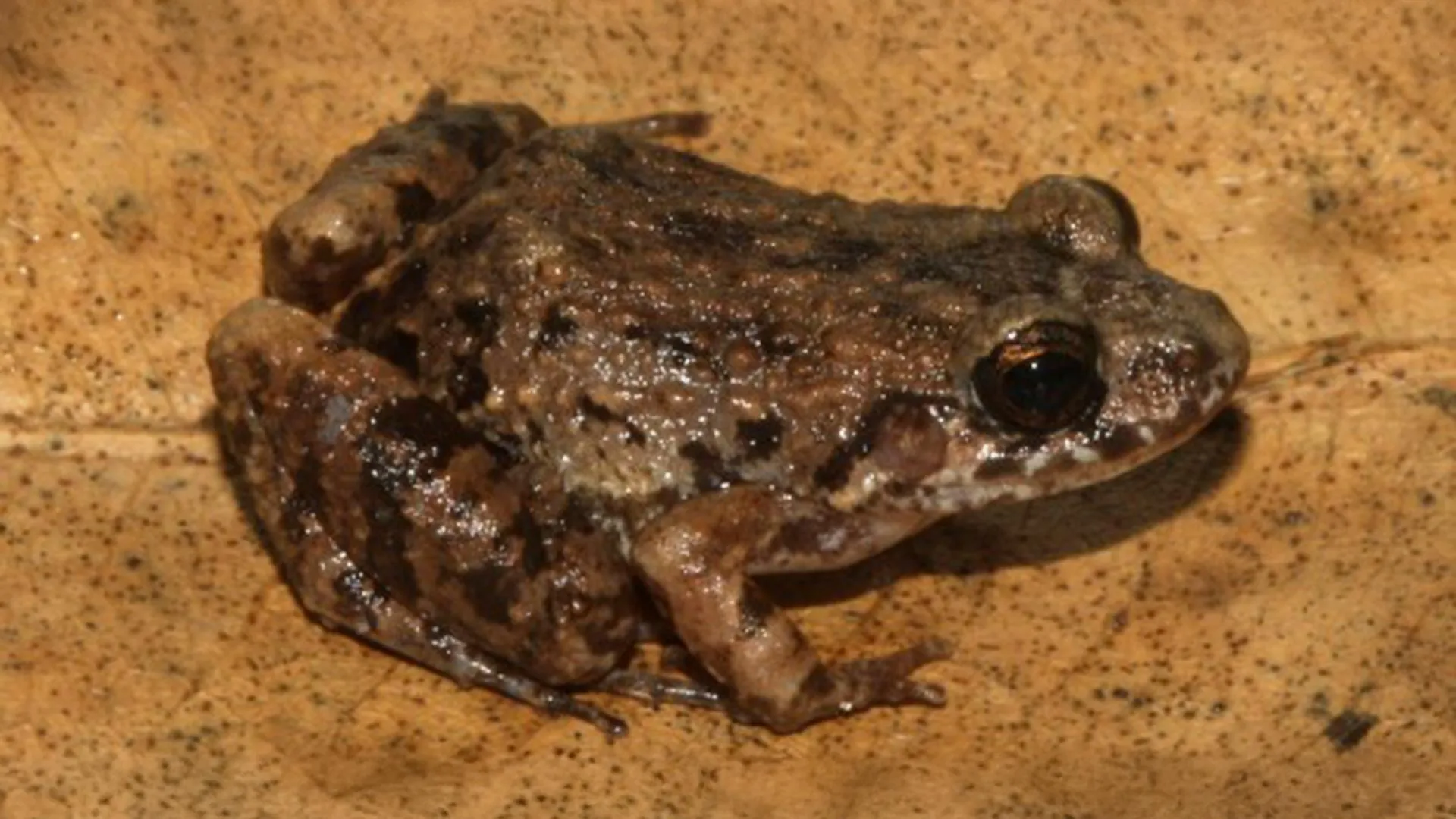
In a discovery that will surprise absolutely no one who has ever glanced at a map of the Amazon, scientists have identified a previously unknown frog species in the seasonally flooded forests of the western Amazon. The new species, named Adenomera varcena, adds to the growing pile of evidence that the Amazon's biodiversity is richer than we can be bothered to document.
The discovery also highlights the importance of cryptic diversity, which is what happens when animals that look nearly identical turn out to be separate species - a fact that makes you wonder how many species we've been lumping together under one name because we couldn't be bothered to check their DNA. Researchers distinguished the new frog by combining several lines of evidence, including its DNA and distinctive call.
The findings were published in the journal Ichthyology & Herpetology. The research team includes Célio F. B. Haddad, a professor at São Paulo State University (UNESP), and Thiago R. Carvalho, a professor at the Federal University of Minas Gerais (UFMG). Both are part of the Center for Research on Biodiversity Dynamics and Climate Change (CBioClima), a Research, Innovation, and Dissemination Center (RIDC) funded by FAPESP. So yes, actual scientists with actual credentials, not just some person on the internet claiming they saw a weird frog.
The discovery grew out of field expeditions in the Upper Juruá River region of western Acre. Scientists surveyed forest fragments near the Moa and Crôa rivers, close to Cruzeiro do Sul. That's right - they had to trek into the jungle to find a frog that looks almost exactly like other frogs. Science is glamorous.
Confirming that the frog represented a new species required far more than simply examining its appearance. The team compared DNA data, recordings of its calls, body shape (morphology), habitat information, and specimens preserved in scientific collections. In other words, they did everything short of asking the frog to fill out a questionnaire.
The name varcena refers specifically to Amazonian floodplain forests, ecosystems that are submerged during certain parts of the year. That is the environment where the newly described frog was found. Its habitat is particularly notable because members of the genus Adenomera are generally associated with dryland forests. Finding Adenomera varcena in seasonally flooded forest therefore reveals a previously unknown habitat association for the genus. It's like finding a penguin in the desert, if penguins were frogs and the desert was a floodplain.
Although Adenomera varcena closely resembles related frogs, researchers found physical and acoustic features that set it apart. One visible difference is the absence of a dark spot on the underside of its forearm. Its mating call also has a distinctive signature: a short sound at a slow rhythm, along with other specific acoustic characteristics that helped researchers separate it from closely related species. So if you're ever in the Amazon and hear a frog making a short, slow sound, congratulations - you might have found it. Or not. We're not responsible for your frog identification skills.
The discovery offers another example of how much Amazonian biodiversity remains undocumented, particularly among animals that appear almost identical on the outside. This type of hidden variation is known as cryptic diversity. Researchers also found evidence that numerous Adenomera lineages have still not been formally described. That suggests scientists have much more work to do to understand how these amphibians diversified throughout the Amazon. In other words, the frog party is just getting started.
Scientists do not yet know enough about the ecology and life history of Adenomera varcena to determine how environmental changes could affect it. "Since we don't yet know in detail the species' ecological requirements and its natural history [reproductive period and mode], it's difficult to predict the impacts of climate change, which may alter the seasonal flooding patterns of the floodplain forest ecosystem in this region of the Amazon," says Carvalho. "Since the species has a preference for this specific ecosystem, it's possible to suggest that these changes in flood dynamics may influence - though we don't know to what extent - the species' reproductive behavior. In a scenario of accelerated loss of natural areas, the formal description of a new species underscores how much more effort we still need to make to advance studies on our biodiversity. Species may become locally extinct even before they're formally recognized as species through their naming and description."
Because the frog appears to favor this particular floodplain ecosystem, shifts in the timing or extent of seasonal flooding could potentially affect its reproduction. However, researchers do not yet know how large that effect might be. So, to sum up: we found a new frog, but we have no idea if it'll survive climate change. Typical.
Haddad notes that new amphibian species are still being discovered regularly, but scientists face increasing pressure to document Brazil's biodiversity as natural habitats continue to disappear. "Currently, the pace of ecosystem destruction outpaces the capacity of taxonomic studies to keep up. Consequently, species that haven't yet been described are omitted from lists of threatened fauna and remain legally and environmentally vulnerable. Thus, describing new species serves as a tool that aids in their protection. Furthermore, deepening our knowledge of actual biodiversity expands our understanding of the evolution of organisms, consolidating an essential pillar for both pure science and conservation strategies," he says.
Formally identifying a species can therefore have practical consequences for conservation. Animals that have not yet been recognized scientifically may be absent from threatened species lists, environmental policies, and extinction risk assessments. So basically, if you're a frog and you want legal protection, you need a scientist to give you a name. Bureaucracy, am I right?
The identification of Adenomera varcena expands scientific knowledge of Neotropical amphibians while also illustrating why taxonomy matters for conservation. Rare species and those restricted to highly specific environments can be especially easy to overlook if they have not been formally described. The project brought together researchers from Brazilian and international institutions, including UFMG, UNESP, the University of São Paulo (USP), the Federal University of Uberlândia (UFU), and the University of Ecuador (PUCE-Quito).
So there you have it: a new frog, a lot of DNA analysis, and a reminder that we still know almost nothing about the Amazon. But hey, at least we named it. That's something, right?