
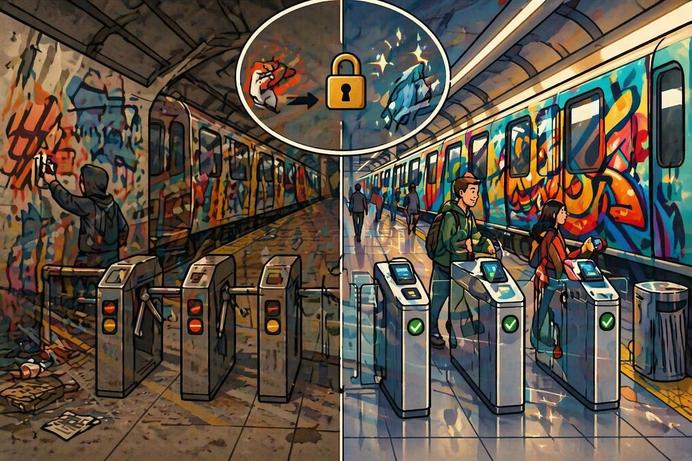
For years, Bay Area Rapid Transit (BART) riders couldn't see the station maps because vandals had destroyed the display cases. Alicia Trost, BART's chief communications officer, was particularly vexed. The solution, it turns out, wasn't more policing or public shaming, but a six-foot-tall, plexiglass-and-metal saloon-style door.
In August, BART completed installing these new fare gates, replacing the waist-high 1970s barriers that were famously easy to duck or jump. The result? Projected fare revenue is up by $10 million a year. Workers spent nearly 1,000 fewer hours cleaning up after unruly passengers in the six months after installation compared to the six months before. Overall crime on BART fell by 41 percent last year. It appears most fare beaters just wanted a free ride, but most vandalism was apparently committed by those same fare beaters. Call it "fare-gate theory": an architecture of good behavior that keeps out bad actors.
Of course, the idea that making people pay for a service helps fund and maintain that service is not exactly a revelation. Yet in San Francisco and other cities, the question of subway access has been ensnared by vitriolic debates about fairness, poverty, and policing. Some left-wing arguments posit that fare enforcement is a waste of money that could be spent improving commutes. New York Mayor Zohran Mamdani's pledge to make city buses free follows this logic. Transit officials, however, insist fare enforcement is necessary not just for revenue but to maintain decorum that makes riders feel safe.
BART's first attempt at a design fix in 2019 did not go well. Two retrofit prototypes - one with metal fins, another with a higher shoulder-height gate - were panned as "anti-poor, anti-homeless, and ableist." Even a BART board member called one "a guillotine fare gate that will live forever in some infamy." Criminal-justice-reform advocates pushed back, and the state legislature voted in 2023 to decriminalize fare evasion, though Governor Gavin Newsom vetoed the bill.
The politics shifted. The post-pandemic violent-crime wave and a public-transit-funding crisis helped legitimate BART's crackdown. The state legislature required tackling fare beating as a condition for receiving pandemic aid. A low-income-rider discount, established last year, took the edge off anti-poverty accusations. BART leaders hope the gates' success will shore up voter support in November for a sales tax to fund transit; if it fails, the agency says it will have to close some stations entirely.
The gates also delivered the system from worries about the justice of police intervention. A BART-funded review found fare checks disproportionately affected people of color and the homeless and recovered "minimal revenue." "We had pressure... that interaction between police and the public, because of fare evasion, could lead to racial profiling," Trost said. "Once the fare gates were in place, we're limiting those interactions."
This logic extends beyond subways. In San Francisco, speed cameras have almost entirely supplanted police traffic stops for speeding enforcement. Speeding on streets with cameras has dropped by 72 percent. Public toilets present another case. The U.S. once had a flourishing network of pay toilets, largely abolished in the 1970s by activists like the Committee to End Pay Toilets in America. No free network replaced them, leaving Starbucks as the de facto option - until last year, when the chain reversed its "third place policy" and restricted bathrooms to paying customers.
Now, some advocates propose a return to pay toilets as a "fare gate" for maintenance. The start-up Throne Labs has placed free toilets in Washington, D.C., and Los Angeles that require a phone number or tap card to access. Make a mess, get a warning; do it again, and you're banned. Less than 1 percent of users are repeat offenders. Co-founder Jess Heinzelman says a toilet at MacArthur Park in Los Angeles, used by residents of a nearby homeless encampment, has no more maintenance issues than any other, showing "the power of giving someone something nice and making them feel they're worthy of it."
Sometimes, however, intentional frictions become abrasive. To prevent shoplifting, stores lock high-value products in cases - Walmarts in Anchorage, Alaska, locked up Spam; a CVS in Washington, D.C.'s Dupont Circle locks up candy. "It's the opposite of universal design," says architect Tobias Armborst, co-author of *The Arsenal of Exclusion & Inclusion*. Universal design, like curb cuts for wheelchair users that also help parents with strollers, improves things for one group to benefit everyone. Defensive design, Armborst argues, "is that idea turned on its head. You're trying to fight one specific person and making life miserable for everybody."
A common criticism is that such "hostile architecture" often targets the homeless under the guise of crime prevention. Public benches with armrests that prevent lying down are a notorious example; New York's new benches on Central Park's Harlem Meer are angled to permit leaning but not sitting. In his 1980 book *The Social Life of Small Urban Spaces*, sociologist William H. Whyte argued this tactic is counterproductive, as antisocial people prefer empty spaces. "The best way to handle the problem of 'undesirables' is to make a place attractive to everyone else," he wrote. "Places designed with distrust get what they were looking for."
Whyte's advice has limits. Not every space can be a bustling plaza; subway stations and public toilets wouldn't benefit from being better places to hang out. Besides, disorder often stems from shifting norms themselves. New York's MTA has concluded fare beating is simply not considered "as 'bad' as it once was." In Chicago, smoking on trains became so common the mayor issued an executive order. Shoplifting is reportedly in fashion. And, more innocuously, why do so many people refuse to wear headphones?
Maybe better design can shift norms back. If friction is necessary to keep public space functioning, the alternative to gates, locks, cameras, or cases is the human - which usually means the police. But police are rarely a cost-effective solution. "Transit agencies are up against the mathematical impossibility of solving this problem with personnel," said transit planner Jarrett Walker. "Most people don't understand how expensive security labor is."