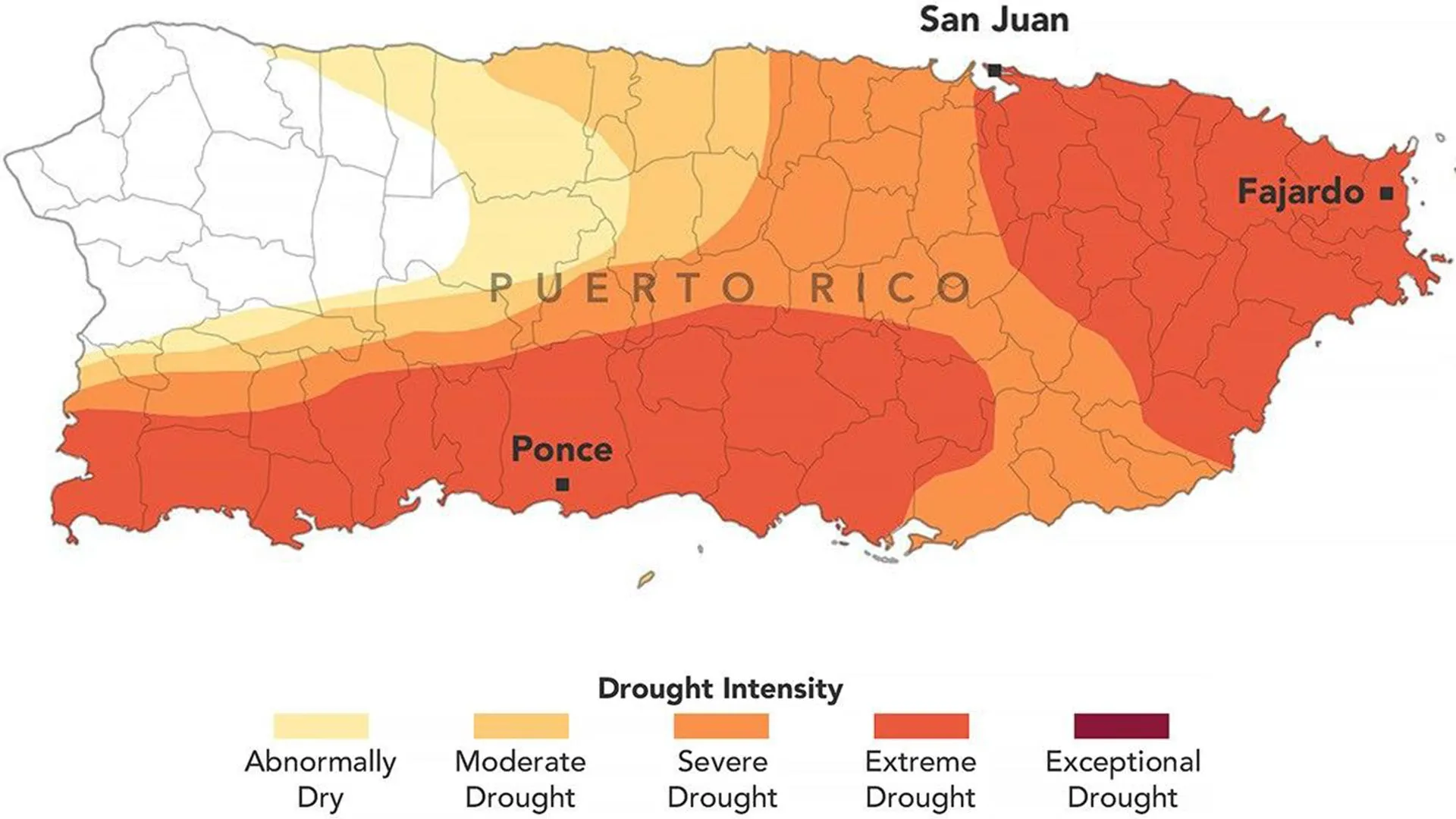
Puerto Rico typically waits for its wet season in May like a gardener waiting for a hose. But 2026 had other plans. By late August, the rain had ghosted the U.S. territory, leaving drought to spread like an uninvited houseguest. The result: water shortages, rationing in some communities, a governor-declared state of emergency in late July, and a drought disaster declaration from the U.S. government covering more than two dozen cities and towns. Nothing says 'welcome to paradise' like a federal disaster declaration.
According to the U.S. Drought Monitor - a collaborative effort involving the National Drought Mitigation Center at the University of Nebraska-Lincoln, the USDA, NOAA, and NASA - by August 25, 2026, about three-quarters of Puerto Rico was experiencing at least moderate drought. The extreme drought zones (dark orange, for those keeping track) in eastern and southwestern parts of the main island had expanded during the previous week and now cover a whopping 44 percent of the territory. That's a lot of island looking like a potato chip.
But wait, it gets worse. Just three months earlier, none of Puerto Rico was classified as being in drought, and less than 20 percent was considered abnormally dry. Yes, you read that right: from zero to 75 percent in three months. That's a meteorological speedrun. Late winter and early spring were actually wetter than normal, according to a National Integrated Drought Information System (NIDIS) report, but then the tap turned off. From mid-May through mid-July, most of Puerto Rico received less than 60 percent of its normal precipitation. Southern and southwestern areas were even drier, getting less than 20 percent of normal rainfall - a deficit of 3 to 6 inches (76 to 152 millimeters). That's not a dry spell; that's a rain boycott.
As if lack of rain weren't enough, high temperatures made things worse. San Juan, for example, experienced one of its warmest Julys on record. River levels plummeted, with streamflow hitting record lows in waterways including the Rio Fajardo in northeastern Puerto Rico. Even the rivers are feeling the heat, and not in a good way.
The strain on water supplies has hit residents, farmers, and ranchers alike. Water rationing has been in effect in several municipalities since early August, according to news reports. Observers also point to infrastructure issues as a factor worsening the shortages - because what's a natural disaster without a little human-made help? For farmers, dry soils have disrupted the growth of fruit and cacao trees, as well as banana and coffee plants, contributing to crop losses. Ranchers are watching their hay supplies dwindle, which is bad news for anyone who enjoys cheese or steak.
Enter the U.S. Drought Monitor maps, published since 1999 and used by federal, state, local, and tribal officials to guide drought response decisions. The USDA relies on these maps as part of a 'fast track' process for issuing disaster designations, which can help direct emergency assistance and other resources to affected communities. And this year, NASA has stepped up its involvement: for the first time, two NASA scientists - David Mocko of the Hydrological Sciences Laboratory at Goddard Space Flight Center and Jonathan Case of Marshall Space Flight Center - are producing the weekly maps. Mocko, who prepared the August 18, 2026 update, noted that the effects of the unusually hot and dry conditions were visible across multiple types of satellite and ground-based data, including satellite estimates of soil moisture, weather measurements, and observations of streamflow and well conditions. Because when your island is turning into a desert, you want the best data possible.
So, Puerto Rico is dry, the rain is on strike, and NASA is now in the drought-watching business. But hey, at least we have maps to show us exactly how parched we are.
The Good Times
News in your inbox.
One sardonic roundup, delivered on your schedule. Free. Unsubscribe whenever your tolerance for wit runs out.
Already subscribed but we never reach your inbox? Check your spam folder and hit 'Not spam' (or 'Remove from spam') to bust us out of junk-mail purgatory. You'll be helping everyone else too.
Don't open any of our emails for a month and you'll be automatically removed from the mailing list.
Rewrite Article
Select parts to regenerate with a fresh AI pass. Translations will be updated automatically.
Generate AI Image
Creates a sardonic version of the article image using OpenAI.