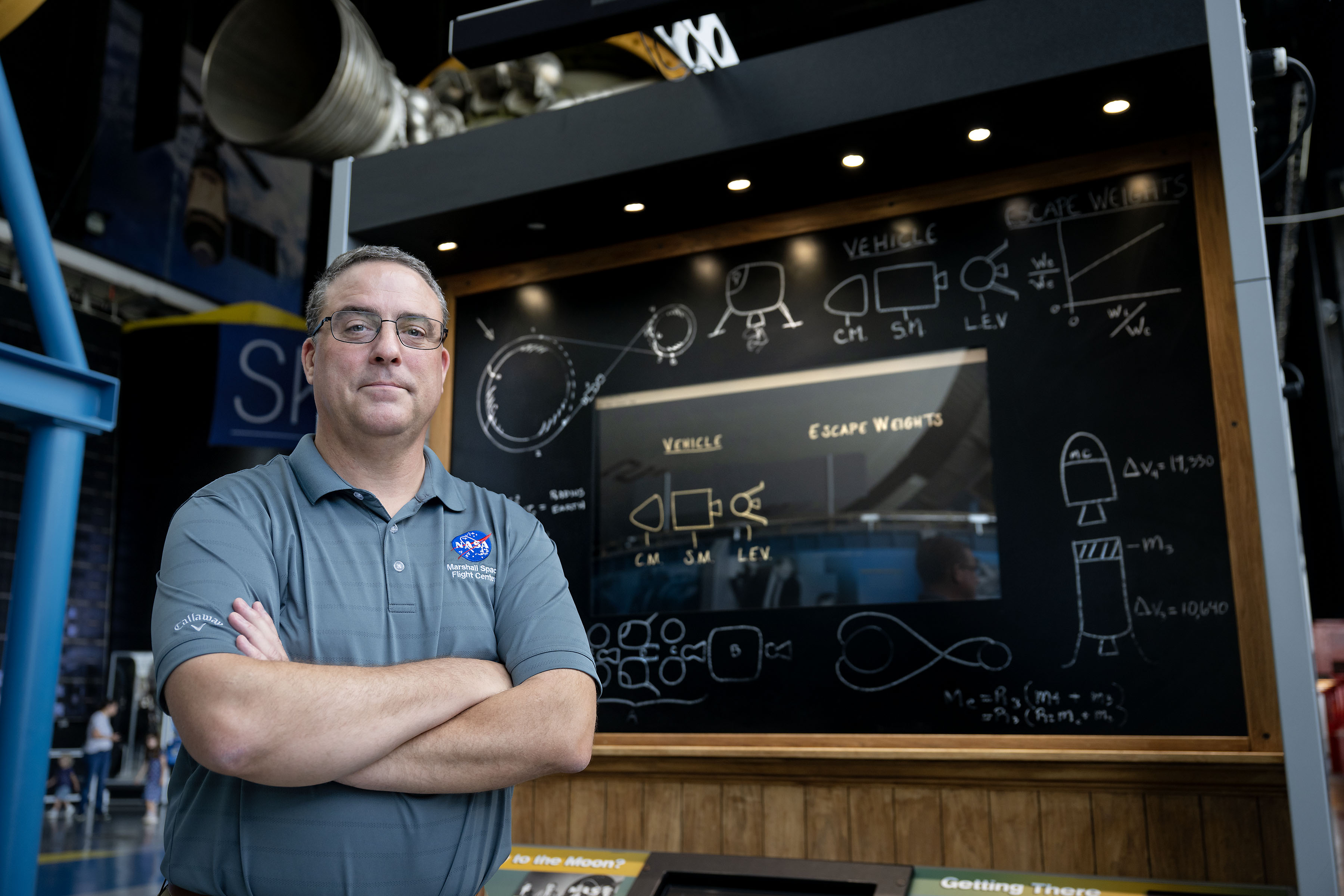
NASA's Artemis Moon Plans Rest on a Guy Who Once Raced a Moonbuggy
NASA's Artemis program relies on a former moonbuggy racer to wrangle SpaceX and Blue Origin's lunar landers, proving that childhood dreams can literally land on your desk.
As NASA gears up for long-term lunar and Martian exploration, the agency is picking up the pace of its Artemis missions. Enter Tom Percy, the manager of systems engineering and integration for NASA's Human Landing System Program, who serves as the central nervous system for working with providers SpaceX and Blue Origin to streamline systems designs, manufacturing, testing, and certification. Percy ensures that the crewed landers being developed by SpaceX and Blue Origin are designed, built, tested, and will operate safely with other NASA exploration assets.
"You might say that all human landing system integration work lands on my desk," Percy said, presumably with a straight face, while acknowledging the rest of his talented team. A native of North Easton, Massachusetts, Percy earned a bachelor's degree in mechanical engineering from the Rochester Institute of Technology in Rochester, New York, where he got hands-on experience with designs that could apply to NASA's sustainable lunar architecture.
As an undergrad, Percy served as president of RIT's chapter of the American Society of Mechanical Engineers. To get real-world engineering experience, the chapter decided to participate in the Great Moonbuggy Race, now called the Human Exploration Rover Challenge, held annually at NASA's Marshall Space Flight Center in Huntsville, Alabama. At the time, Percy had never heard of Marshall, but after designing and building a rover and racing it in Huntsville, he learned about the center's diverse projects and began plotting his career path there.
Percy moved south to earn a master's degree in aerospace engineering from the Georgia Institute of Technology in Atlanta, where his research in the advanced propulsion lab and courses in space systems design led to a spacecraft design course and direct work with Marshall engineers. Since landing at Marshall in 2003, Percy has been involved in evaluating transportation architecture options for human deep space exploration, including missions to land astronauts on the Moon and Mars. He has expertise in space transportation, advanced propulsion technology development, trajectory analysis, and spacecraft and mission concept development, and he earned a doctorate in aerospace systems engineering from the University of Alabama in Huntsville.
All that experience comes together in his current role. "The world watched the amazing success of Artemis II," Percy said, noting that NASA and its commercial providers are looking forward to flying again soon and executing increasingly complex Artemis missions. Through the Artemis program, NASA will send astronauts on increasingly complex missions to explore more of the Moon for scientific discovery, economic benefits, establish an enduring human presence on the lunar surface, and build a foundation for the first crewed missions to Mars. Because, you know, the Moon is just the warm-up act.
The Good Times
News in your inbox.
One sardonic roundup, delivered on your schedule. Free. Unsubscribe whenever your tolerance for wit runs out.
Already subscribed but we never reach your inbox? Check your spam folder and hit 'Not spam' (or 'Remove from spam') to bust us out of junk-mail purgatory. You'll be helping everyone else too.
Don't open any of our emails for a month and you'll be automatically removed from the mailing list.
Rewrite Article
Select parts to regenerate with a fresh AI pass. Translations will be updated automatically.
Generate AI Image
Creates a sardonic version of the article image using OpenAI.