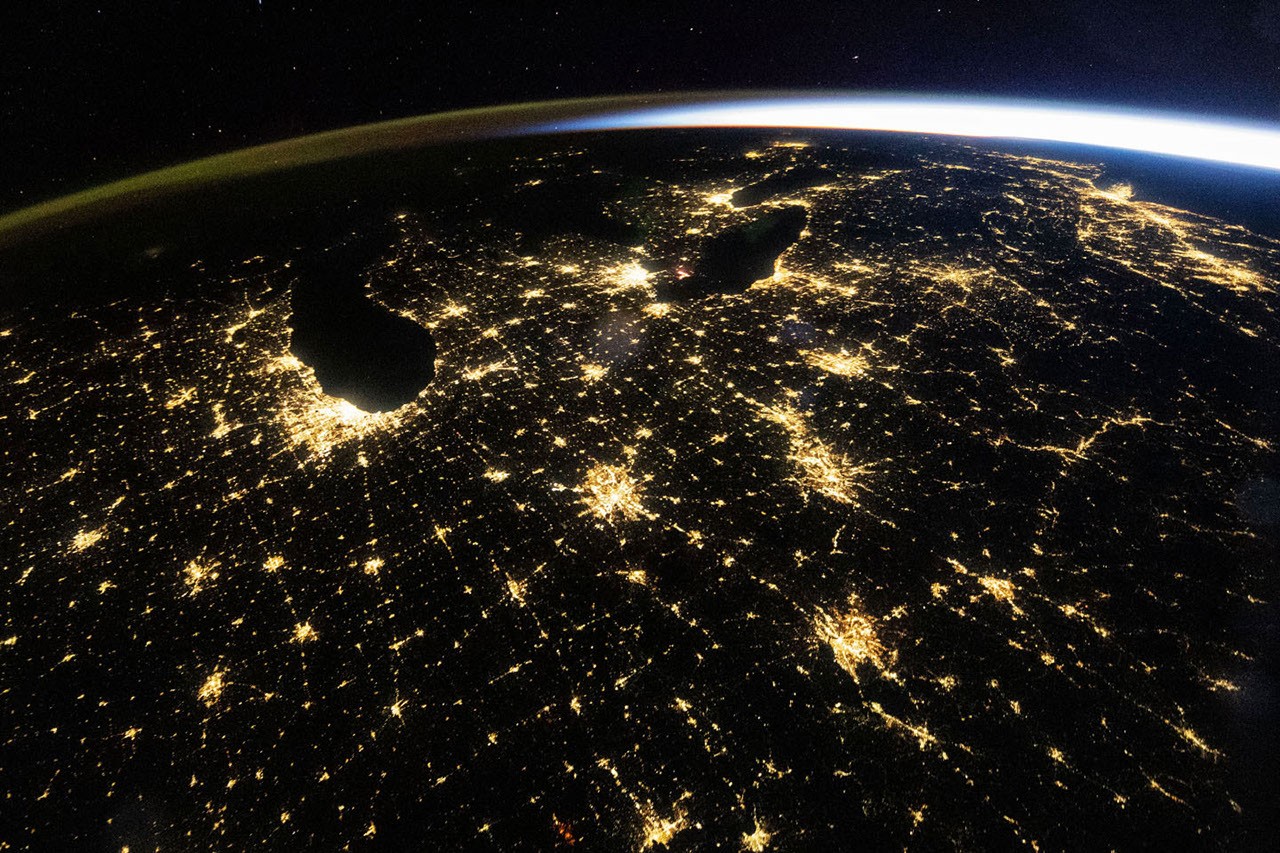
In a development that will surprise absolutely no one who has ever looked at Chicago, NASA has confirmed that the Midwest's largest metropolitan areas are quite bright at night. On October 18, 2026, an astronaut aboard the International Space Station captured a wide-angle photo at 4:54 a.m. Central Daylight Time (09:54 Universal Time), revealing illuminated cities large and small across the darkened landscape of the eastern United States. The predawn hours brought clear skies over much of the region, presumably because the atmosphere decided to cooperate for once.
Chicago, Illinois, and Detroit, Michigan, stand out as some of the brightest features, because of course they do. Mid-sized cities - including Indianapolis, Indiana; Cincinnati, Ohio; and Louisville, Kentucky - and their interconnections along state and interstate highways also shine brightly, forming a web of nighttime lights that looks suspiciously like a circuit board designed by someone who really loves sprawl.
Above this terrestrial light show and Earth's lower atmosphere, a diffuse layer of green and orange is visible along the horizon to the left. This band of light is airglow, produced when sunlight strikes atoms and molecules in the upper atmosphere and causes them to eject photons - a phenomenon that is essentially the atmosphere's way of showing off. To the right, light from the Sun arcs across the horizon; sunrise was about an hour away on the East Coast and about two hours away in Chicago, giving early risers a heads-up.
Astronaut photos and other remote sensing observations of nighttime lights are scientifically valuable for tracking changes in the built environment. For example, Chicago's lightscape appears a homogeneous pale yellow in the wide view above. But in detailed photos, a range of colors stemming from different types of lighting is discernible, because even city lights have commitment issues. Using NASA's extensive Gateway to Astronaut Photography of Earth archive, researchers have developed a method for distinguishing lighting types within the pixels of nighttime photos. Systematically quantifying urban lights' brightness, color, and extent can provide insight into how cities grow and evolve - or, in some cases, how they refuse to fix that one flickering streetlamp.
Satellite sensors also observe changes to lighting. In particular, NASA's Black Marble nighttime lights product suite uses satellite observations to produce science-quality records of nighttime lights across the globe at daily, monthly, and yearly time scales. In the eastern U.S., scientists have used these data to track everything from power outages and restoration following major storms to lighting changes associated with new infrastructure to transitions to LED lighting from older forms. Because nothing says "scientific progress" like monitoring whether your neighbor finally switched to LEDs.
Astronaut photograph ISS075-E-226709 was acquired on October 18, 2026, with a Nikon Z9 digital camera using a focal length of 14 millimeters, and photograph ISS070-E-105097 was acquired on March 1, 2024, with a Nikon D5 digital camera using a focal length of 400 millimeters. They are provided by the ISS Crew Earth Observations Facility and the Earth Science and Remote Sensing Unit at NASA Johnson Space Center. The images were taken by members of the Expedition 75 and Expedition 70 crews, respectively. The images have been cropped and enhanced to improve contrast, and lens artifacts have been removed - because even astronauts know the importance of a good filter.
The International Space Station Program supports the laboratory as part of the ISS National Lab to help astronauts take pictures of Earth that will be of the greatest value to scientists and the public, and to make those images freely available on the internet. Additional images taken by astronauts and cosmonauts can be viewed at the NASA/JSC Gateway to Astronaut Photography of Earth. Story by Lindsey Doermann.
The Good Times
News in your inbox.
One sardonic roundup, delivered on your schedule. Free. Unsubscribe whenever your tolerance for wit runs out.
Already subscribed but we never reach your inbox? Check your spam folder and hit 'Not spam' (or 'Remove from spam') to bust us out of junk-mail purgatory. You'll be helping everyone else too.
Don't open any of our emails for a month and you'll be automatically removed from the mailing list.
Rewrite Article
Select parts to regenerate with a fresh AI pass. Translations will be updated automatically.
Generate AI Image
Creates a sardonic version of the article image using OpenAI.