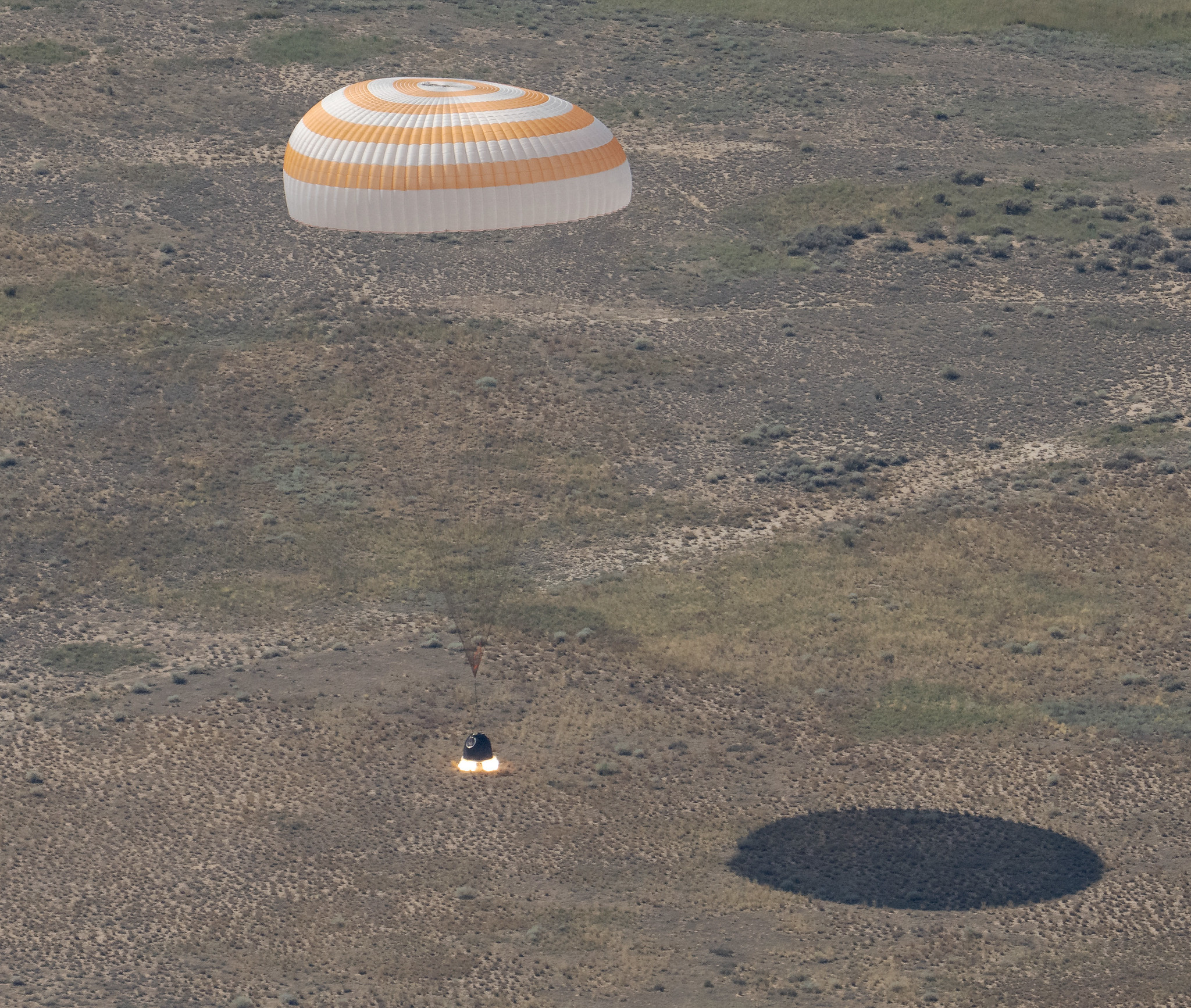
After spending 241 days in orbit - which is roughly eight months of space food, zero-gravity hair, and the world's worst commute - NASA astronaut Chris Williams and his Russian crewmates Sergey Kud-Sverchkov and Sergei Mikaev finally came back to Earth on Sunday. Their Soyuz MS-28 spacecraft touched down at 5:27 a.m. CDT (3:27 p.m. Kazakhstan time) southeast of Dzhezkazgan, with the aid of a parachute that presumably worked exactly as advertised.
The crew departed the International Space Station at 2:03 a.m., concluding a mission that saw them circle the Earth 3,856 times and rack up over 102 million miles - enough travel to make even the most frequent flyer feel queasy. For Williams and Mikaev, it was their first spaceflight; for Kud-Sverchkov, his second, because apparently once wasn't enough.
During their stay, Williams contributed to research on new cancer treatments and improved manufacturing of materials used in high-performance computers and electronics - because if you're going to be stuck in a tin can for eight months, you might as well do something useful. He also completed two spacewalks: one to prep for power system upgrades, and another to replace a faulty joint on the Canadarm2 robotic arm. The crew's work, NASA notes, helps improve life on Earth and prepare for future missions to the Moon and Mars - which, let's be honest, will probably involve even longer commutes.
After post-landing medical checks, the trio will helicopter to Karaganda, Kazakhstan, where recovery teams are based. Williams will then board a NASA aircraft bound for the Johnson Space Center in Houston, presumably to enjoy a hot shower and a meal that doesn't come from a tube.
For over 25 years, humans have continuously inhabited the space station, advancing science and making breakthroughs that would be impossible on Earth. The station helps NASA understand the challenges of long-duration spaceflight, expand commercial opportunities in low Earth orbit, and build the foundation for missions to the Moon and Mars - because apparently the Moon is just a pit stop on the way to somewhere even farther away.
The Good Times
News in your inbox.
One sardonic roundup, delivered on your schedule. Free. Unsubscribe whenever your tolerance for wit runs out.
Already subscribed but we never reach your inbox? Check your spam folder and hit 'Not spam' (or 'Remove from spam') to bust us out of junk-mail purgatory. You'll be helping everyone else too.
Don't open any of our emails for a month and you'll be automatically removed from the mailing list.
Rewrite Article
Select parts to regenerate with a fresh AI pass. Translations will be updated automatically.
Generate AI Image
Creates a sardonic version of the article image using OpenAI.