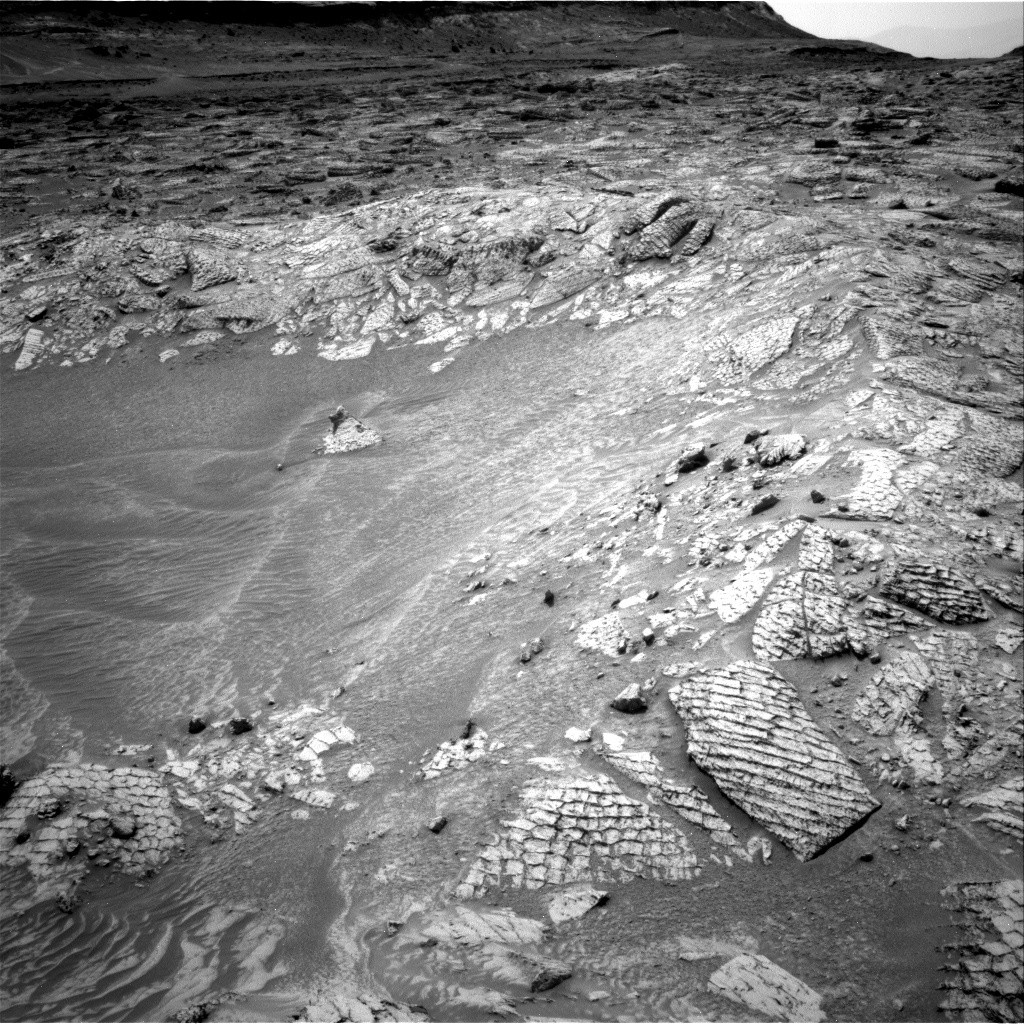
NASA's Curiosity rover, in a stunning display of arriving where it was told, parked itself on the rim of the 10-meter (33 feet) wide 'Antofagasta' crater. The crater was fresh and deep, just as the team had hoped, with a nice, well-defined rim. However, the bottom was inconveniently filled with dark, rippled sand, which had the audacity to cover up the most interesting rock layers.
A few tantalizing rock exposures peeked out just above the sand, potentially sheltered from space radiation since their deposition. But reaching them from the rim would have required the rover to assume such an awkward angle that it couldn't have delivered any samples to its instruments. The alternative - driving the rover onto the sandy crater fill - was deemed far too risky, as it might have gotten stuck. Examining nearby blocks for potential ejecta from deeper layers also proved futile, as all the rocks looked suspiciously similar. Consequently, the team decided against attempting to drill in or around the crater.
Undeterred, the rover found its workspace rich with other interesting bedrock targets, including polygonal features. The team planned detailed imaging of the crater and nearby buttes, alongside APXS geochemistry, MAHLI close-up imaging, and ChemCam LIBS geochemistry of the polygon-bearing rocks on the crater rim. The plan was rounded out with ongoing observations of the present-day Martian environment, including dust-devil monitoring and regular atmospheric measurements.
With Antofagasta scratched off the list, the hunt for the next drill site began. To plan the strategy in this 'post-boxwork' section of layered sulfate strata, the team has been studying the exposed layering in the buttes above as Curiosity drives up through 'Valle Grande.' These observations have allowed team members to map a succession of varying depositional styles and levels of diagenetic activity.
It's been a while since the rover drilled into typical layered sulfate rocks outside the distinctive boxwork-forming unit and Gediz Vallis. The last such drill was the 'Mineral King' campaign in February/March 2024, over 150 meters (492 feet) lower in elevation. The new goal is to measure a representative bedrock sample from the layers just above the boxworks.
Fortune smiled in the Sol 4870 workspace, presenting a drillable-looking, representative-looking block right in front of the rover. Preliminary APXS, MAHLI, and ChemCam geochemistry have been planned on the potential drill target, dubbed 'Atacama,' with additional measurements on surrounding blocks for context. If the results look promising, a preload test will be scheduled, bringing the promise of fresh drill data from the Red Planet.
The Good Times
News in your inbox.
One sardonic roundup, delivered on your schedule. Free. Unsubscribe whenever your tolerance for wit runs out.
Already subscribed but we never reach your inbox? Check your spam folder and hit 'Not spam' (or 'Remove from spam') to bust us out of junk-mail purgatory. You'll be helping everyone else too.
Don't open any of our emails for a month and you'll be automatically removed from the mailing list.
Rewrite Article
Select parts to regenerate with a fresh AI pass. Translations will be updated automatically.
Generate AI Image
Creates a sardonic version of the article image using OpenAI.