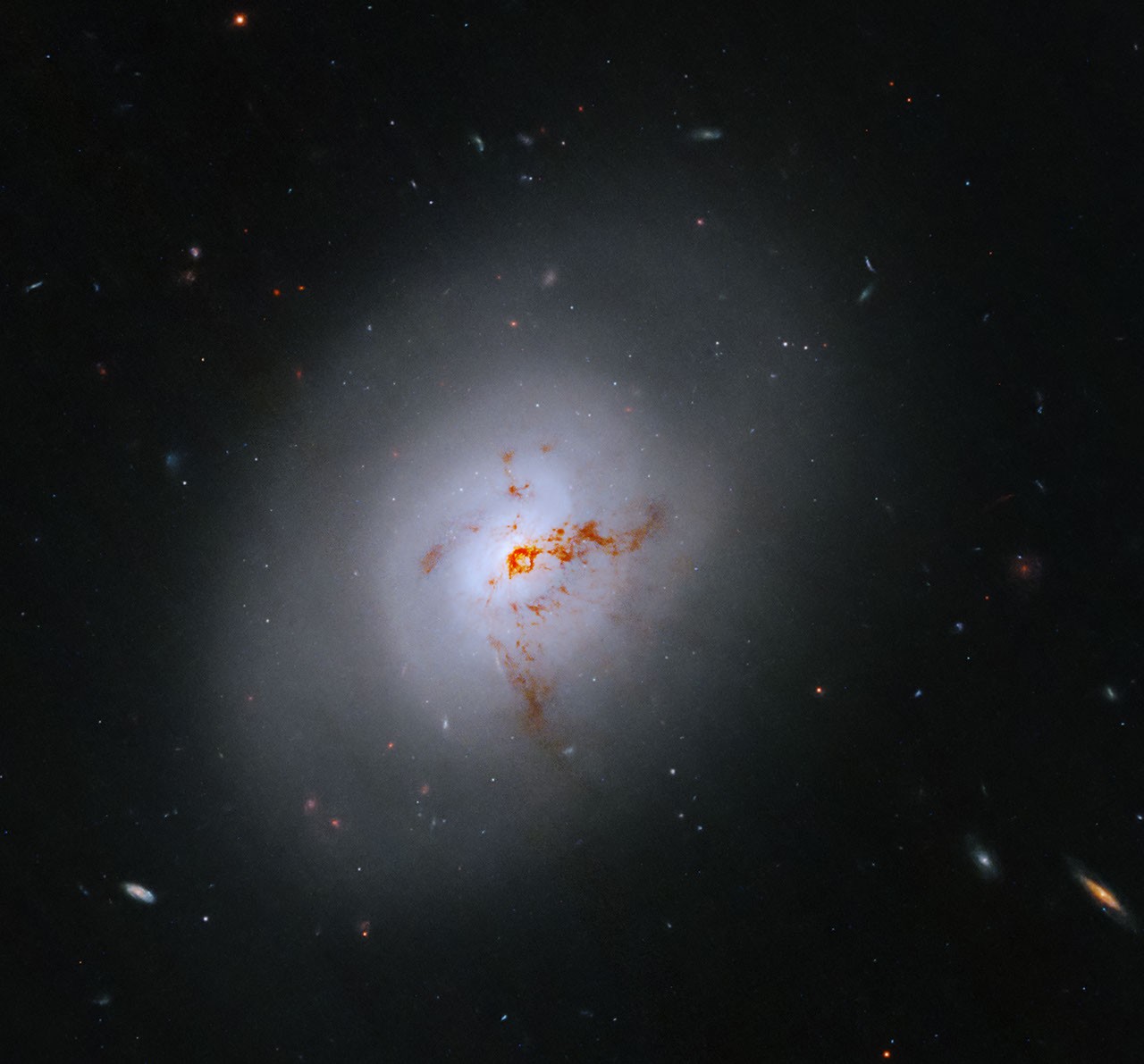
Hubble Spots Galaxy in Existential Crisis: Too Cool for Star Formation, Too Hot to Be a Spiral
Hubble captures a lenticular galaxy that partied too hard half a billion years ago and is now too shocked to make new stars, thanks to its supermassive black hole acting as a cosmic bouncer.
NASA's Hubble Space Telescope has captured an image of a galaxy that appears to be going through an identity crisis. NGC 1266, located some 100 million light-years away in the constellation Eridanus, is a lenticular galaxy - a cosmic shape-shifter that sits somewhere between a spiral and an elliptical. It has the bright bulge and flattened disk of a spiral, but lacks the spiral arms and is too cool (or rather, too hot and turbulent) for much star formation. Think of it as the galaxy equivalent of a teenager who has outgrown their favorite hoodie but hasn't quite figured out what to wear next.
But NGC 1266 isn't just any transitional galaxy. It's a rare post-starburst galaxy, meaning it had a massive star-making party about 500 million years ago - likely triggered by a minor merger with another galaxy - and now it's recovering from the hangover. Only about one percent of local galaxies are in this state. The merger funneled gas into the galaxy's supermassive black hole, which got so excited it became an active galactic nucleus (AGN), blasting out powerful winds and jets. These jets, combined with the burst of new stars, have depleted most of the galaxy's star-forming gas, and what little gas remains is so shocked and turbulent that new stars can't form. Observations by Hubble and other observatories show a strong outflow of gas from the galaxy, with any remaining stellar nurseries confined to its core. The supermassive black hole is essentially acting like a cosmic bouncer, ejecting star-forming gas and creating shockwaves that prevent any new gravitational clumping into infant stars.
Post-starburst galaxies like NGC 1266 are ideal for astronomers studying the complex processes that suppress star formation - and how supermassive black holes boss around their host galaxies. So while NGC 1266 may be a bit of a cosmic mess, it's a very informative mess.
The Good Times
News in your inbox.
One sardonic roundup, delivered on your schedule. Free. Unsubscribe whenever your tolerance for wit runs out.
Already subscribed but we never reach your inbox? Check your spam folder and hit 'Not spam' (or 'Remove from spam') to bust us out of junk-mail purgatory. You'll be helping everyone else too.
Don't open any of our emails for a month and you'll be automatically removed from the mailing list.
Rewrite Article
Select parts to regenerate with a fresh AI pass. Translations will be updated automatically.
Generate AI Image
Creates a sardonic version of the article image using OpenAI.