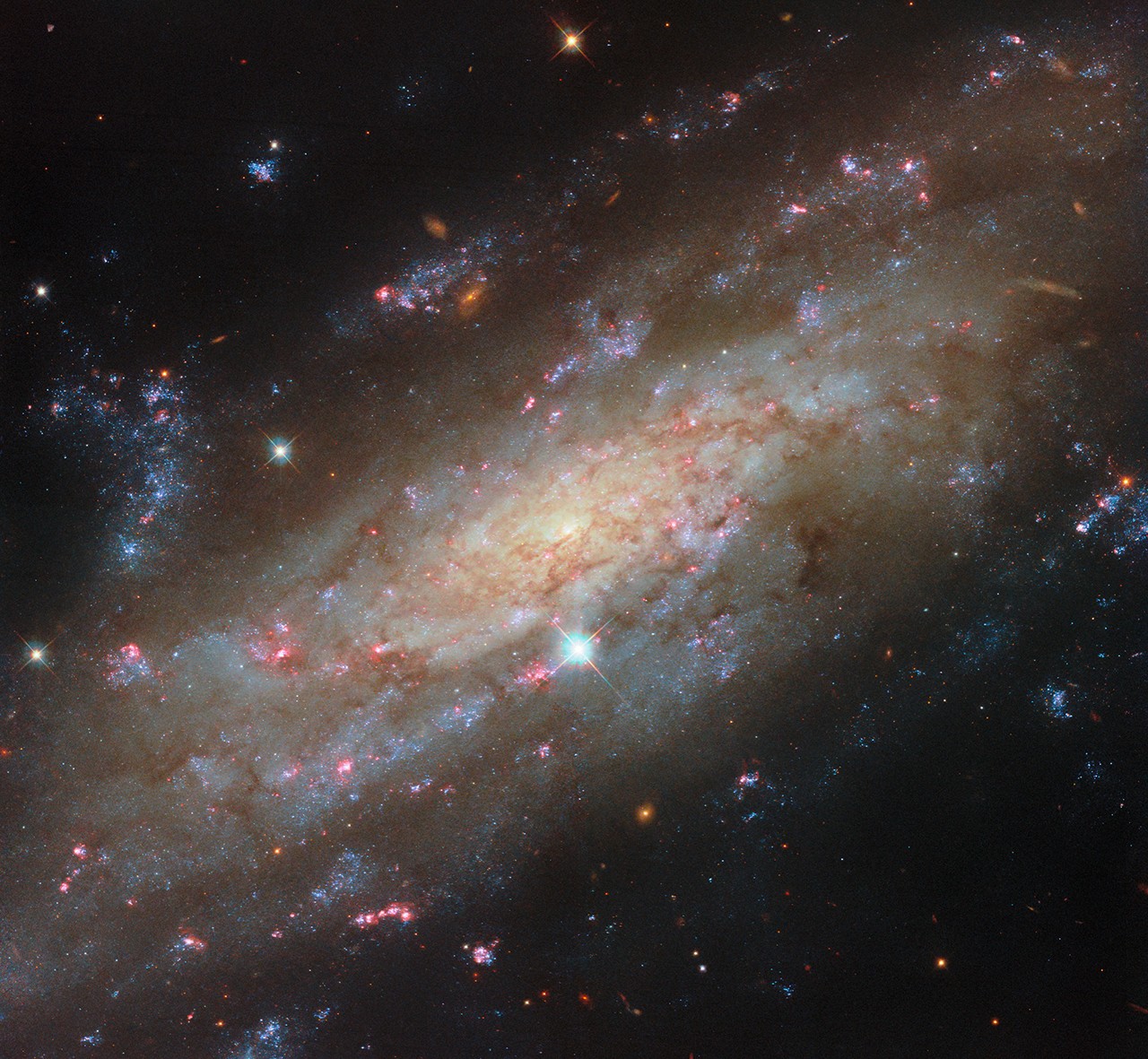
Hubble Snaps a Stunning Spiral Galaxy, Because That's What It Does
Hubble spots a spiral galaxy 53 million light-years away with a 60-million-solar-mass black hole, because apparently that's just what it does on a Tuesday.
In a move that will surprise absolutely no one, NASA's Hubble Space Telescope has once again pointed its lens at something beautiful and released a picture that makes the rest of us feel deeply inadequate about our own photography skills. The latest subject is NGC 3137, a spiral galaxy located 53 million light-years away in the constellation Antlia - which is Latin for "the Air Pump," because apparently astronomers ran out of mythological figures and started naming things after household appliances.
NGC 3137 is of particular interest to astronomers because it travels through space with a group of galaxies that is thought to be similar to the Local Group, the galaxy group that contains our Milky Way. Think of it as a cosmic neighborhood that looks a lot like ours, except with fewer questionable HOAs. The NGC 3175 group contains two large spiral galaxies - NGC 3137 and NGC 3175 (which Hubble has also observed, because Hubble gets around) - plus a number of smaller dwarf galaxies. Researchers have found more than 500 dwarf galaxy candidates in this group, though they're still not sure how many there are total. By studying this nearby galaxy group, astronomers can learn about the dynamics of our own galactic home, which is a lot cheaper than actually leaving the solar system.
NGC 3137 is revealed in fantastic detail by Hubble, thanks to observations in six different color bands. The galaxy’s center, encircled by a network of fine, dusty clouds, hosts a black hole estimated to be 60 million times more massive than the Sun. That's 60 million suns' worth of mass just sitting there, being all gravitationally demanding. The galaxy is highly inclined from our point of view, giving a unique perspective on its loose, feathery spiral structure. A couple of photobombing Milky Way stars and a smattering of far more distant background galaxies complete the image, because even in space, someone always has to crash the photo.
As stunning as each of these features may be, it’s the galaxy’s brilliant star clusters that steal the show. The galaxy is peppered with dense clusters of bright blue stars and glowing red gas clouds, which signal the presence of hot, young stars still encased in their birth nebulae. These star clusters are exactly what has drawn Hubble’s keen eye, as researchers are using the telescope to carry out an observing program (#17502; PI: D. Thilker) focusing on star clusters in 55 nearby galaxies. The data will help astronomers identify star clusters and their glowing nebulae, providing a way to measure the ages of stars in galaxies like NGC 3137. It's essentially a cosmic retirement home census, but for stars.
The observations are part of the PHANGS (Physics at High Angular Resolution in Nearby Galaxies)-HST program, a larger effort combining data from Hubble, the NASA/ESA/CSA James Webb Space Telescope, and the Atacama Large Millimeter/submillimeter Array (ALMA). Together, Hubble’s powerful optical and ultraviolet capabilities, Webb’s sensitive infrared eyes, and ALMA’s broad network of radio dishes bring us an unmatched view of star formation in the local universe. Because one telescope is never enough when you're trying to understand why the universe keeps making so many stars.
The Good Times
News in your inbox.
One sardonic roundup, delivered on your schedule. Free. Unsubscribe whenever your tolerance for wit runs out.
Already subscribed but we never reach your inbox? Check your spam folder and hit 'Not spam' (or 'Remove from spam') to bust us out of junk-mail purgatory. You'll be helping everyone else too.
Don't open any of our emails for a month and you'll be automatically removed from the mailing list.
Rewrite Article
Select parts to regenerate with a fresh AI pass. Translations will be updated automatically.
Generate AI Image
Creates a sardonic version of the article image using OpenAI.