
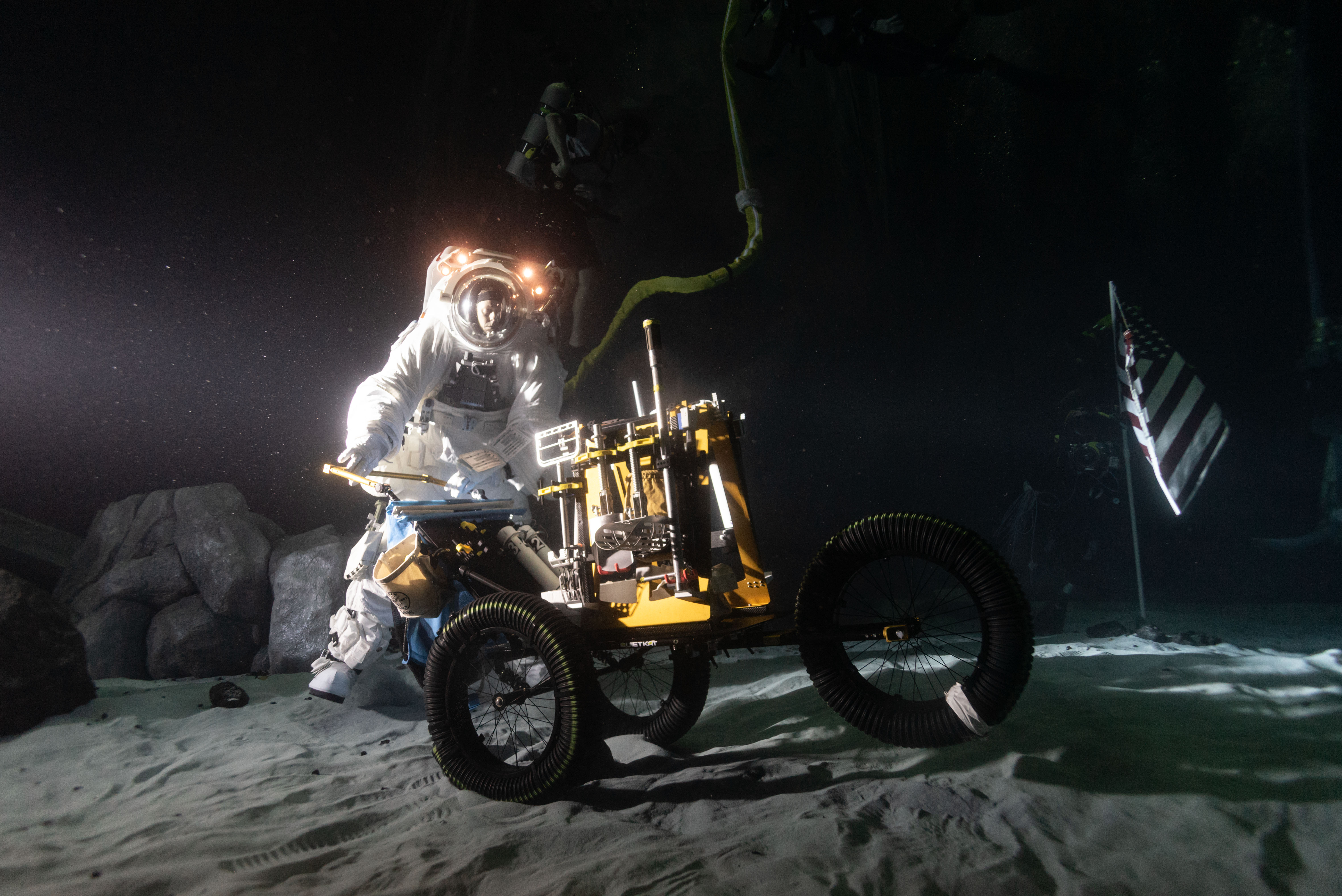
Scott Wray's spacewalk career began at age 6, when a tent impersonating a lunar lander and a pillow serving as a launch seat were all he needed to simulate a countdown sequence. “I would lie on my back with my feet propped up on a pillow as I imagined going through a launch countdown sequence,” he said. “Then I would exit the tent into a darkened bedroom and hop around just like the footage I had seen of Apollo astronauts.” Today, after 16 years at NASA’s Johnson Space Center, Wray has graduated from bedroom hopping to shaping spacewalk training across three eras of human spaceflight.
That childhood spark turned into a passion for engineering, fueled by LEGO builds and aircraft design books, and cemented by a week-long camp at Space Center Houston featuring tours of Johnson’s facilities and a visit from former NASA Flight Director Gene Kranz. “I was so inspired by the facilities and the incredible history of this place, I knew that I had to work here someday,” he said.
Wray entered NASA through the Contractor Co-op Program with United Space Alliance while studying aerospace engineering at Embry-Riddle Aeronautical University. During a co-op with the shuttle’s In-Flight Maintenance Team (IFM), he saw the IFM and EVA teams help the STS-117 crew fix a peeled-back thermal blanket on space shuttle Atlantis’s Orbital Maneuvering System pod using surgical staples and pins. “This real-time troubleshooting is where I learned about the EVA group and set my sights on working there during my final co-op tour,” he said. “I love to be hands-on, to take things apart and come up with creative solutions - that’s what really attracted me to EVA.”
EVA work reminded Wray of his time as a dog mushing guide in Alaska, living in a remote glacier camp with 250 Alaskan Huskies. “That is where I got my first taste of expeditionary skills,” he said. “I learned how to make do with the tools you have and make repairs to a broken sled miles away from home.” At Johnson, the EVA team often creates similar workarounds when hardware or vehicles malfunction. “It sounds scrappy, but I think it’s how we put the human into human spaceflight,” he noted.
After graduation, Wray became a full-time EVA team member, working under various contracts until becoming a civil servant in 2021. He started as an EVA instructor focused on tools and hardware, then developed new techniques and tools to accommodate NASA’s evolving astronaut corps, which now includes a wider range of backgrounds and body types. “That meant creating a curriculum that capitalized on individual strengths while building teamwork and resilience,” he said.
Wray also served as a flight controller for shuttle and space station EVAs, including a July 2013 station EVA that was terminated early when water filled the spacesuit helmet of ESA astronaut Luca Parmitano. “That incident taught me that even after decades of operating a spacesuit, there are still failure modes we haven’t imagined,” he said. “It reinforced the need for vigilance, adaptability, and continuous learning - because in human spaceflight, lives depend on it.”
Now the Artemis EVA training lead, Wray oversees training for lunar surface operations - a challenge NASA hasn't faced in over 50 years. “It’s going to be a completely new spacesuit, new vehicles, new environment,” he said. “And now they’re going to be walking instead of translating with their hands like we do on station.” The curriculum integrates geology, covering impact cratering, volcanology, sample collection, and traverse planning. “It’s about enabling astronauts to become effective field scientists while mastering complex EVA operations,” he explained.
Training uses multiple facilities: the Neutral Buoyancy Laboratory (since 1997), the Active Response Gravity Offload System for suited mobility, virtual reality, lighting labs simulating the Moon’s harsh South Pole conditions, field sites for geology training, and suit simulators for caution-and-warning scenarios. “Spearheading this effort as EVA training lead allows me to ensure every element - from science to operations - is integrated into a program that will prepare astronauts for success on the Moon and beyond,” Wray said. “This effort is more than preparation, it’s the foundation for future exploration and a steppingstone toward Mars.”
Outside work, Wray and his wife - inspired by their daughter - took an acting class at a local fine arts studio, leading to his on-stage debut in “Rock of Ages” and a starring role as William Shakespeare in this year’s “Something Rotten.” “I never would have thought I’d have so much fun acting, singing, and dancing on stage,” he said.
Wray remains grateful for his off-stage role in missions that will conduct science on the lunar surface. “Returning to the Moon is something I’ve dreamed about since I was a kid,” he said. “Artemis isn’t just about going back - it’s about shaping the future. When we choose to push the boundaries of exploration, the advancements we make don’t just expand knowledge, they create lasting benefits for all of humanity.”