
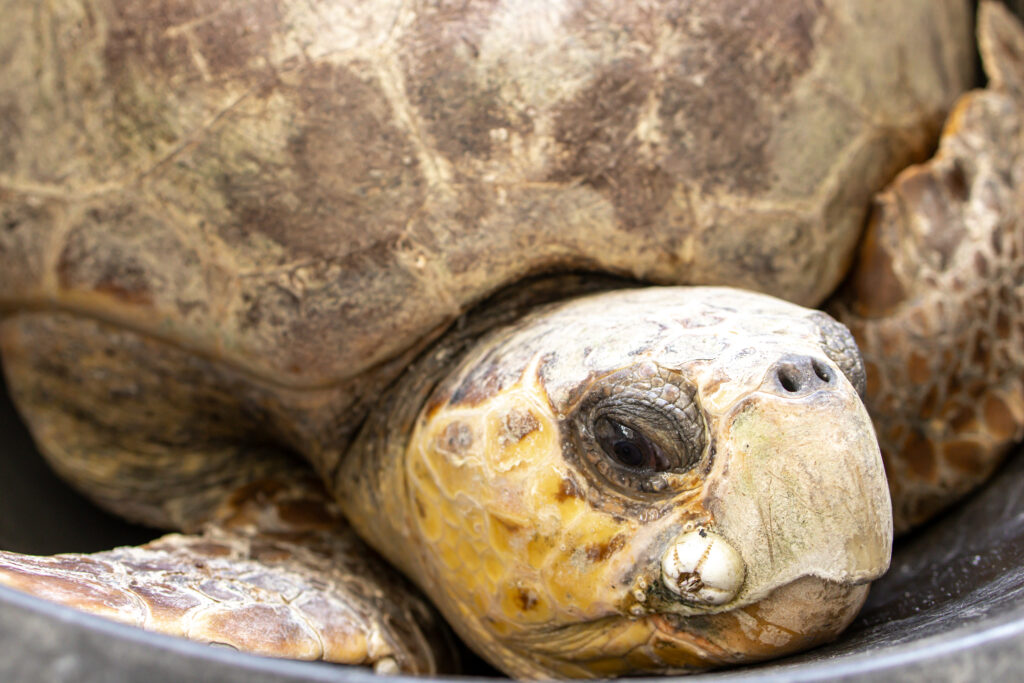
On a recent Sunday evening, a 172-pound male loggerhead sea turtle named Bowser found himself in a predicament familiar to far too many of his kind: hooked by a fisherman near his front left flipper off the Navarre Beach Fishing Pier. Enter Scott Dexter and a team of volunteers from the Navarre Beach Sea Turtle Conservation Center, who arrived like the world's most stressed-out AAA roadside assistance.
"Pull! Pull!" Dexter chanted as eight men hauled the thrashing reptile 35 feet up into the air using a specialized hoist that Dexter himself designed and had built for exactly this purpose. Because when you're a volunteer turtle rescuer in Florida, you don't just buy equipment off the shelf - you invent it.
Bowser was foul-hooked, meaning he wasn't trying to eat the bait but simply swam past at the wrong moment and got snagged. The crew cut the line close to the hook, loaded him onto a Kawasaki UTV, and got him off the pier within 25 minutes, despite Bowser's best efforts to escape his would-be saviors. "That's a good sign," Cheri Dexter said of his feistiness. "If they're lethargic or just laying there, that's a bad sign."
Bowser was the 26th turtle rescue of 2026 from that pier. The 27th came two days later. Last year, the center rescued 59 turtles from the pier, mainly loggerheads or green sea turtles. Entanglements peak during nesting season, May through October, which is also when the pier's human visitors are most active.
Navarre Beach is a small beachfront community in the Florida Panhandle, but it boasts the longest fishing pier in the state - 1,545 feet of prime turtle-hooking real estate. From 2000 to 2022, Santa Rosa County, where Navarre Beach sits, accounted for 56 percent (254 of 452) of fishing pier entanglements reported on Florida's Gulf Coast. For context, every turtle incident between 2014 and 2022 occurred at that single pier.
Statewide, the federal Sea Turtle Stranding and Salvage Network reported 503 strandings last year in Florida due to incidental capture from fishing entanglements. Across all Atlantic and Gulf Coast states, there were 954 such strandings. And those are just the ones people manage to rescue. Scott Dexter estimates that about 38 percent of hooked turtles at the Navarre Beach pier are successfully saved before they break the line and swim off with dangerous gear still attached.
Loggerheads like Bowser are one of five sea turtle species found in the Gulf. Loggerheads and green sea turtles are the most common here, along with the Kemp's ridley - the most imperiled of all sea turtle species, with fewer than 1,000 breeding females estimated to exist worldwide. Leatherbacks, which can hit 2,000 pounds and dive 3,000 feet, mainly nest on Florida's Atlantic coast but occasionally show up on Gulf beaches. Hawksbills stick to south Florida or the Caribbean.
All five species are listed as endangered or threatened under the Endangered Species Act, having been pushed to the brink by hunting, fishing nets, and centuries of humans deciding their shells and meat were worth more than their lives. Turtle excluder devices, required by law since 1987, have helped. But climate change now poses a particular threat: the sex of hatchlings is determined by sand temperature, and warmer nests produce more females, which is about as sustainable as it sounds.
Bowser was taken to the Gulfarium CARE Center, a nonprofit rehab facility in Fort Walton Beach. Staff there removed the J-style hook from his flipper and another external hook he'd been carrying around for who knows how long. X-rays revealed he also had a hook lodged in his esophagus from a previous encounter - the sea turtle equivalent of a frequent customer card nobody wants.
Gulfarium staff will try to sedate Bowser and remove the hook manually. For deeper hooks, they use a delightfully low-tech solution: feeding the turtle cotton balls soaked in mineral oil. "They don't digest it, it will just go straight through them," said marketing manager Mary Fomby. The cotton ball gets caught on the hook, creating a barrier to prevent further damage. It's not elegant, but it beats surgery.
The Gulfarium currently has 31 turtle patients, with seven slated for release this week. The center recently celebrated its 1,000th successfully released turtle. Most rescues happen between May and October, which is also when the center's donation-dependent budget gets the most workout.
None of these operations are state-funded, beyond occasional grants. The Navarre Beach center, the Gulfarium CARE Center, and the Loggerhead Marinelife Center all rely on donations, grants, and their own revenue. Most of the rescue teams are trained volunteers, not full-time employees. They do this because the alternative is letting endangered animals die from hooks, lines, and the general chaos of sharing a coastline with 22 million people.
Bowser got his name from Gulfarium staff as part of a Super Mario Brothers naming theme that week. The previous week's rescues were named after famous artists: Da Vinci, Raphael, Degas, and Frida. It's a small kindness for creatures that can't tell you their names, but at least someone's keeping track.