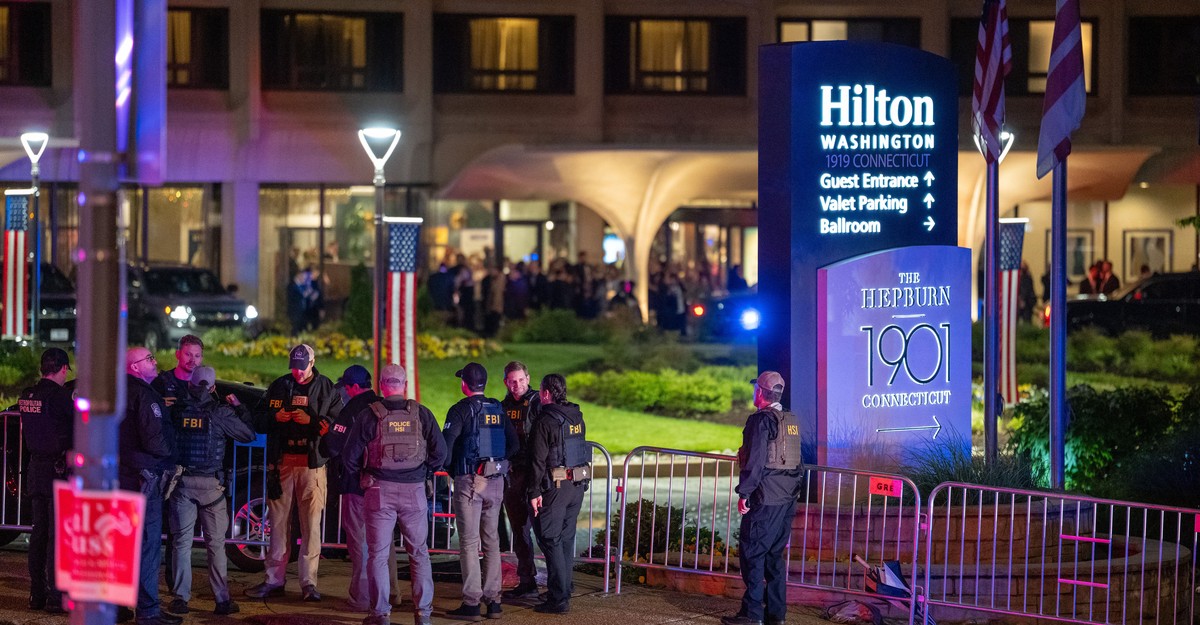
On Saturday night, a heavily armed shooter easily accessed areas near the ballroom where the White House Correspondents' Dinner was being held, prompting a rushed evacuation of the president and senior officials and a hectic, scary evening for attendees. Why wasn't the event safe? That's a fair question, but perhaps the wrong one. The more realistic inquiry is whether this kind of event can ever be made safer - and the answer, delivered with the enthusiasm of a root canal, is 'kind of, maybe, but not really.'
This summer, the United States will host two major multicity events: celebrations for the 250th anniversary of America's founding and the World Cup. Both are highly complex, attracting large domestic and international audiences, including political leaders. In two years, Los Angeles will host the Summer Olympics. White House Chief of Staff Susie Wiles is convening a meeting this week with various officials to discuss security at events the president attends. The guiding principle, according to Harvard's mega-event planning program, is not to eliminate risk but to reduce it as much as possible. 'Less bad' is hardly a rallying cry, nor an excuse for political violence, an overly permissive gun culture, or negligent planning - it's simply an acknowledgment that vulnerability is the price of freedom, which is a bit like saying your leaky roof is the price of having a ceiling.
For security officials, building a fortress is relatively easy: deploy 'the three g's' - guns, guards, and gates. Nobody visiting a nuclear facility complains about the onerous security features. But even a hard target bumps up against soft areas - roads, skies - that create vulnerability. Mega-event organizers must balance site logistics, risk assessment, emergency response, community engagement, crisis communications, weather events, crowd management, and transportation. The trick is a triangle: one corner is reducing risk (terror, violence, storms, cyberattacks, health scares, drones); another is coordinating defenses (community, city, state, federal, military, private, and nonprofit actors); and the top point is fun, joy, togetherness, celebration, spectacle, and purpose. Yes, 'fun' is a security goal. That might be fans watching an athletic performance, journalists shining in front of an administration that seeks to undermine them, or a fractious democracy celebrating its birthday.
The World Cup will occur across three countries - the United States, Mexico, and Canada - in 16 host cities, over six weeks and four time zones. Conflict in Iran, border-enforcement controversies, cartels in Mexico, dangerous weather, and gun violence will be persistent risks. The July 4 celebrations for America's 250th will include public events in every state, high-profile extravaganzas and pavilions in Washington, D.C., and a Naval Review parade in New York and New Jersey involving 30 tall ships from different countries. Safety planning for both has been in the works for years, but the WHCD shooting and ongoing political violence may require recalibration. Organizers must shore up law-enforcement defenses without taking away from the meaning of the events - a balancing act that sounds like juggling flaming torches while riding a unicycle on a tightrope.
The protective planning at the WHCD this year was not sufficient. The ballroom itself, which required electronic scanning to enter, was never breached, though it was far more secure than areas accessed by the public, hotel guests, and partygoers attending pre-events. The gunman entered the hotel by simply reserving a room there, gaining easy access through one layer of defenses - not unlike how most of us check into a Marriott. Perhaps future dinners should be moved to a convention center or stand-alone facility with limited access and heavier security. The answer is not, however, the one promoted by Donald Trump and his supporters - that the incident proves Trump needs his own ballroom at the White House. Putting aside the controversies surrounding his destruction of the East Wing in that pursuit, the dinner is not named the White House's Correspondents Dinner. It celebrates the free press, and a future dinner at the Trump White House would mock the media's very essence, even if - or because - it is more secure.
The Good Times
News in your inbox.
One sardonic roundup, delivered on your schedule. Free. Unsubscribe whenever your tolerance for wit runs out.
Already subscribed but we never reach your inbox? Check your spam folder and hit 'Not spam' (or 'Remove from spam') to bust us out of junk-mail purgatory. You'll be helping everyone else too.
Don't open any of our emails for a month and you'll be automatically removed from the mailing list.
Rewrite Article
Select parts to regenerate with a fresh AI pass. Translations will be updated automatically.
Generate AI Image
Creates a sardonic version of the article image using OpenAI.