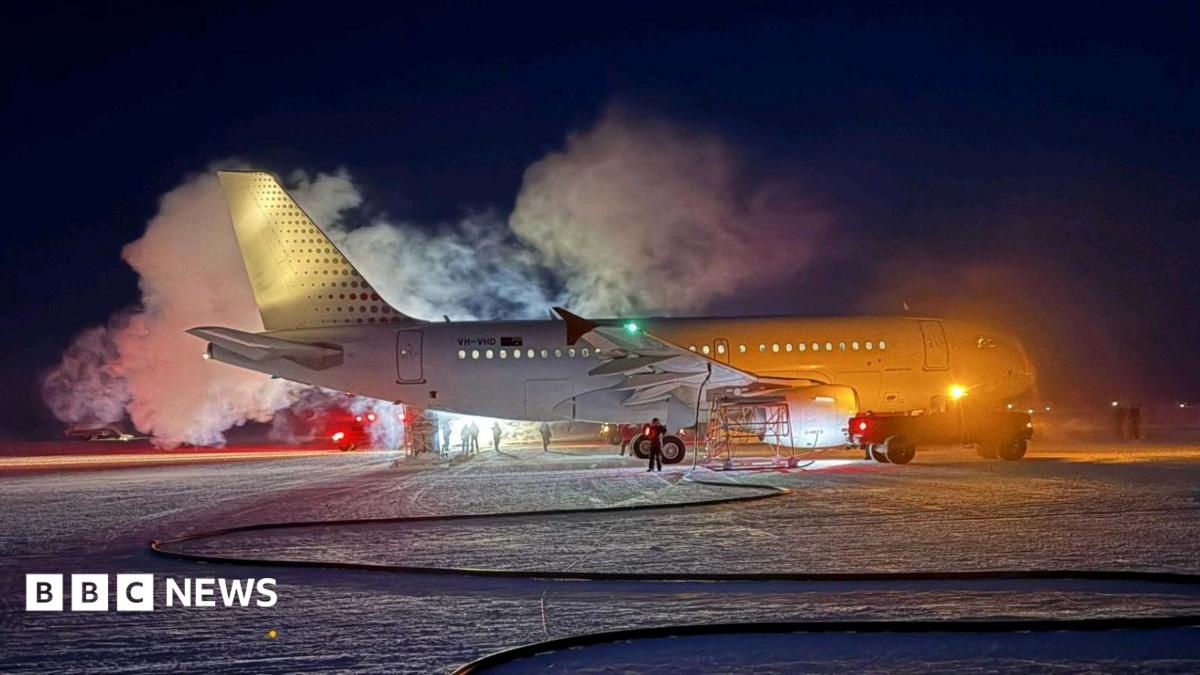
In a move that makes your Monday morning commute look like a leisurely stroll, an Australian aviation crew has executed a daring midwinter rescue in Antarctica, braving freezing temperatures and total darkness to save a US expedition member from McMurdo Station.
Skytraders, the aviation company behind the operation, described the mission as 'extraordinary' - which is one way to put flying a passenger jet in -43°C (-45.4F) darkness. The call came in last Friday with a request for urgent medical evacuation, and after a brief weather-induced delay, the crew managed to land their Airbus A319 in what they termed 'extremely challenging conditions.'
The patient, whose condition remains as mysterious as the plot of a Christopher Nolan film, was safely loaded onto the plane - affectionately known as Snowbird 1 - and flown to Christchurch, New Zealand, where they are now recovering well. No further details were provided, so we'll just assume it was a case of severe frostbite from touching a doorknob without gloves.
Skytraders' deputy chief executive, Duncan Mackay, revealed that the plane underwent a complete refit into a specialised medevac configuration within 24 hours of the call - because when you're in the business of Antarctic rescues, you apparently keep a spare medevac kit lying around. Takeoff was then delayed for 12 hours while the crew waited for a suitable weather window, because even heroes need to wait for the weather to cooperate.
The plane eventually took off from Hobart, Tasmania, in the early hours of Friday morning, landing at the US research station on Ross Island. Mackay noted that this was likely the closest a civilian airliner had operated to the winter solstice (21 June), adding that while Skytraders has conducted winter medevacs before, 'never this close to the winter solstice.' Because apparently, there's a competition for who can fly in the most inhospitable conditions, and Skytraders is winning.
Captain Al Wallach, the pilot, credited the success to the team's specialist expertise, including flight crews, meteorologists, operational planners, runway teams, and medical personnel. He said that while every Antarctic mission demands precision, winter operations 'raise the complexity significantly' - a masterclass in understatement. 'The conditions we encountered were right on the edge of even the most specialised aircraft capability,' he added, which sounds like a great tagline for a disaster movie.
This isn't Skytraders' first rodeo in Antarctic heroics; they performed a similar mission in March 2020, evacuating a member of the US Antarctic Program from McMurdo when temperatures were a balmy -30°C. Because why save lives in reasonable conditions when you can save them in the literal bowels of winter?
The Good Times
News in your inbox.
One sardonic roundup, delivered on your schedule. Free. Unsubscribe whenever your tolerance for wit runs out.
Already subscribed but we never reach your inbox? Check your spam folder and hit 'Not spam' (or 'Remove from spam') to bust us out of junk-mail purgatory. You'll be helping everyone else too.
Don't open any of our emails for a month and you'll be automatically removed from the mailing list.
Rewrite Article
Select parts to regenerate with a fresh AI pass. Translations will be updated automatically.
Generate AI Image
Creates a sardonic version of the article image using OpenAI.