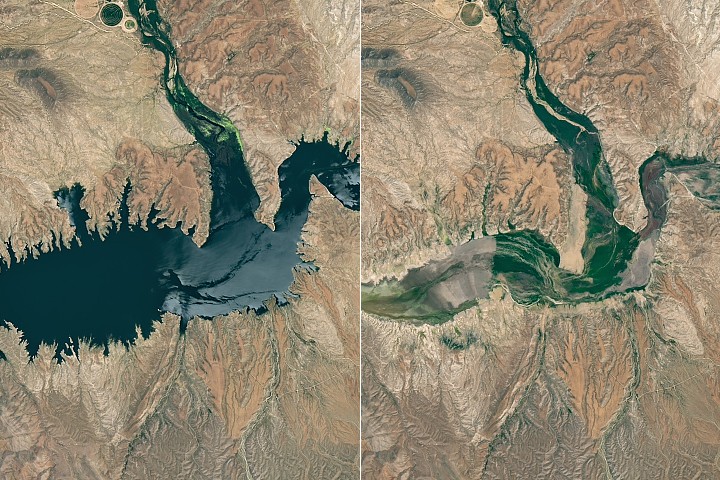
The Gila River, one of the Southwest's most important waterways - delivering water for people, farms, and wildlife while connecting New Mexico's snowy peaks to Arizona's desert lowlands - is having a rough year. The San Carlos Reservoir, formed by the Coolidge Dam and normally one of Arizona's largest bodies of water, is currently less than 1 percent full. In wetter years, snowmelt from the Mogollon Mountains and Black Range refills it, but the 2026 snowpack was just 2 percent of the 1991-2020 March median. April streamflow hit 39 percent of normal, and by June, after mandatory water releases for downstream agriculture, the reservoir held a paltry 389 acre-feet.
NASA's Landsat images tell the tale: a May 22, 2026 shot shows the near-empty reservoir with green vegetation - tamarisk, willow, cottonwood, sedges, and grasses - growing along the channel, compared to a June 2023 image when it was about 60 percent full. Officials closed the reservoir indefinitely on June 5 after low oxygen levels caused hypoxia that killed virtually all fish, including largemouth bass, black crappie, bluegill, channel catfish, flathead catfish, brown trout, and rainbow trout. The San Carlos Recreation and Wildlife Department warned that decomposing fish may pose health risks to anyone attempting to boat or fish.
This isn't the reservoir's first rodeo: it has run out of water at least 20 times since 1930. At the dedication ceremony, humorist Will Rogers famously told President Calvin Coolidge, "If that was my lake, I'd mow it," as grass grew on the dry bottom. Major fish kills also occurred in 1976 and 2018; after 5 million fish died in 1976, the Gila Herald reported it took five years for the ecosystem to rebound. The region is in a multi-year dry period, with severe drought in New Mexico's Gila River headwaters, per the U.S. Drought Monitor.
But there's hope: heavy monsoon rains could help. NOAA's May 2026 outlook projected a 33 to 50 percent chance of above-average rainfall that summer. A strengthening El Niño in the central and eastern equatorial Pacific may also boost heavy rains in the U.S. Southwest. So while the fish are dead and the reservoir is a mud puddle, nature might still send a drink - eventually.
The Good Times
News in your inbox.
One sardonic roundup, delivered on your schedule. Free. Unsubscribe whenever your tolerance for wit runs out.
Already subscribed but we never reach your inbox? Check your spam folder and hit 'Not spam' (or 'Remove from spam') to bust us out of junk-mail purgatory. You'll be helping everyone else too.
Don't open any of our emails for a month and you'll be automatically removed from the mailing list.
Rewrite Article
Select parts to regenerate with a fresh AI pass. Translations will be updated automatically.
Generate AI Image
Creates a sardonic version of the article image using OpenAI.