Air India Crash: The 19 Victims Not on the Plane, and the City That Can't Look Away
A year after an Air India plane crashed into a medical college hostel in Ahmedabad, killing 19 people on the ground, survivors and families still live with the wreckage - and the sound of planes overhead.
Warning: This story contains details some readers might find distressing.
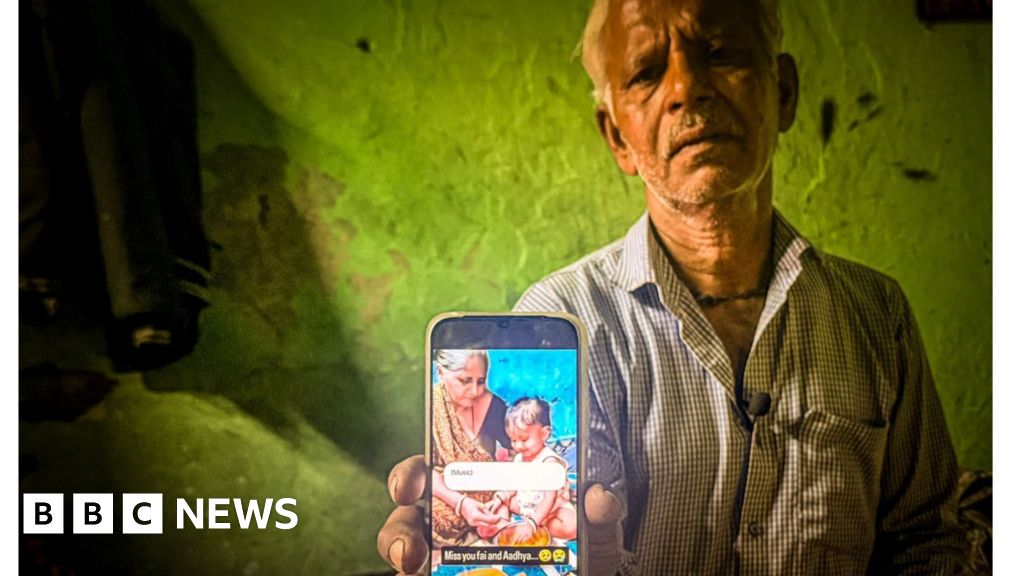
Prahlod Thakur wakes up every morning to the same photographs: his wife Sarlaben, his granddaughter Aadhya in a white dress, both beaming from frames on peeling green walls in his Ahmedabad home. They were among the 19 people killed on the ground when an Air India plane crashed into the BJ Medical College hostel complex in June last year - 241 of the 260 victims were on the aircraft. A year later, the loss feels as fresh as the soot on the wrecked building's walls.
"I just miss them," says Thakur. "I see the photos and feel like crying."
Investigators are expected to release a report soon, but in Ahmedabad, the question isn't just what happened to the plane - it's what happens to a place when catastrophe refuses to leave. Unlike most disaster sites, the hostel remains an open wound: ripped upper floors, jagged concrete, a smoke-blackened staircase, and luggage still buried under rubble. Officials have approved demolition, but for now, students pass it daily on their way to lectures as planes rumble overhead - a sound that used to blend into the city's background noise but now carries a very different meaning.
"Whenever a plane passes by, we feel the same pain," says Thakur. "We don't even look at the sky."
For 15 years, Thakur's family ran a tiffin service for doctors at the adjoining hospitals. Their two-year-old granddaughter rarely left her grandmother's side. On the day of the crash, lunch was being served in the mess when the plane hit. Sarlaben took Aadhya upstairs to the washroom; moments later, the aircraft came crashing in. Thakur, working in another building, ran toward the smoke, searching room to room, calling "Sarla, Sarla." Six days later, he found them in a hospital mortuary.
Arman Khan Pathan was late for lunch; his best friend Aditya Dayal was later still. Those minutes separated their experiences but not their memories. Arman was trapped under a table as cylinders exploded and dust filled the room; he smashed a window with his bare fist to breathe. Aditya helped carry him out on a mattress. A year later, they still recall the unrecognizable, charred bodies that arrived that afternoon - and the smell that lingers unexpectedly.
Brijesh, riding a scooter to the mess with two friends, still undergoes physiotherapy for burn injuries, wearing pressure garments through Ahmedabad's heat. "It happened," he says. "What can be done?" He passes the ruins sometimes, developing a habit of looking away.
Meenakshi Parikh, the college dean, had to keep the institution running while grappling with overwhelming grief: parents searching for children, students healing, staff overworked, families awaiting DNA results. One man who lost his son, daughter-in-law, and granddaughter refused to leave until he saw their bodies. "My eyes are the DNA test," he told officials. Parikh pauses when recalling it: "I could see where he was coming from."
As the anniversary approaches on 12 June, the college has planned a prayer meeting, a blood donation drive, and tree planting. Moving forward, Parikh says, is not the same as moving on. "It was a gradual process of settling back into life."
Back at his house, Thakur reaches for his phone - a video recorded the day before the crash shows Aadhya carefully feeding her grandmother a morsel of food. Sarlaben smiles. Outside, another aircraft crosses the Ahmedabad sky.
The Good Times
News in your inbox.
One sardonic roundup, delivered on your schedule. Free. Unsubscribe whenever your tolerance for wit runs out.
Already subscribed but we never reach your inbox? Check your spam folder and hit 'Not spam' (or 'Remove from spam') to bust us out of junk-mail purgatory. You'll be helping everyone else too.
Don't open any of our emails for a month and you'll be automatically removed from the mailing list.
Rewrite Article
Select parts to regenerate with a fresh AI pass. Translations will be updated automatically.
Generate AI Image
Creates a sardonic version of the article image using OpenAI.