
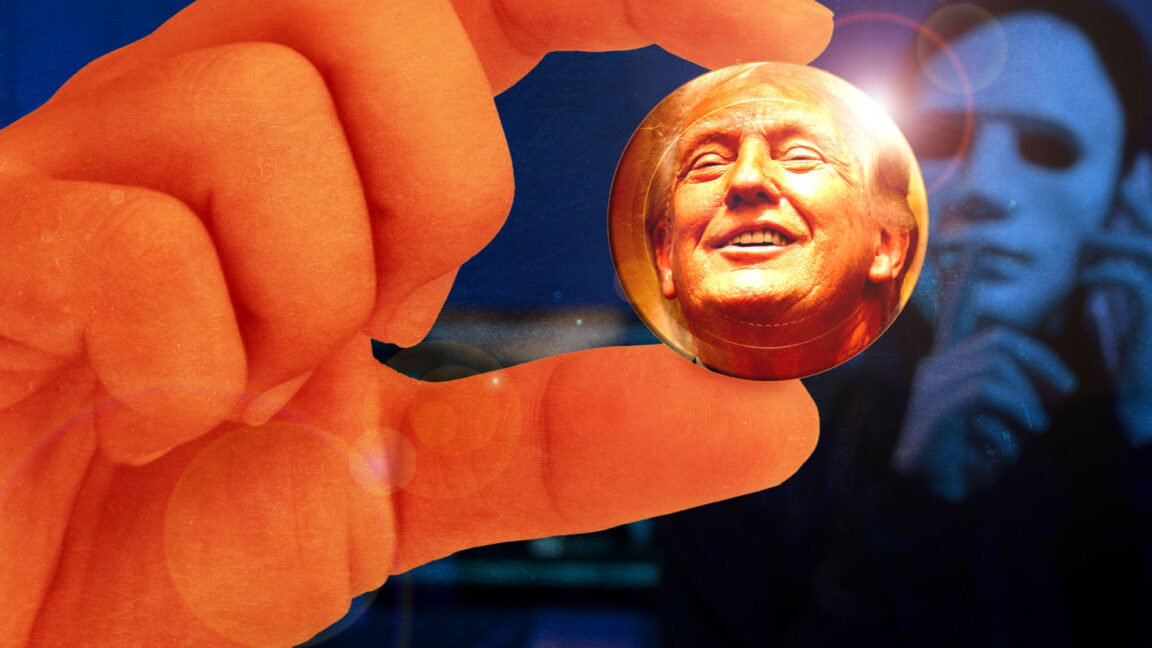
The next Donald Trump memecoin event could very well be the last, but not because the party's over. If Democrats retake control of Congress this fall, they may succeed in passing legislation banning the president and his family from profiting from the token that has government ethicists reaching for the smelling salts.
Trump launched his official memecoin before his inauguration in January 2025, becoming the first president to release his own cryptocurrency. Since then, Trump’s family has reportedly made more than $280 million, while the memecoin’s value has tanked. Insiders linked to Trump affiliates, who hold most of the tokens, have cashed out at key moments, collected fees on every retail trade, and earned profits exceeding $600 million. Meanwhile, retail investors have lost more than $4.3 billion, according to a CryptoRank analysis.
Initially priced at $28.73, the tokens have lost about 93 percent of their value from their peak. The Melania Trump memecoin, launched simultaneously, is the bigger failure, with a 99 percent loss. The true value for hoarders isn't gains, though - it’s the chance to score an invite to exclusive Trump-hosted events if they’re among the top 200 to 300 holders.
Investors competing for leaderboard spots have caused the price to spike twice since trading began on Solana and TRON blockchains. Last year, a Mar-a-Lago dinner announcement drove the price to $45.50. After the dinner, it dropped to an all-time low of $2.71. Apart from a brief 60 percent spike after last month’s announcement of a second Mar-a-Lago event - a cryptocurrency conference and gala scheduled for April 25 - the price has largely stuck under $3.
Ahead of the next event, the “GetTrumpMemes” X account cheered retail investors on, teasing photo ops with boxer Mike Tyson and a keynote from Trump. The posts reminded investors it was a “close race” to become a top-29 VIP, who get extra perks like a watch, on top of the “Trump fragrance,” trading card, and commemorative poster everyone receives.
David Krause, a finance expert at Marquette University, has been monitoring the token. He found that the upcoming gala failed to “reverse the long-term downward trend” and noted that “approximately 80 percent of the token supply is controlled by Trump-affiliated entities” who collect fees on every trade, earning more than $324 million in fees alone. “This level of concentration is highly unusual and widely considered a significant red flag,” Krause said.
Because insiders maintain significant control, they can prioritize personal gain over long-term value for investors. CryptoRank reported that for every dollar insiders earned, investors lost $20. If lawmakers don’t intervene, this could stretch across Trump’s entire term, “since developers locked $2.7 billion in insider tokens in smart contracts until 2028,” establishing a “structured exit strategy” for insiders to cash out later, potentially leaving “underwater retail holders” stuck.
Krause has recommended additional research into on-chain wallet activity to “determine whether insider selling accompanies promotional announcement.” He also noted the token’s lack of a roadmap, utility, and “heavy reliance on financial incentives” like events “rather than tangible product development.”
In lieu of a roadmap, GetTrumpMemes posted an update claiming “$TRUMP is entering its next phase of development, focused on liquidity depth, additional utilities, and disciplined long-term value creation.” The post proposed initiatives like offering rewards for participating in “Kamino vaults” and unlocking more tokens for “growth initiatives.”
Krause said “the plans represent an attempt to pivot from pure speculation to a yield-driven ecosystem.” However, he noted that “independent analysts caution that despite these efforts, the token’s price reality remains bearish,” and any long-term reversal would require the token to “decouple from political news cycles and develop real utility beyond speculative incentives.” Essentially, for retail investors to profit, peak prices cannot hinge on Trump throwing a big party at Mar-a-Lago.
GetTrumpMemes did not respond to Ars’ request to comment.
Robert Maguire, vice president of research for Citizens for Responsibility and Ethics in Washington (CREW), told Ars that Trump has already outpaced the conflicts of interest tracked during his last term. The memecoin launch signaled the president would be more brazen about using the office to enrich himself.
But Trump’s crypto activity could grind to a halt as his approval ratings hit record lows. Voters are upset about policies on tariffs, AI, and immigration. His decisions in the Iran War - and a threat that “a whole civilization will die” if his demands weren’t met - spurred urgent calls for impeachment from Democrats.
As the president’s popularity wanes, his memecoins may come under more scrutiny. Maguire said there’s “ample evidence” that retail investors “hope and intend to get something in return” for enriching the president, like a pardon or business opportunity. There’s also a “foreign influence element,” Maguire said, noting that “more than 70 percent of attendees” of the first event who could be identified “were foreign.” Although the Trump memecoin website says “no foreign Government Officials are allowed to attend” the upcoming event, Maguire said there’s no knowing whose interests could be represented by large purchases from unknown foreign entities.
“So not only have we been very clearly shown that the president is acting in his own financial interests and not the national interest, but he’s also acting in his own financial interest as it relates to any foreign entity that has the ability to make the kinds of payments that will catch his eye,” Maguire said. If any foreign government were found to be purchasing memecoins to influence the president, that would violate the Foreign Emoluments Clause of the Constitution.
Notably, the other cryptocurrency venture tied to Trump, World Liberty Financial, has eclipsed the memecoin and enriched the Trump family by an estimated $5 billion. That venture sparked a Senate request for an ethics probe over a billion-dollar deal with a state-backed Emirati investment firm, MGX. Senators wrote that the deal “may violate the Emoluments Clause” and “federal ethics statutes, including criminal provisions barring bribery,” raising the prospect that the Trump family “could expand the use of their stablecoin as an avenue to profit from foreign corruption.”
The White House has repeatedly denied any conflicts of interest, and Trump has evaded serious inquiries. Maguire suggested this may be because investigating agencies are understaffed following Department of Government Efficiency reductions or run by appointed officials loyal to Trump. “We have this situation where the president is open for business, and people are showing up and personally enriching him, and they are getting things in return,” Maguire said. “And we are largely, in many ways, being left in the dark.”
Should Democrats reclaim the House, Maguire thinks even hesitant Republicans could back legislation to limit his family’s crypto dealings. “I feel pretty confident that this would be a priority for a new Congress,” Maguire said, adding it's “difficult in this era to imagine Congress actually doing something, but it is also entirely possible that this starts to gain a salience and that people start to realize it’s really sort of becoming a bipartisan issue.”
Last month, the SEC narrowed securities definitions in a way that could benefit the Trump family, classifying “most of crypto-based assets as commodities, collectibles, payment tokens or ‘digital tools'” instead of securities. This exempts Trump’s crypto ventures from SEC oversight and disclosure requirements.
None of that would be an issue if Democrats drummed up support for two bills introduced last year that stalled without Republican support. The Modern Emoluments and Malfeasance Enforcement (MEME) Act, pointedly targeting Trump’s memecoin, would block the president, senior officials, and their families from “benefiting from the issuance, sponsorship, or promotion of certain assets,” including “digital assets such as cryptocurrency or a memecoin.” The bill requires disgorgement and imprisonment of up to five years for violations.