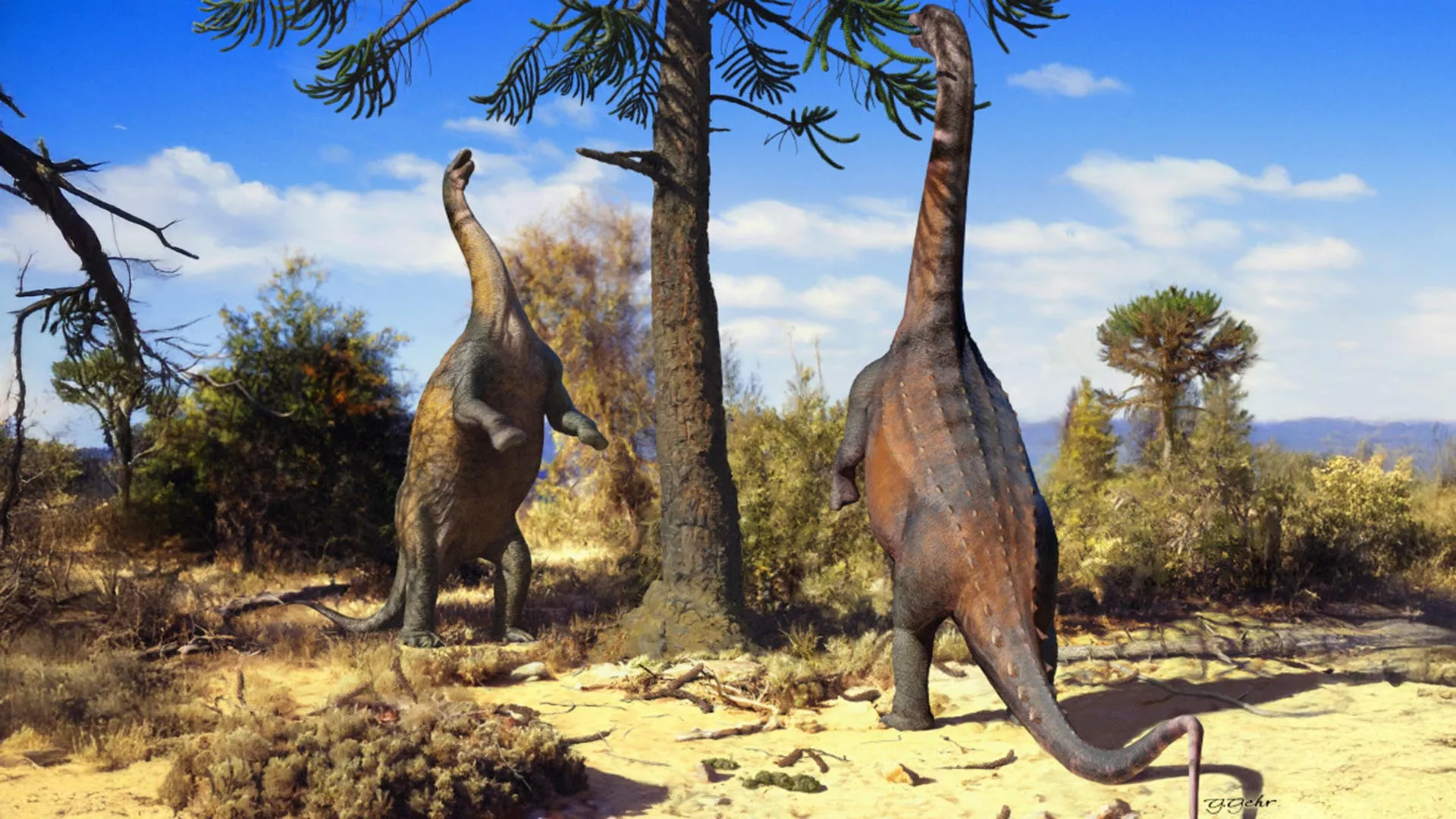
About 66 million years ago, two South American sauropods - Uberabatitan from Brazil and Neuquensaurus from Argentina - could rise onto their hind legs and stay there for relatively long periods, especially when they were young. This ability may have helped them reach leaves high in trees, appear more intimidating to predators, attract mates, or reproduce. But new research suggests their standing-upright game declined as they grew: younger animals were better at supporting themselves on two legs, while adults likely experienced much greater strain from their increasing weight.
The findings, published in the journal *Palaeontology* and supported by FAPESP, come from an international team including scientists from Brazil, Germany, and Argentina. The researchers used finite element analysis (FEA) - a computational method normally used to test bridges, buildings, and machines - to estimate how much stress gravity and body weight placed on the femur when each dinosaur shifted onto its hind legs. They created digital reconstructions of femurs from seven sauropod species, including the two South American ones.
"Smaller sauropods like these had a bone and muscle structure that allowed them to stand more easily and for longer on their two hind legs. Larger ones were probably also able to stand, but for a shorter time and with less comfort," explains Julian Silva Júnior, a postdoctoral researcher at São Paulo State University and first author of the study. The lowest stress levels appeared in a juvenile Uberabatitan ribeiroi (named after the Brazilian municipality of Uberaba, coincidentally Silva Júnior's hometown) and Neuquensaurus australis (found near Argentina's Neuquén River). Both had particularly robust femurs that dissipated stress better.
Adult Uberabatitan individuals, which could grow up to 26 meters long - making them the largest dinosaurs known from Brazil - likely faced the same problem as other giant sauropods: too much weight, not enough comfort. "That doesn't mean they couldn't stand up, but they probably chose the best time to do so, because it must have been an uncomfortable position," says the paleontologist. Standing upright could have helped them reach high vegetation, play a role in reproduction, or intimidate predators by forming a tripodal stance with tail support.
The researchers note that their models didn't include cartilage or tail support, so the method is most useful for comparing dinosaurs rather than producing exact measurements. "By comparing representatives from different lineages, we can get a fairly accurate picture of how these animals behaved millions of years ago," says Silva Júnior.
The Good Times
News in your inbox.
One sardonic roundup, delivered on your schedule. Free. Unsubscribe whenever your tolerance for wit runs out.
Already subscribed but we never reach your inbox? Check your spam folder and hit 'Not spam' (or 'Remove from spam') to bust us out of junk-mail purgatory. You'll be helping everyone else too.
Don't open any of our emails for a month and you'll be automatically removed from the mailing list.
Rewrite Article
Select parts to regenerate with a fresh AI pass. Translations will be updated automatically.
Generate AI Image
Creates a sardonic version of the article image using OpenAI.