Scientists Melt Holes at the Bottom of the World, Catch Ghost Particles, Win Nobel
Scientists drilled nearly 100 holes near the South Pole, froze basketball-sized detectors into the ice, caught ghostly neutrinos from across the universe, and now one of them has a Nobel Prize. The Antarctic remains unimpressed.
Discover the cosmos! Each day a different image or photograph of our fascinating universe is featured, along with a brief explanation written by a professional astronomer.
Scientists are melting holes in the bottom of the world. Not for fun, not for geothermal energy, and not because they ran out of Antarctic real estate - but because it turns out the South Pole is an excellent place to build an astronomical observatory, provided you're willing to drill nearly 100 holes into it first.
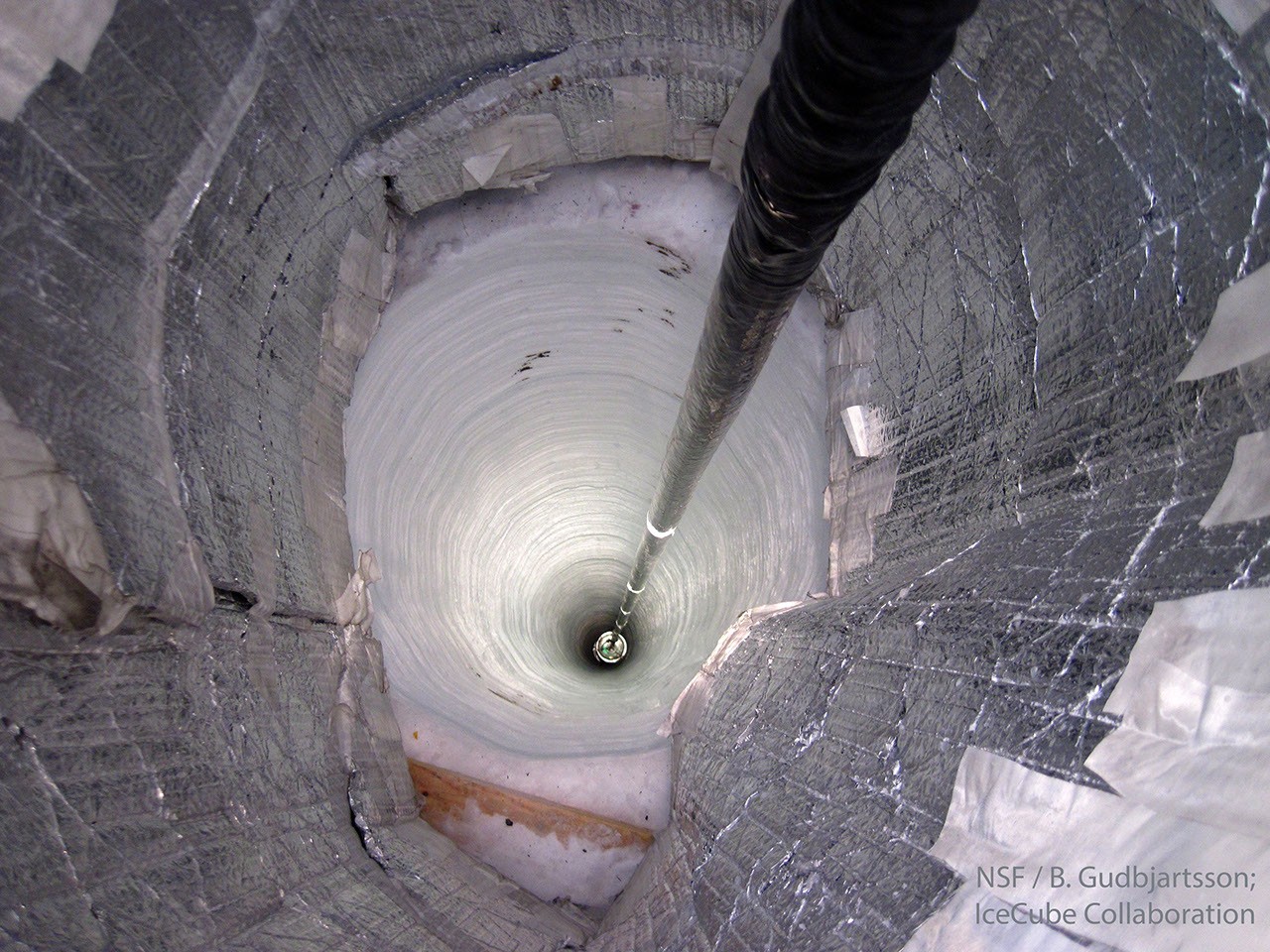
Astronomers with the IceCube Neutrino Observatory lowered a long string knotted with basketball-sized light detectors into each vertical lake. The water in each hole soon refreezes, which is the Antarctic's way of saying "you're welcome" - and also its way of sealing your expensive equipment in solid ice forever, which is apparently the plan all along.
The detectors attached to the strings are sensitive to blue light emitted in the surrounding clear ice. That light results from fast-moving secondary particles liberated when high-energy neutrinos emitted by powerful processes out in the universe collide with ice molecules - because nothing says "cutting-edge astrophysics" like using a cubic kilometer of frozen water as a giant cosmic bug zapper.
IceCube has now detected many illuminating neutrinos, which is a polite way of saying the experiment works, the ice is doing its job, and the neutrinos - notoriously antisocial particles that pass through literally everything - have finally been caught in the act.
Pictured in 2010, one of the last of IceCube's detector strings is lowered into the freezing abyss, making IceCube the largest neutrino detector ever created. It is, in the grand tradition of big science, a monument to the human conviction that if you just build something large enough in a sufficiently inhospitable location, the universe will eventually have no choice but to reveal its secrets.
In recognition of unprecedented discoveries, it was announced earlier this week that a founding leader of the IceCube Collaboration will be awarded the Nobel Prize in Physics. So: melt holes, freeze water, wait patiently, win Nobel. Somewhere, a grant reviewer is quietly weeping with validation.
Tomorrow's picture: Moons Planet
The Good Times
News in your inbox.
One sardonic roundup, delivered on your schedule. Free. Unsubscribe whenever your tolerance for wit runs out.
Already subscribed but we never reach your inbox? Check your spam folder and hit 'Not spam' (or 'Remove from spam') to bust us out of junk-mail purgatory. You'll be helping everyone else too.
Don't open any of our emails for a month and you'll be automatically removed from the mailing list.
Rewrite Article
Select parts to regenerate with a fresh AI pass. Translations will be updated automatically.
Generate AI Image
Creates a sardonic version of the article image using OpenAI.